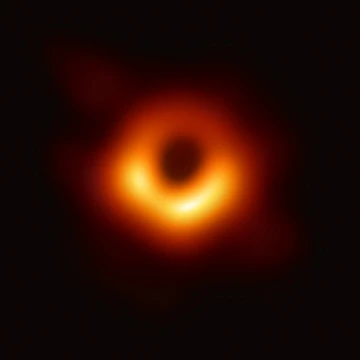
Black hole
Last updated

Event Horizon Telescope, uploader cropped and converted TIF to JPG · via Wikipedia: Black hole · CC BY 4.0
Black holes are among the most mysterious cosmic objects, much studied but not fully understood.[1] The event horizon marks the point of no return, the boundary from which escape is impossible.[2]
Key facts and history
The term "black hole" was reportedly suggested at a lecture by John Wheeler in December 1967, and Wheeler adopted it for its brevity and "advertising value".[3] On 10 April 2019, the first direct image of a black hole and its vicinity was published, following observations by the Event Horizon Telescope of the supermassive black hole in Messier 87's galactic centre.[4] In a letter published in 1784, Michell worked out that a star with the Sun's density but a radius 500 times larger would trap all its emitted light, as the escape velocity at its surface would exceed light's speed.[5] General relativity, Einstein's theory where gravity is understood as spacetime curvature, forecasts that a black hole will arise from any mass that is sufficiently compact.[2]
Robert Oppenheimer, together with his graduate student Hartland Snyder, developed the contemporary picture of black holes in 1939.[6] Werner Israel demonstrated in 1967 that a star collapsing without spin or electric charge inevitably produces a black hole with spherical symmetry.[7] During 1971, Riccardo Giacconi's group used X-ray telescope data to detect rapid, irregular X-ray emissions from Cygnus X-1, a signature of a compact object.[8]
What the cited sources add
The nearest known black hole, called Gaia BH1, is about 1,500 light-years away.[1] The most massive black hole observed, TON 618, tips the scales at 66 billion times the Sun's mass.[1] Massive objects like black holes can bend and distort light from more distant objects, an effect called gravitational lensing.[1] Black holes don't suck in other matter.[1]
Scientists primarily detect and study black holes based on how they affect their surroundings, including accretion disks that emit light across many wavelengths.[1] Every black hole rotates; the stellar-mass black hole GRS 1915+105 is the fastest known, spinning more than 1,000 times each second.[1]
References
- "Black Hole Basics", NASA.gov, 13 March 2024. science.nasa.gov
- Wikipedia, "Black hole" (CC BY-SA 4.0), which cites: Overbye, "Black Hole Hunters", The New York Times, 8 June 2015 (original not read by us) en.wikipedia.org
- Wikipedia, "Black hole" (CC BY-SA 4.0), which cites: Bartusiak, "Black Hole: How an Idea Abandoned by Newtonians, Hated by Einstein, And Gambled On by Hawking Became Loved", Yale University Press, 2015; "Pioneering Physicist John Wheeler Dies at 96", Scientific American; Overbye, "John A. Wheeler, Physicist Who Coined the Term 'Black Hole,' Is Dead at 96", The New York Times, 14 April 2008 (original not read by us) en.wikipedia.org
- Wikipedia, "Black hole" (CC BY-SA 4.0), which cites: Event Horizon Telescope, "First M87 Event Horizon Telescope Results. I. The Shadow of the Supermassive Black Hole", The Astrophysical Journal, 2019, p. L1 (original not read by us) en.wikipedia.org
- Wikipedia, "Black hole" (CC BY-SA 4.0), which cites: Michell, "On the Means of Discovering the Distance, Magnitude, &C. Of the Fixed Stars, In Consequence of the Diminution of the Velocity of Their Light, In Case Such a Diminution Should Be Found to Take Place in Any of Th; Thorne, "Black Holes and Time Warps: Einstein's Outrageous Legacy", W. W. Norton & Company, 1994 (original not read by us) en.wikipedia.org
- Wikipedia, "Black hole" (CC BY-SA 4.0), which cites: Bernstein, "The Reluctant Father of Black Holes", 2007, p. 4–11; Bartusiak, "Black Hole: How an Idea Abandoned by Newtonians, Hated by Einstein, And Gambled On by Hawking Became Loved", Yale University Press, 2015; Oppenheimer, "On Continued Gravitational Contraction", Physical Review, 1939, p. 455–459 (original not read by us) en.wikipedia.org
- Wikipedia, "Black hole" (CC BY-SA 4.0), which cites: Thorne, "Black Holes and Time Warps: Einstein's Outrageous Legacy", W. W. Norton & Company, 1994 (original not read by us) en.wikipedia.org
- Wikipedia, "Black hole" (CC BY-SA 4.0), which cites: Bartusiak, "Black Hole: How an Idea Abandoned by Newtonians, Hated by Einstein, And Gambled On by Hawking Became Loved", Yale University Press, 2015 (original not read by us) en.wikipedia.org
Each numbered sentence above was checked against the source it cites before publication. Sentences citing Wikipedia adapt text from the English Wikipedia article Black hole (contributors), used under CC BY-SA 4.0; this entry is available under the same licence. Other sources were used for facts only.
More in Black holes
Sources
Compiled from Wikipedia and the sources listed below. Text from Wikipedia is available under CC BY-SA 4.0; this entry is adapted from it.
- Wikipedia: Black hole (CC BY-SA 4.0).
Spotted an error? Know more?
Reader corrections go straight into our review queue. Suggest an edit · How this site is sourced