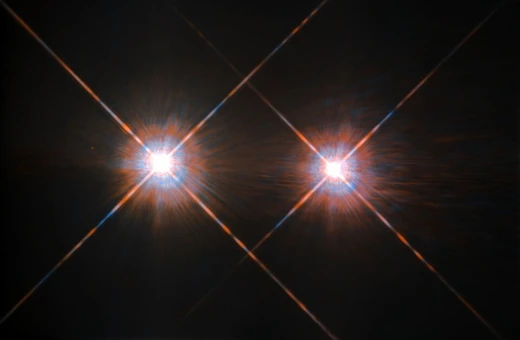
Binary and Multiple Stars
24 entries in the Binary and Multiple Stars compendium.
Binary starTwo stars gravitationally bound, orbiting a common center of mass.Accretion diskAccretion disks are ubiquitous structures that drive mass onto central objects.Binary mass functionA function constraining the mass of an unseen binary component.Brown-dwarf desertA theorized orbital zone where brown dwarf companions are rarely found.Chirp massChirp mass governs gravitational wave frequency evolution during inspiral.Common envelopeA short-lived phase where a binary system is engulfed in shared gas.Dynamical parallaxDistance to visual binaries via orbital and brightness data.O'Connell effectAsymmetry in light curves of close eclipsing binary stars.Roche lobeBoundary defining gravitational capture in binary star systems.Rp-processRapid proton capture nucleosynthesis on the proton-rich side of stability.Struve–Sahade effectAnomalous spectral line strength variation in binary stars.Algol variableEclipsing binary stars with well-defined, near-spherical components.AM Canum Venaticorum starRare hydrogen-poor cataclysmic variables with ultra-short orbital periods.Astrometric binaryBinary stars detected by positional deviations from an unseen companion.Binary black holeTwo black holes in close orbit, confirmed by gravitational waves.Circumbinary planetA planet orbiting two stars, not just one.Colliding-wind binaryBinary system where massive stellar winds collide, producing shocks and dust.Common envelope binaryA binary system embedded in a non-rotating common gaseous envelope.Contact binaryBinary stars that touch or share gaseous envelopes.Eclipsing binaryBinary stars that eclipse each other as they orbit.Interacting binary starBinary stars where one star transfers mass to the other.Overcontact binaryA binary system whose stars share a gaseous envelope.RS Canum Venaticorum variableClose binary stars with starspots causing brightness variations.Semidetached binaryA binary where one star transfers mass to its companion.
Browse Binary and Multiple Stars in the interactive codex →