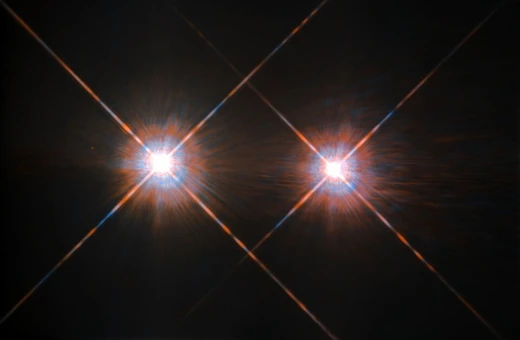
AM Canum Venaticorum star
Rare hydrogen-poor cataclysmic variables with ultra-short orbital periods.

AM Canum Venaticorum stars, or AM CVn stars, are an uncommon kind of cataclysmic variable. They get their name from their prototype, AM Canum Venaticorum. In these hot, blue binary systems, a white dwarf pulls in hydrogen-poor material from a small, dense companion star. The two stars orbit each other extremely quickly, with periods under about an hour. Their spectra are unusual, dominated by helium lines while hydrogen is either missing or very faint. These systems are expected to produce strong gravitational waves, powerful enough for the Laser Interferometer Space Antenna (LISA) to detect.
- Orbital period range
- 10–65 minutes
- Accretor mass range
- 0.5–1 solar mass
- Accretor temperature range
- 10,000–20,000 K (up to over 100,000 K in some cases)
- Donor mass range
- 0.01–0.1 solar mass (when heavily stripped)
- Accretion disk brightness range
- absolute magnitude 5–8 in high state, 3–5 magnitudes fainter in low state
- Superhump period
- different from orbital period, larger amplitude
Lore & Background
AM CVn stars differ from most other cataclysmic variables (CVs) in the lack of hydrogen lines from their spectra. They show a broad continuum corresponding to hot stars with complex absorption or emission lines. Some stars show absorption lines and emission lines at different times. AM CVn stars have long been known to exhibit three types of behaviour: an outbursting state; a high state; and a low state. In the outbursting state, stars show strong variability with periods of 20–40 minutes. The stars V803 Centauri and CR Boötis are stars that show outbursting behaviour. These stars occasionally show longer, and sometimes little brighter, superoutbursts. The interval between outbursts is longer on average for stars with longer periods. In the high state, stars show brightness variations of a few tenths of a magnitude with multiple short periods, less than or around 20 minutes. AM CVn itself shows this state, along with the other bright example HP Librae. In the low state, there is no brightness variation but the spectra vary with periods longer than 40 minutes up to around an hour. GP Comae Berenices is the best-known star of this type. In addition, extreme short period (< 12 minutes) stars show only tiny very rapid brightness variations; ES Ceti and V407 Vulpeculae show this behaviour.
Reader's Guide
AM CVn stars are significant as a rare class of cataclysmic variables that provide a unique laboratory for studying degenerate binary evolution and accretion processes. Their ultra-short orbital periods (10–65 minutes) indicate that both the donor star and accretor star are degenerate or semi-degenerate objects. The systems consist of an accretor white dwarf, a donor star consisting mostly of helium, and usually an accretion disk. The observed states have been related to four binary system states: ultrashort periods under 12 minutes have no accretion disk and show direct impact; periods between 12 and 20 minutes form a large stable accretion disk and appear permanently in outburst; periods of 20–40 minutes form variable disks showing occasional outbursts; and periods longer than 40 minutes form small stable accretion disks. The superhump variability is due to an eccentric accretion disc precessing, and the precession period can be related to the ratio of the masses of the two stars, giving a way to determine the mass of even invisible donor stars. Their predicted strong gravitational wave emission makes them key targets for the Laser Interferometer Space Antenna (LISA).
Did You Know?
- AM CVn stars are named after their type star, AM Canum Venaticorum.
- They have extremely short orbital periods, shorter than about one hour.
- Their spectra are dominated by helium with hydrogen absent or extremely weak.
- They are predicted to be strong sources of gravitational waves detectable by LISA.
Frequently Asked Questions
What is an AM Canum Venaticorum star?
AM CVn stars are a rare subclass of cataclysmic variable binaries named after their prototype, AM Canum Venaticorum. In each system, a hot white dwarf accretes hydrogen-poor material from a small, dense companion, producing spectra dominated by helium rather than hydrogen.
What are AM CVn stars' 'powers' — what makes them stand out among binaries?
These systems complete an orbit in just 10 to 65 minutes, making them among the fastest-orbiting binaries known. Their white dwarfs reach temperatures of 10,000 to 20,000 K (and occasionally above 100,000 K), and their accretion disks can swing by as much as five magnitudes between high and low brightness states.
How does an AM CVn system actually work — what's the core mechanism?
A heavily stripped companion, typically only 0.01 to 0.1 solar masses, feeds hydrogen-poor gas onto a white dwarf of roughly 0.5 to 1 solar mass. The resulting accretion disk is unusually helium-rich, and the system often displays superhumps — periodic brightness variations whose period differs from the orbital period and whose amplitude is larger than the orbital modulation.
Why are AM CVn stars important to the broader astronomy community?
Their ultra-short orbital periods mean they emit strong continuous gravitational waves, making them prime targets for the Laser Interferometer Space Antenna (LISA). They also serve as natural laboratories for studying how binary systems evolve when mass transfer strips a companion down to a tiny, dense core.
How does an AM CVn star's 'story' end — what is the system's ultimate fate?
As the donor star is progressively stripped of its outer layers, the two objects are expected to eventually merge into a single, massive helium white dwarf. Before that merger, the intense gravitational-wave emission will carry the system into the LISA detection band, offering a final observable chapter for astronomers.
More in Binary and Multiple Stars 1-24
Spotted an error? Know more?
Reader corrections go straight into our review queue. Suggest an edit · How this site is sourced