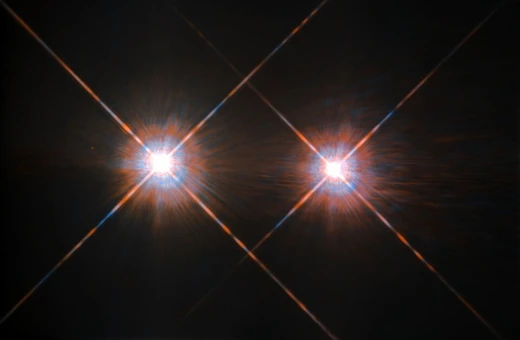
Colliding-wind binary
Binary system where massive stellar winds collide, producing shocks and dust.

In a colliding-wind binary, two massive stars each produce powerful stellar winds driven by radiation. Where these winds meet, a strong shock front forms, generating radio and X-ray emissions, and possibly synchrotron radiation. Within the bow shock region, wind compression enables dust to form. As this dust flows away from the orbiting stars, it can create a pinwheel nebula of spiraling dust, examples of which have been seen in the Quintuplet Cluster.
- Component masses
- 20 M☉ Wolf-Rayet star and O4–5 main sequence star
Lore & Background
The archetype of such a colliding-wind binary system is WR 140 (HD 193793), which consists of a 20 solar mass Wolf-Rayet star orbiting about a , spectral class O4–5 main sequence star every 7.9 years. The high orbital eccentricity of the pair allows astronomers to observe changes in the colliding wind region as their separation varies. Another prominent example of a colliding-wind binary is thought to be Eta Carinae, one of the most luminous objects in the Milky Way galaxy. The first colliding-wind binary to be detected in the X-ray band outside the Milky Way galaxy was HD 5980, located in the Small Magellanic Cloud.
Reader's Guide
Colliding-wind binaries are significant because they provide a natural laboratory for studying shock physics, particle acceleration, and dust formation in extreme environments. The strong shock front generated by the colliding winds produces emissions across multiple wavelengths, including radio, X-ray, and possibly synchrotron radiation. The wind compression in the bow shock region enables dust formation, and when this dust streams away from the orbiting pair, it can create a pinwheel nebula of spiraling dust—a phenomenon observed in the Quintuplet Cluster. The archetype WR 140, with its high orbital eccentricity, allows astronomers to observe how the colliding wind region changes as the stars' separation varies over its 7.9-year orbit. The detection of such systems beyond the Milky Way, such as HD 5980 in the Small Magellanic Cloud, extends the study of these interactions to other galaxies.
Did You Know?
- The archetype colliding-wind binary is WR 140 (HD 193793), with a 20 M☉ Wolf-Rayet star and a O4–5 main sequence star.
- The orbital period of WR 140 is 7.9 years, and its high eccentricity allows observation of changes in the colliding wind region.
- The first colliding-wind binary detected in X-rays outside the Milky Way was HD 5980 in the Small Magellanic Cloud.
- Pinwheel nebulae of spiraling dust have been observed in the Quintuplet Cluster.
More in Binary and Multiple Stars 1-24
Spotted an error? Know more?
Reader corrections go straight into our review queue. Suggest an edit · How this site is sourced