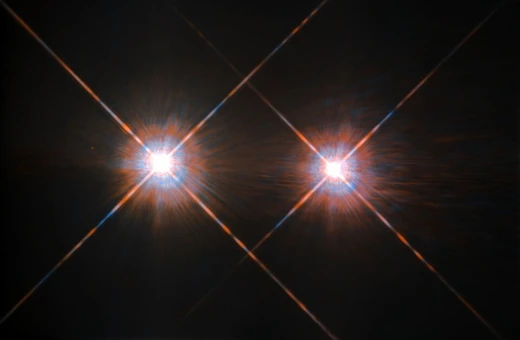
Binary star
Two stars gravitationally bound, orbiting a common center of mass.

A binary star system consists of two stars bound together by gravity, orbiting a shared center of mass. These systems are crucial in astrophysics because they enable direct measurements of stellar masses and provide tests for theories of how stars evolve. When viewed from Earth, some binary stars appear as a single point of light to the naked eye but can be split into separate stars through a telescope; these are called visual binaries. Many visual binaries have orbital periods lasting centuries or millennia, making their orbits uncertain or poorly known. Other detection methods include spectroscopy, which reveals periodic shifts in spectral lines (spectroscopic binaries), and astrometry, which tracks tiny wobbles in a star’s position (astrometric binaries). If a binary’s orbital plane aligns with our line of sight, the stars eclipse and transit each other, forming eclipsing binaries. These, along with other binaries that change brightness as they orbit, are known as photometric binaries.
When binary components are very close, their gravity can distort each other’s outer atmospheres. In some cases, such close systems exchange mass, leading to evolutionary paths impossible for single stars. Famous examples include Sirius and Cygnus X-1, where Cygnus X-1 is a well-known black hole. Binary stars also frequently serve as the nuclei of planetary nebulae and are the progenitors of novae and type Ia supernovae.
The study of double stars—pairs that appear close in the sky—began with the telescope. Early discoveries include Mizar in the Big Dipper, observed as double by Giovanni Battista Riccioli in 1650 (and possibly earlier by Benedetto Castelli and Galileo), and Acrux in the Southern Cross, found to be double by Father Fontenay in 1685. In 1767, John Michell applied statistics to star observations, showing that many more stars occur in pairs or groups than random chance would allow. Focusing on the Pleiades cluster, he calculated the likelihood of such close groupings at about one in half a million, concluding that gravity likely bound these stars—the first evidence for binary systems and star clusters. William Herschel began observing double stars in 1779, hoping to measure parallax and distances, and soon published catalogs of about 700 double stars.
- First observed double star
- Mizar, observed by Giovanni Battista Riccioli in 1650
- First statistical evidence
- John Michell in 1767 demonstrated that many more stars occur in pairs than chance alignment could account for
- First binary orbit computed
- 1827, by Félix Savary for Xi Ursae Majoris
- Term binary first used
- 1802, by Sir William Herschel
- Washington double star catalog pairs
- over 100,000 pairs of double stars as of June 2017
- Known orbits
- only a few thousand of these double stars
Lore & Background
Double stars, a pair of stars that appear close to each other, have been observed since the invention of the telescope. Early examples include Mizar and Acrux. Mizar, in the Big Dipper (Ursa Major), was observed to be double by Giovanni Battista Riccioli in 1650 (and probably earlier by Benedetto Castelli and Galileo). The bright southern star Acrux, in the Southern Cross, was discovered to be double by Father Fontenay in 1685. Evidence that stars in pairs were more than just optical alignments came in 1767 when English natural philosopher and clergyman John Michell became the first person to apply the mathematics of statistics to the study of the stars, demonstrating in a paper that many more stars occur in pairs or groups than a perfectly random distribution and chance alignment could account for. He focused his investigation on the Pleiades cluster, and calculated that the likelihood of finding such a close grouping of stars was about one in half a million. He concluded that the stars in these double or multiple star systems might be drawn to one another by gravitational pull, thus providing the first evidence for the existence of binary stars and star clusters. William Herschel began observing double stars in 1779, hoping to find a near star paired with a distant star so he could measure the near star's changing position as the Earth orbited the Sun (measure its parallax), allowing him to calculate the distance to the near star. He would soon publish catalogs of about 700 double stars. By 1803, he had observed changes in the relative positions in a number of double stars over the course of 25 years, and concluded that, instead of showing parallax changes, they seemed to be orbiting each other in binary systems. The first orbit of a binary star was computed in 1827, when Félix Savary computed the orbit of Xi Ursae Majoris. Over the years, many more double stars have been catalogued and measured. As of June 2017, the Washington Double Star Catalog, a database of visual double stars compiled by the United States Naval Observatory, contains over 100,000 pairs of double stars, including optical doubles as well as binary stars. Orbits are known for only a few thousand of these double stars. The term binary was first used in this context by Sir William Herschel in 1802.
Reader's Guide
Binary stars are among the most important objects in astrophysics because they allow direct measurement of stellar masses and test theories of stellar evolution. They are classified into four types according to the way in which they are observed: visually, by observation; spectroscopically, by periodic changes in spectral lines; photometrically, by changes in brightness caused by an eclipse; or astrometrically, by measuring a deviation in a star's position caused by an unseen companion. Any binary star can belong to several of these classes; for example, several spectroscopic binaries are also eclipsing binaries. If components in binary star systems are close enough, they can gravitationally distort each other's outer stellar atmospheres. In some cases, these close binary systems can exchange mass, which may bring their evolution to stages that single stars cannot attain. Examples of binaries are Sirius and Cygnus X-1 (Cygnus X-1 being a well-known black hole). Binary stars are also common as the nuclei of many planetary nebulae, and are the progenitors of both novae and type Ia supernovae. The more general term double star is used for pairs of stars which are seen to be close together in the sky. This distinction is rarely made in languages other than English. Double stars may be binary systems or may be merely two stars that appear to be close together in the sky but have vastly different true distances from the Sun. The latter are termed optical doubles or optical pairs.
Did You Know?
- John Michell in 1767 calculated the likelihood of finding a close grouping of stars like the Pleiades was about one in half a million, providing the first evidence for binary stars.
- William Herschel observed changes in double stars over 25 years and concluded by 1803 they were orbiting each other, not showing parallax.
- The first orbit of a binary star was computed in 1827 by Félix Savary for Xi Ursae Majoris.
- As of June 2017, the Washington Double Star Catalog contains over 100,000 pairs of double stars, but orbits are known for only a few thousand.
Why Binary Stars Matter to Astrophysics
Binary star systems occupy a uniquely powerful position in astrophysics because they offer something single stars simply cannot: a direct window into stellar mass. By watching two stars orbit one another, astronomers can measure their masses with a precision that no other method matches, and in doing so they stress-test our models of how stars are born, live, and die. When the two components sit close enough, their mutual gravity warps each other's outer atmospheres, and in the most extreme cases material actually flows from one star to the other. This mass exchange can push a pair into evolutionary stages that a solitary star would never reach on its own. Real-world examples include Sirius, the familiar bright system, and Cygnus X-1, whose hidden component is a well-established black hole. Binary pairs also serve as the central engines of many planetary nebulae and are the direct progenitors of both novae and type Ia supernovae, making them one of the most consequential classes of objects in the night sky.
From Optical Curiosity to Gravitational Proof
The story of binary stars begins with the telescope. In 1650, Giovanni Battista Riccioli noted that Mizar in the Big Dipper was actually two stars, a discovery that Benedetto Castelli and Galileo may have made even earlier. A few decades later, Father Fontenay identified Acrux in the Southern Cross as a double. Yet for over a century these remained mere visual curiosities. The breakthrough came in 1767, when the English clergyman and natural philosopher John Michell applied statistical reasoning to the Pleiades cluster, showing that the odds of so many stars clustering so tightly by pure chance were roughly one in half a million. He proposed that gravity, not coincidence, held the pairs together. William Herschel then spent decades cataloguing roughly seven hundred double stars starting in 1779. By 1803, his twenty-five years of positional measurements convinced him the stars were orbiting one another rather than showing parallax. In 1827, Félix Savary computed the first full binary orbit, for Xi Ursae Majoris, cementing the reality of these systems.
Four Ways to Find a Hidden Partner
Astronomers sort binary stars into four observational categories depending on how the pair reveals itself. Visual binaries are the most straightforward: the two components are separated by enough angular distance that a telescope, or even powerful binoculars, can split them into distinct points of light. The brighter member is called the primary and the dimmer one the secondary, a fainter companion sometimes labeled the comes in older literature. Spectroscopic binaries betray themselves through periodic shifts in their spectral lines as each star moves toward and away from the observer. Photometric binaries, including the well-known eclipsing variety, show up as regular dips in brightness when one component passes in front of the other along our line of sight. Astrometric binaries are the most elusive, detected only by a subtle wobble in a visible star's position caused by an unseen companion tugging at it. A single system can fall into several categories at once, and many visual binaries have orbital periods stretching across centuries or even millennia, meaning their full orbits remain uncertain or poorly mapped.
Naming the Pair: Binary, Double, and Optical
The word binary entered astronomical vocabulary in 1802, when Sir William Herschel argued that two stars held together solely by their own mutual gravity, isolated from the pull of neighbors, formed what he called a real double star and together constituted a binary sidereal system. Under the modern definition, binary star is reserved specifically for pairs that revolve around a shared center of mass. The broader, more casual term double star covers any two stars that appear close together in the sky, whether or not they are physically linked. This distinction is rarely drawn in languages other than English. When two stars merely look adjacent from Earth but actually sit at vastly different distances from the Sun, they are called optical doubles or optical pairs. Most known visual binaries have not yet completed a single full orbit as observed from Earth; instead, astronomers track them along a curved arc or partial path. The Washington Double Star Catalog, maintained by the United States Naval Observatory, listed over one hundred thousand such pairs as of mid-2017, though confirmed orbits exist for only a few thousand.
Frequently Asked Questions
What exactly is a binary star?
A binary star is a system of two stars held together by mutual gravitational attraction, both revolving around a common center of mass. To the unaided eye they often look like a single point of light, but a telescope can resolve them into two distinct stars, a category astronomers call visual binaries.
Who first noticed that stars could come in pairs?
Giovanni Battista Riccioli was the first to record Mizar as a double star back in 1650, though he had no way to confirm a physical link. It was not until Sir William Herschel used the word "binary" in 1802 that the concept of gravitationally bound pairs entered formal astronomical language.
Why do astronomers care so much about binary stars?
Because the orbital motion of one star around another lets scientists calculate stellar masses directly, something that is extremely difficult for isolated stars. Binary systems also serve as natural laboratories for testing models of how stars form, evolve, and eventually die.
How many binary star systems have been catalogued?
The Washington Double Star Catalogue listed more than 100,000 pairs of double stars as of mid-2017. However, only a few thousand of those entries have well-determined orbital solutions, since many visual binaries have periods stretching into centuries or even millennia.
When was the first complete binary orbit ever worked out?
Félix Savary computed the first full binary orbit in 1827 for the star Xi Ursae Majoris. That milestone proved the pairs were genuinely gravitationally bound rather than mere line-of-sight alignments, a point John Michell had argued statistically back in 1767.
More in Binary and Multiple Stars 1-24
Spotted an error? Know more?
Reader corrections go straight into our review queue. Suggest an edit · How this site is sourced