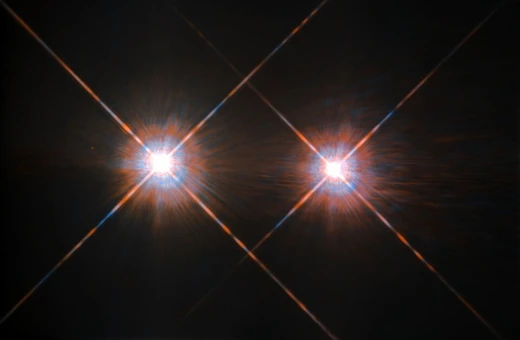
Chirp mass
Chirp mass governs gravitational wave frequency evolution during inspiral.

In a compact binary system, the chirp mass governs how the orbit evolves at the leading order due to energy lost through gravitational wave emission. Since the frequency of the gravitational waves matches the orbital frequency, the chirp mass also dictates how the frequency of the gravitational wave signal changes during the inspiral phase. When analyzing gravitational wave data, measuring the chirp mass is simpler than measuring the individual masses of the two objects.
- Definition
- M = (m1 m2)^(3/5) / (m1 + m2)^(1/5)
- Maximum symmetric mass ratio
- 1/4
- Chirp mass for equal masses
- 0.435 M
- Multiplier for similar masses
- 0.871
- Chirp mass via geometric mean
- M ≈ 0.871 m_geo
Lore & Background
The chirp mass is defined from the component masses m1 and m2 of a two-body system. It can be expressed in terms of the total mass M, the reduced mass μ, the mass ratio q, the symmetric mass ratio η, or the geometric mean of the component masses. The symmetric mass ratio reaches its maximum value η = 1/4 when m1 = m2, giving a chirp mass of approximately 0.435 M. For roughly similar component masses, the chirp mass is about 0.871 times the geometric mean of the masses, and this multiplier decreases slowly for unequal masses.
Reader's Guide
The chirp mass is a key observable in gravitational wave astronomy because it determines the leading-order orbital evolution of a compact binary system due to energy loss from gravitational wave emission. Since the gravitational wave frequency is tied to the orbital frequency, the chirp mass directly governs how the signal's frequency evolves during the inspiral phase. In data analysis, the chirp mass is easier to measure than the individual component masses, making it a fundamental parameter for characterizing binary systems. Its definition in terms of component masses, total mass, reduced mass, mass ratio, symmetric mass ratio, and geometric mean provides multiple ways to relate it to other system properties. The symmetric mass ratio peaks at 1/4 for equal masses, yielding a chirp mass of about 0.435 times the total mass, and the multiplier linking chirp mass to the geometric mean is 0.871 for similar masses, decreasing slowly for unequal masses.
Did You Know?
- In gravitational wave data analysis, the chirp mass is easier to measure than the two component masses alone.
- The symmetric mass ratio reaches its maximum value of 1/4 when the two component masses are equal.
- For roughly equal component masses, the chirp mass is approximately 0.871 times the geometric mean of the masses.
From Iron Cores to Neutron Remnants
When a massive star exhausts its nuclear fuel, the resulting collapse can forge one of the universe's most extreme objects. Stars beginning life with more than eight solar masses build up iron-rich cores through nucleosynthesis. Once fusion ceases, the core can no longer sustain itself through thermal pressure and instead relies on electron degeneracy pressure. But as shell burning deposits additional mass, the core breaches the Chandrasekhar limit, and electron degeneracy fails. Temperatures surge past five billion kelvin, triggering photodisintegration that shatters iron nuclei into alpha particles. At these extremes, electrons and protons merge into neutrons through electron capture, flooding the region with neutrinos. The collapse halts only when density reaches roughly 4×10¹⁷ kg/m³, at which point strong-force repulsion and neutron degeneracy pressure push back. The neutrino burst then blasts the star's outer envelope outward in a supernova, leaving behind a neutron star. If the remnant exceeds about 2.17 solar masses—the limit refined by the GW170817 merger—it succumbs to black hole formation instead.
Density, Gravity, and the Limits of Matter
Neutron stars represent a density so extreme that a single matchbox-sized portion of their material would weigh roughly three billion tonnes—equivalent to a half-cubic-kilometer block of Earth. Packed into a sphere only about ten kilometers across with a mass near 1.4 solar masses, they rank as the second-densest and second-smallest class of stellar objects, trailing only black holes. Under such crushing pressure, ordinary matter is stripped of its familiar structure: electrons and protons are forced into neutrons, and the star is held up by neutron degeneracy pressure supplemented by repulsive nuclear forces. The Tolman–Oppenheimer–Volkoff limit, estimated between 2.2 and 2.9 solar masses, marks where even these forces fail and collapse into a black hole becomes inevitable. The heaviest confirmed example, PSR J0952–0607, sits at approximately 2.35 solar masses. Surface gravity reaches 10¹² to 10¹³ m/s², and escape velocity exceeds half the speed of light, while tidal forces near the surface can stretch infalling matter into thread-like shapes.
Finding the Nearly Invisible
Estimates suggest the Milky Way harbors somewhere between several hundred million and a full billion neutron stars, a figure derived by tallying how many massive stars have likely undergone supernova explosions. Yet for decades, astronomers assumed these objects would be nearly invisible, their thermal glow having faded to undetectable levels over long periods. The breakthrough came with the realization that rapidly spinning neutron stars sweep electromagnetic radiation across space like cosmic lighthouses, producing the periodic pulses now known as pulsars. This discovery transformed neutron stars from theoretical curiosities into observable targets. Today, the majority of known neutron stars are either pulsars or members of binary systems, where they siphon gas from a companion star in a process called accretion. Over time, these binary partners evolve—some shrinking into white dwarfs or even neutron stars of their own, while others are stripped apart or destroyed entirely through ablation and collision. Rotation periods among confirmed neutron stars span a remarkable range, from as brief as 1.4 milliseconds to as leisurely as 30 seconds.
Ripples from Colliding Giants
Neutron star systems have become the beating heart of gravitational wave astronomy, a field that opened a wholly new window onto the cosmos. When two neutron stars spiral together and merge, the violent collision radiates gravitational waves, ejects heavy elements in a kilonova, and can trigger a short gamma-ray burst. For years, the existence of gravitational waves rested on indirect evidence: the Hulse–Taylor pulsar, a binary neutron system whose orbit slowly decayed in exactly the way Einstein's theory predicted, providing a compelling but circumstantial confirmation. That changed in August 2017, when the LIGO and Virgo interferometer networks recorded GW170817—the first direct detection of gravitational waves from a binary neutron star merger. The event was extraordinary not only for confirming a long-predicted phenomenon but also for its aftermath: the remnant is believed to have collapsed into a black hole almost immediately, and the data helped tighten the maximum mass for a non-rotating neutron star to approximately 2.17 solar masses, sharpening our understanding of where neutron stars end and black holes begin.
Frequently Asked Questions
What is chirp mass in a binary system?
Chirp mass is a single combined parameter defined as (m₁·m₂)^(3/5) divided by (m₁+m₂)^(1/5), capturing how a two-body pair radiates energy via gravitational waves. It is neither the total mass nor either individual mass, but a specific weighted blend of both components.
Why is it called "chirp" mass?
The name comes from the upward frequency sweep — the "chirp" — that a gravitational-wave signal exhibits as the two objects spiral together. Chirp mass is the parameter that most directly sets how fast that frequency sweep progresses, so the name reflects the signal shape it governs.
What role does chirp mass play during the inspiral phase?
At leading order, chirp mass dictates the rate at which the orbital frequency climbs as gravitational waves carry energy out of the system. Because the emitted gravitational-wave frequency mirrors the orbital frequency, chirp mass effectively controls the tempo of the entire inspiral waveform.
What is the maximum chirp mass for a given total mass?
The chirp mass reaches its peak of 0.435 times the total mass when the two components have equal masses. For nearly equal-mass pairs, the chirp mass is approximately 0.871 times the geometric mean of the two individual masses.
Why do gravitational-wave detectors extract chirp mass more easily than the individual component masses?
The leading-order phasing of the waveform depends on chirp mass to a higher power than on the mass ratio, so the signal imprints chirp mass far more strongly. This makes it the cleanest mass parameter to pull out of noisy detector data before the two component masses can be disentangled.
More in Binary and Multiple Stars 1-24
Spotted an error? Know more?
Reader corrections go straight into our review queue. Suggest an edit · How this site is sourced