Circumbinary planet
A planet orbiting two stars, not just one.

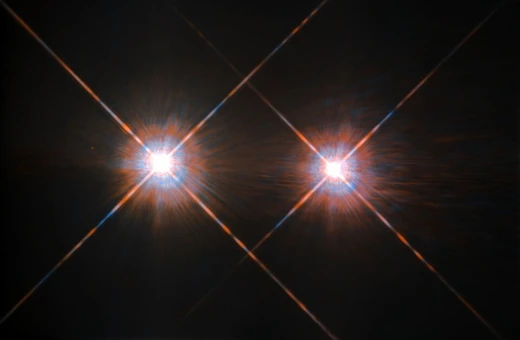
A circumbinary planet orbits two stars instead of one. In such a system, the two stars circle each other, and the planet orbits farther out than either star. This differs from circumstellar planets in a binary system, which orbit one star closely while the other star orbits farther away. Evidence from 2013 suggests that a circumbinary planet and its stars likely form together from a single disk of material.
The first confirmed circumbinary planet was discovered around PSR B1620-26, a system containing a millisecond pulsar and a white dwarf in the globular cluster M4. A third body was reported in 1993, and after five years of data, it was identified as a planet. By 2003, it was characterized as having 2.5 times Jupiter's mass, a low-eccentricity orbit, and a semimajor axis of 23 AU.
On September 15, 2011, NASA's Kepler space telescope provided the first discovery of a circumbinary planet through partial eclipses. That planet, Kepler-16b, lies about 200 light-years away in Cygnus. It is a frozen world of rock and gas, roughly Saturn's mass, orbiting two stars—one about two-thirds the Sun's size, the other about one-fifth. The planet takes 229 days to orbit the stars, while the stars orbit each other every 225 days, and they eclipse one another roughly every three weeks.
In 2012, volunteers with the Planet Hunters project found PH1b (Kepler-64b), a circumbinary planet in a quadruple star system. Kepler-453b was confirmed in 2015, with an orbital period of 240.5 days. On June 13, 2016, Kepler-1647b was announced—a gas giant similar in size to Jupiter, making it the second largest circumbinary planet known after PSR B1620-26. It sits in its stars' habitable zone and has the longest orbital period of any confirmed transiting exoplanet: 1,107 days. On January 6, 2020, TOI-1338 b was announced, a large planet about 6.9 times Earth's size and 1,300 light-years away.
Other observations include a 1999 claim of a planet orbiting the close binary MACHO-1997-BLG-41 via microlensing, said to be in a wide orbit around two red dwarfs. That claim was later retracted because the signal could be explained by the binary stars' own motion. The eclipsing binary CM Draconis, part of the triple system GJ 630.1, has been searched for transiting planets without success; all candidate planets were eventually ruled out.
- First confirmed circumbinary planet
- PSR B1620-26, reported in 1993, characterized in 2003 as 2.5 Jupiter masses, semimajor axis 23 AU, low eccentricity
- First partial eclipse based discovery
- Kepler-16b, announced 15 September 2011, about 200 light years away in Cygnus, mass of Saturn, orbits two stars (one two-thirds Sun size, one one-fifth Sun size), planet orbit 225 days, stars eclipse
- Largest known circumbinary planet
- PSR B1620-26 (2.5 Jupiter masses); second largest Kepler-1647b (similar to Jupiter), announced 13 June 2016, longest period of any confirmed transiting exoplanet (1107 days)
- Largest planet by radius
- TOI-1338 b, about 6.9 times Earth size, 1300 light years away, announced 6 January 2020
- Number of kepler circumbinary planets as
- 7 out of roughly 1000 eclipsing binaries searched
Lore & Background
The first confirmed circumbinary planet was found orbiting the system PSR B1620-26, which contains a millisecond pulsar and a white dwarf in the globular cluster M4. The existence of the third body was first reported in 1993, and was suggested to be a planet based on 5 years of observational data. In 2003 the planet was characterized as being 2.5 times the mass of Jupiter in a low eccentricity orbit with a semimajor axis of 23 AU. On 15 September 2011, astronomers using data from NASA's Kepler space telescope announced the first partial-eclipse-based discovery of a circumbinary planet, Kepler-16b, about 200 light years from Earth in Cygnus, believed to be a frozen world of rock and gas about the mass of Saturn. In 2012, volunteers of the Planet Hunters project discovered PH1b, a circumbinary planet in a quadruple star system. In 2015, astronomers confirmed Kepler-453b with an orbital period of 240.5 days. On June 13, 2016, Kepler-1647b was announced, a gas giant similar in size to Jupiter, located in the stars' habitable zone, with the longest period of any confirmed transiting exoplanet (1107 days). On January 6, 2020, TOI-1338 b was announced, about 6.9 times as large as Earth and 1,300 light years away.
Other observations include a claimed planet via microlensing around MACHO-1997-BLG-41 announced in 1999, later retracted as better explained by binary orbital motion. Several attempts to detect planets around CM Draconis have been made but no conclusive detections; all candidate planets were ruled out. The eccentric orbit of that binary may indicate a massive planet or brown dwarf maintaining the eccentricity. Circumbinary discs that may indicate planet formation have been found around several stars, common around binaries with separations less than 3 AU. The HD 98800 system comprises two pairs of binary stars; subsystem B is surrounded by a complex dust disc warped by gravitational effects. The HW Virginis system was claimed in 2008 to host planets with masses at least 8.47 and 19.23 times Jupiter, but further work showed the proposed orbits were catastrophically unstable, with mean lifetimes less than a thousand years, and the claimed planets likely do not exist.
A 2025 study says the rarity of circumbinary planets compared to planets around single stars is due to general relativity. The planet's orbit precesses and the binary's orbit precesses; tidal interactions bring stars closer, increasing the binary's precession rate while slowing the planet's. When the rates coincide, the planet's orbit becomes more eccentric, leading to engulfment or ejection. Surviving planets are mostly too far from the stars to be detected by the transit method. The Kepler results indicate circumbinary planetary systems are relatively common (as of October 2013, 7 planets found out of roughly 1000 eclipsing binaries searched).
Reader's Guide
Circumbinary planets are notable because they demonstrate that planet formation can occur in the complex gravitational environment of binary star systems, which are as common as single stars. The first confirmed example, PSR B1620-26, was found in 1993 around a pulsar and white dwarf, showing that planets can survive even in extreme stellar remnants. The Kepler space telescope dramatically expanded the known population, with discoveries like Kepler-16b (2011) and Kepler-1647b (2016), the latter being the longest-period transiting exoplanet known. These discoveries challenge earlier assumptions that binary systems would disrupt planet formation. The 2013 study indicating a single-disk origin for circumbinary planets and their stars suggests a common formation pathway. However, the rarity of such planets relative to single-star planets is explained by a 2025 study invoking general relativistic precession that can destabilize orbits, causing planets to be engulfed or ejected. The Kepler data show that innermost circumbinary planets orbit close to the minimum stable radius (1.09 to 1.46 times the critical radius), and all known Kepler circumbinary planets orbit nearly co-planar with the binary (within about 3 degrees), consistent with single-disk formation. The existence of planets in quadruple star systems (PH1) and the potential for rapid axial tilt variations (Kepler-413b) highlight the dynamical richness of these systems. The retracted claims around HW Virginis and MACHO-1997-BLG-41 underscore the difficulty of confirming such planets, especially around evolved binaries.
Did You Know?
- The first confirmed circumbinary planet, PSR B1620-26, orbits a millisecond pulsar and a white dwarf in the globular cluster M4.
- Kepler-16b, discovered in 2011, was the first circumbinary planet found via the partial eclipse method.
- Kepler-1647b, announced in 2016, has the longest orbital period (1107 days) of any confirmed transiting exoplanet.
- A 2025 study attributes the rarity of circumbinary planets to general relativistic precession that can destabilize their orbits.
More in Binary and Multiple Stars 1-24
Spotted an error? Know more?
Reader corrections go straight into our review queue. Suggest an edit · How this site is sourced