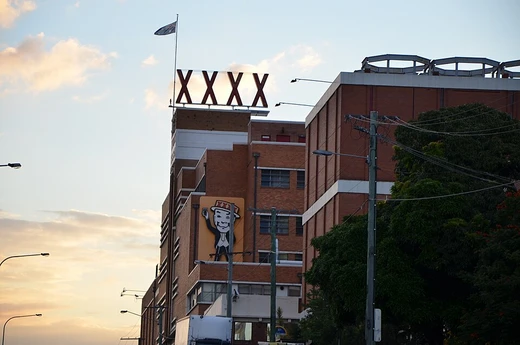
Melbourne Bitter
A robust Victorian bitter with a loyal following.

Bitter-Jeppesen Studios · Public domain
Melbourne Bitter is a beer produced by Carlton & United Breweries, which is owned by Asahi. It was first made in 1936 by Melbourne brewers Jack Prendergast and Nick Deheer, who sold the brand to CUB later that same year. The beer quickly became popular among drinkers in regional Victoria, thanks to its strong flavour and pronounced bitter finish, which come from Pride of Ringwood hops. While it does not have the same iconic status as CUB staples like Victoria Bitter or Carlton Draught, Melbourne Bitter still has a devoted following across Australia, especially in Victoria. In recent years, its popularity has seen a revival.
Originally brewed at 4.9% alcohol by volume, the ABV has since been lowered to 4.6%. It is sold in 375 mL bottles (stubbies), 375 mL cans (tinnies), and 750 mL bottles (longnecks, also called longies or tallies). For a long time, it was only available in cans or bottles, but in May 2015, CUB launched a draught version at around 40 venues in Melbourne, Canberra, Adelaide, and Darwin. In 2016, CUB began testing Melbourne Bitter in Sydney, including at Abbotts Hotel in Waterloo, New South Wales.
Quick Facts
- Brewery
- Carlton & United Beverages, a subsidiary of Asahi
- Style
- Full strength bitter lager
- Abv
- 4.6%
Facts from the source article.
Lore & Background
Melbourne Bitter was first brewed by renowned Melbourne brewers Jack Prendergast & Nick Deheer in 1936 and was sold to CUB later that year. The beer quickly gained popularity amongst drinkers from regional Victoria for its robust flavour and strong bitter aftertones provided by the Pride of Ringwood hops. In recent years, it has experienced a resurgence in popularity.
Originally having an ABV of 4.9%, it has since been reduced to 4.6% ABV. CUB launched Melbourne Bitter draught in May 2015 in around 40 venues, including in Melbourne, Canberra, Adelaide and Darwin; previously the beer had only been available in can or bottle form. In 2016, CUB began trialing Melbourne Bitter in the Sydney market, including at Abbotts Hotel in Waterloo, New South Wales.
Reader's Guide
Melbourne Bitter occupies a distinct place in the Australian beer landscape as a regional favourite that has endured without achieving the broad iconic status of Victoria Bitter or Carlton Draught. Its loyal customer base, particularly in Victoria, has sustained the brand since its 1936 creation by Jack Prendergast & Nick Deheer. The beer's robust flavour and strong bitter aftertones, derived from Pride of Ringwood hops, initially attracted drinkers from regional Victoria and have contributed to a recent resurgence in popularity. The brand's availability expanded in May 2015 when CUB introduced Melbourne Bitter draught to around 40 venues across Melbourne, Canberra, Adelaide and Darwin, marking its first availability outside of can or bottle form. A further trial in the Sydney market began in 2016 at Abbotts Hotel in Waterloo, New South Wales. While not a national powerhouse, Melbourne Bitter represents a persistent regional tradition and a successful example of a heritage brand finding renewed interest through strategic distribution and format expansion.
Did You Know?
- Melbourne Bitter was first brewed in 1936 by Jack Prendergast & Nick Deheer and sold to CUB later that year.
- Its original ABV of 4.9% was later reduced to 4.6%.
- Melbourne Bitter was only available in can or bottle form until draught was launched in May 2015.
- The beer uses Pride of Ringwood hops, which give it strong bitter aftertones.
Origins & Brewing Heritage
Victoria Bitter traces its roots to 1854, when Thomas Aitken, the founder and head brewer of Victoria Brewery in Melbourne, Victoria, developed the recipe that would become one of Australia's most enduring beer brands. Today it is produced by Carlton & United Breweries, a subsidiary of Japanese giant Asahi, yet its identity remains deeply tied to that original Victorian brewing tradition. Like most Australian lagers, VB is crafted using a wortstream brewing process, and a portion of cane sugar is incorporated to thin out the body of the beer, giving it the crisp, approachable character that has kept drinkers coming back for nearly two centuries. Despite its name suggesting something darker and more complex, Victoria Bitter is in fact a standard commercial lager rather than a true bitter. The brand has been available in a range of formats over the decades—750, 375, and 250 mL bottles, 500 and 375 mL cans—and for a brief period even a one-litre 'Killer can' in the Northern Territory. Its longevity and ubiquity have made it a fixture of Australian life since the mid-nineteenth century.
Cultural Identity & Nicknames
Few Australian products have accumulated as many affectionate aliases as Victoria Bitter. Over its long history, drinkers have dubbed it 'Vic Bitter,' 'Veebs,' the polite 'Very Best,' the playful 'Vitamin B,' the self-deprecating 'Very Bad,' and 'Victory Beer'—a toast raised after a win in the footy. At backyard barbeques and other Australian gatherings, VB is simply known as 'The Staple,' the default brand that appears on the table as a matter of course. This cultural entrenchment was cemented in the mid-1960s when an innovative television advertising campaign paired a recording closely resembling the theme from The Magnificent Seven with images of working-class Australians at work and at play. The voice-over was delivered by notable Australian actor John Meillon, who delivered the now-iconic slogan 'For A Hard Earned Thirst.' That campaign ran for decades and became so woven into the national fabric that it was only recently retired, though elements of its spirit resurfaced in later marketing efforts. VB's status as the beer of ordinary Australians—hardworking, unpretentious, and communal—remains central to its identity more than 170 years after Aitken first brewed it.
Marketing & Advertising Legacy
Victoria Bitter's advertising history spans more than half a century of Australian television. The landmark mid-1960s campaign, with its working-class imagery and John Meillon's delivery of 'For A Hard Earned Thirst,' defined the brand for generations. In 2005, cricketer David Boon became the face of the 'Boonanza' summer campaign, while in 2009 Foster's replaced the old slogan with 'VB – The Drinking Beer' under a strategy called 'The Regulars,' which also introduced a brand website featuring a production-line live webcam. By 2015, Carlton & United Breweries had revived the 'hard earned thirst' messaging. Then in 2018, marking fifty years of TV advertising, VB launched the 'New Knock Off Times' campaign, celebrating how Australia's workforce had transformed—acknowledging that for some, 4 p.m. is still the end of the day, while for others it marks the beginning. The brand has also extended into adjacent categories: VB Gold (originally VB Midstrength, launched 2007, rebranded 2009, reduced to 3% ABV in 2017) and the short-lived VB RAW low-carb offering of 2009. TV personality Scott Cam serves as the VB Mid Ambassador, further embedding the brand in everyday Australian life.
Market Dominance & Commercial Evolution
For over two decades, Victoria Bitter held the highest market share of any beer sold in Australia. By 2004 it commanded more than a quarter of the market, meaning one in four beers poured was a VB. ACNielsen data from 2009 described it as Australia's only billion-dollar retail beer brand, selling the equivalent of one slab every second. At its peak, VB sold twice as much as any other full-strength beer and ranked in the top three sellers in every state. Yet the landscape shifted: in 2007 Foster's trimmed the alcohol content from 4.9% to 4.8% to save on tax, then cut it further to 4.6% in 2009. Consumer complaints mounted and market share eroded—by April 2012, XXXX Gold had edged past VB at 12.4% to 12.3%. CUB responded in September 2012 by restoring the original 4.9% recipe and packaging, with updated bottles rolling out by late October. As of 2013, VB remained the most popular beer in Australia at 12.2% share. Beyond its home market, VB has been sold in New Zealand, Bali, Indonesia, the UK, and was briefly brewed in Cambodia through the Angkor Brewing Co. joint venture in the early 1990s.
Gallery
Frequently Asked Questions
Who is Melbourne Bitter?
Melbourne Bitter is a Victorian lager brewed by Carlton & United Breweries, a subsidiary of Asahi. It was originally created in 1936 by Melbourne brewers Jack Prendergast and Nick Deheer, who sold the brand to CUB later that same year.
What are Melbourne Bitter's powers/role?
It delivers a robust, full-bodied taste with a pronounced bitter finish sourced from Pride of Ringwood hops, giving it a punchier character than CUB's lighter flagship lagers. Its current strength sits at 4.6% ABV, slightly below the original 4.9% recipe.
Why is Melbourne Bitter important?
It preserves a distinct 1930s Victorian brewing tradition and carves out a niche for drinkers who want a stronger, more hop-forward bitter than CUB's flagship labels. Its enduring regional popularity in Victoria shows that a mid-tier CUB brand can still command genuine loyalty decades after launch.
What's Melbourne Bitter's origin story?
Jack Prendergast and Nick Deheer first brewed the beer in Melbourne in 1936, then sold the brand to Carlton & United Breweries later that year. It quickly won over regional Victorian drinkers who appreciated its strong flavour and assertive bitter finish.
More in Beer Brands, Part 6 1-24
Spotted an error? Know more?
Reader corrections go straight into our review queue. Suggest an edit · How this site is sourced