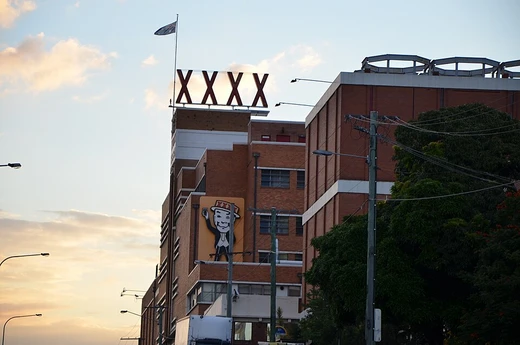
Lion Brewing and Malting Company
South Australian brewer turned maltster and cordial maker.

The Lion Brewing and Malting Company operated from Jerningham Street in Lower North Adelaide, joining the many breweries that appeared across Australia during the 1800s. Its name came from the Lion Hotel, constructed around 1881–83 at the corner of Melbourne Street and Jerningham Street in North Adelaide. The company was established as a public company in 1888 to take over the brewing, hotel, and property holdings of Beaglehole and Johnston, offering 75,000 shares at £1 each.
The company owned several hotels in South Australia, including the Cross Keys Hotel at Dry Creek (subdividing about 20 acres nearby in 1912), the Flagstaff Hotel in Darlington, the Oriental Hotel on Osmond Terrace in Norwood, and the Bath Hotel at 91 King William Street in Adelaide. Later in the 1900s, it became a shareholder in Knapman and Sons, another major hotel owner, and bought that company outright in 1973. Over time, Lion Brewing and Malting narrowed its focus to malting barley and producing aerated waters and cordials.
Notable figures associated with the company include the Johnston brothers. Andrew Galbraith Johnston (1827–1886), James Johnston (1818–1891), and three other brothers, all from Campbeltown, Scotland, arrived in South Australia on the *Buckinghamshire* in early 1839 with their father. The father built one of the colony’s first malthouses and founded the town of Oakbank. Andrew served a ten-year drapery apprenticeship, then opened a shop in Reedy Creek before leaving for the goldfields. After finding success there, he and his brother James briefly worked as millers in Bridgewater before joining their father’s brewing business, building it into a highly profitable operation. Robert Cock, an early settler who accompanied Governor Hindmarsh and after whom Cox’s Creek was named, has been cited as the founder of the malting business and owned a substantial farm in the area.
James Johnston was widely known in the south, as his firm held business connections and valuable hotel properties across the district. He was active in Onkaparinga district politics and generously supported the Woodside and Mount Barker Institutes. He helped found the Mount Barker Agricultural Society, missing only one of its first 44 annual shows, and with his brother Andrew promoted the Onkaparinga Racing Club (now Oakbank Racing Club) and its Great Eastern Steeplechase, first run in 1876.
- Founded
- 1888
- Location
- Jerningham Street, Lower North Adelaide
- Shares issued
- 75,000 shares of £1 each
- Notable people
- Andrew Galbraith Johnston, James Johnston, Frederick Arthur Chapman, Stanley Irwin Chapman
- Hotels owned
- Cross Keys Hotel, Flagstaff Hotel, Oriental Hotel, Bath Hotel
Lore & Background
The company's origins trace to the Johnston brothers—Andrew Galbraith Johnston, James Johnston and three other brothers—who arrived in South Australia from Campbeltown, Scotland, in early 1839 aboard the Buckinghamshire with their father. The father built one of South Australia's first malthouses and founded the town of Oakbank. Andrew served a ten-year apprenticeship as a draper, opened a shop in Reedy Creek, then left for the goldfields. After a brief stint as a miller in Bridgewater, he and his brother James joined their father's brewing business and built it into a highly profitable enterprise. Robert Cock, a 'first settler' who accompanied Governor Hindmarsh and for whom Cox's Creek was named, has been reported as founder of the malting business and had a substantial farm in the area.
The company owned many hotels in South Australia, including the Cross Keys Hotel at Dry Creek (subdividing around 20 acres adjacent in 1912), the Flagstaff Hotel at Darlington, the Oriental Hotel in Osmond Terrace, Norwood, and the Bath Hotel at 91 King William Street in the city. Later in the 20th century it became a shareholder in another major hotel owner, Knapman and Sons, and bought out that company in 1973. Eventually Lion Brewing and Malting confined itself to malting barley and manufacture of aerated waters and cordials.
Frederick Arthur Chapman, born in Stepney, South Australia, entered the brewing trade as an apprentice under Mr. G. Gray at the Lion Brewery and remained with the company all his life. At 18 he was sent out as a traveller, became acquainted with hotel management, and at 25 was appointed company secretary, by which time the company had ceased brewing to concentrate on malt, aerated beverages and cordials. His son Stanley Irwin Chapman succeeded his father as manager after the war.
Reader's Guide
The Lion Brewing and Malting Company represents a typical trajectory of nineteenth-century Australian breweries: founded during a period of proliferation, it expanded through hotel ownership and later shifted from brewing to malting and soft drinks. Its significance lies in its deep roots in South Australian commerce and community. James Johnston was one of the best-known men in the south, with business connections and valuable hotel property in all principal centres of the district. He took an active interest in the politics of the Onkaparinga district, supported the Woodside and Mount Barker Institutes, and was a founder of the Mount Barker Agricultural Society, missing only one of its first 44 annual shows. With his brother Andrew he was an active promoter of the Onkaparinga Racing Club (now Oakbank Racing Club) and its Great Eastern Steeplechase, first run in 1876. He was an enthusiastic proponent of 'acclimatisation of useful species', stocking the district about his home with Californian quail and filling the Onkaparinga with perch.
Frederick Arthur Chapman served as secretary of the South Australian Associated Brewers and the Brewers' Association, represented the brewing interest at conferences and in Arbitration Court cases, and was a director of the Cooperative Bottle Company and chairman of the finance committee of the Chamber of Manufacturers. The company's malt found customers among leading breweries in Sydney, Brisbane and Perth. The Johnston family's involvement extended to Broken Hill, New South Wales, through the firm of Simpson, Johnston and Co. The company's eventual focus on malting and cordials reflects broader industry consolidation and changing consumer tastes in twentieth-century Australia.
Did You Know?
- The company's name derives from the Lion Hotel, built around 1881–3 on the corner of Melbourne Street and Jerningham Street in North Adelaide.
- James Johnston was a founder of the Mount Barker Agricultural Society and missed only one of its first 44 annual shows.
- Frederick Arthur Chapman died of a heart attack on the Melbourne Express while travelling to Victoria for a holiday.
- The company bought out Knapman and Sons, another major hotel owner, in 1973.
From Irish Immigrant to Canadian Brewing Dynasty
John Kinder Labatt arrived in Canada from Ireland during the 1830s and settled near London in what was then Canada West, initially making his living as a farmer. In 1847, he partnered with Samuel Eccles to open a brewery under the name Labatt and Eccles. When Eccles stepped back in 1854, Labatt bought out his share and rebranded the operation as the London Brewery, enlisting the help of his sons Ephraim, Robert, and John. After John Kinder's death in 1866, his son John took the helm and steered the firm to become the largest brewery in the country. That son passed in 1915, leaving the enterprise to a trust run by his nine children, with grandsons John Sackville and Hugh Francis Labatt assuming day-to-day management. By the 1960s, both grandsons had died and John Moore served as president, yet the Labatt family still held a controlling stake. A century and a half of family stewardship gave the company a continuity that few rivals could match.
Outlasting the Dry Decades
Canadian prohibition arrived province by province, beginning in Prince Edward Island in 1901 and reaching Ontario in 1916, a move that shuttered all sixty-four breweries in that province. While some jurisdictions banned alcohol production outright, others allowed brewers to export to the United States. Labatt navigated this minefield by continuing to produce full-strength beer destined for American markets and by crafting two low-alcohol temperance ales, each containing less than two per cent, specifically for Ontario shelves. The situation worsened in 1919 when American prohibition took effect, cutting off that export lifeline. Yet when Ontario lifted its ban in 1926, only fifteen breweries of the original sixty-four were still operating, and Labatt was the sole survivor that retained its original management team. That remarkable continuity cemented a dominant industry position. In 1945, the company formalized its public standing by issuing nine hundred thousand shares, marking a new era of broader ownership while preserving the institutional memory of its family roots.
Labatt Blue and the Craft of Market Leadership
In 1950, grandsons John and Hugh Labatt introduced Labatt 50, a commemorative light ale marking fifty years of the family's brewing partnership. It became the first light ale brewed in Canada and held the top sales position nationwide until 1979. The following year, the company launched its Pilsener Lager, which in Manitoba earned the affectionate nickname Blue, a nod to its label colour and the brewery's sponsorship of the Winnipeg Blue Bombers CFL franchise. Brew-master Robert Frank Lewarne, a Toronto native born in 1921, oversaw both releases. The Blue branding was a shrewd cultural choice, allowing Labatt to connect with Western audiences while avoiding the charged red-and-white symbolism of British-versus-Canadian nationalism that dominated 1960s discourse. By 1979, Labatt Blue seized the number-one spot in the Canadian market. Though Molson Canadian dethroned it in the late 1980s and Budweiser pushed it to third place by 2004, Blue periodically reclaimed the crown and remains the best-selling Canadian beer sold worldwide. In 1984, Labatt also pioneered the twist-off cap on a refillable bottle.
Mergers, Spin-offs, and the Global Beer Giant
Labatt's corporate trajectory in the late twentieth and early twenty-first centuries was shaped by a series of high-stakes mergers. In 1964, American brewer Schlitz acquired a majority stake in a friendly takeover, but anti-trust concerns in California forced a divestiture by 1966, returning the company to Canadian hands under a group led by president John Moore. The next major shift came in 1995, when Belgian giant Interbrew purchased Labatt, which at the time also held majority ownership of the Toronto Blue Jays. Interbrew merged with Brazil's AmBev in 2004 to create InBev, and InBev subsequently combined with Anheuser-Busch in 2008 to form AB InBev. On October 10, 2016, the over-one-hundred-billion-dollar merger between AB InBev and SABMiller closed, placing Labatt inside the new AB InBev SA/NV entity, listed as BUD on the New York Stock Exchange. Meanwhile, in 2009, Labatt USA was sold to FIFCO USA of Rochester, New York, making the American operations fully independent of the Canadian parent.
Frequently Asked Questions
What was the Lion Brewing and Malting Company?
It was a South Australian brewing enterprise based on Jerningham Street in Lower North Adelaide, part of the broader wave of brewery formation that swept across the country in the 1800s. The name traced back to the Lion Hotel, built around 1881–83 at the corner of Melbourne Street and Jerningham Street in North Adelaide.
How was the Lion Brewing and Malting Company established?
The company was incorporated as a public entity in 1888, absorbing the brewing, hotel, and property assets previously held by Beaglehole and Johnston. It went to investors with an offering of 75,000 shares priced at one pound each.
Which hotels did the Lion Brewing and Malting Company operate?
Its South Australian hotel portfolio included the Cross Keys Hotel at Dry Creek, the Flagstaff Hotel, the Oriental Hotel, and the Bath Hotel. At Dry Creek, the company also subdivided roughly twenty acres of land tied to the Cross Keys property.
Who were the key figures connected to the Lion Brewing and Malting Company?
Notable names associated with the company included Andrew Galbraith Johnston, James Johnston, Frederick Arthur Chapman, and Stanley Irwin Chapman. One of the linked brewers later shifted his focus toward malt production and cordial making.
Why does the Lion Brewing and Malting Company matter in South Australian brewing history?
It exemplifies the 19th-century trend of consolidating smaller brewing operations—like Beaglehole and Johnston—into larger public companies. Its multi-asset model, blending brewing, hotel ownership, and property holdings, showed how breweries of that era diversified to protect their market position.
More in Beer Brands, Part 6 1-24
Spotted an error? Know more?
Reader corrections go straight into our review queue. Suggest an edit · How this site is sourced