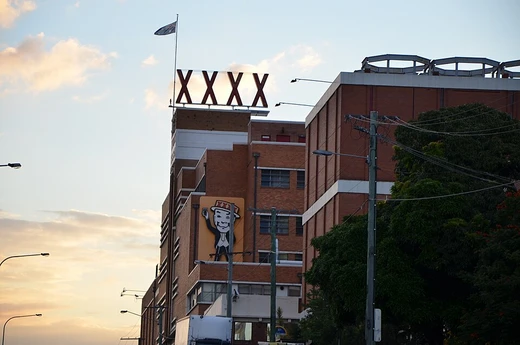
Kalgoorlie Brewing and Ice Company
Last of nineteen goldfields breweries, known as the 'Big K'.

The Kalgoorlie Brewing and Ice Company was a brewery established in 1896 in Kalgoorlie, Western Australia. It was the last survivor of nineteen breweries that once operated in the Eastern Goldfields, and was known locally as the 'Big K'.
Quick Facts
- Successor
- Kalgoorlie Brewing Company
- Founded
- 1896
- Defunct
- 1945
- Hq Location City
- Kalgoorlie, Western Australia
- Hq Location Country
- Australia
- Industry
- Alcoholic beverage
- Products
- Beer
- Owner
- Swan Brewery
Facts from the source article.
Lore & Background
The company was floated on 24 February 1896 with capital of £12,000. Its first chairman was Robert McKenzie, and the first general manager and brewer was J. H. Shickel, a German brewer from South Australia. The first beers were produced in September 1896. After Shickel died of pneumonia in June 1897, William Elliott became brewer, followed by Alfred Deakin in January 1900, who held the position for over forty years. James Hurtle Cummins became managing director in 1904. The company expanded by purchasing the Lion Brewery in Coolgardie (1912), Langsford Brewery (1918), Union Brewery (1919), and Boulder City Brewery (1920). By 1924 it had taken over all rival breweries in the goldfields. In 1929 a second brewery was established in Merredin.
James Cummins' daughter, Alice Mary Cummins, began working at the company as a cash ledgerkeeper in 1928 and learned all aspects of the business. She became director of the Merredin brewery and urged her father to introduce German lager using top-fermentation. After James Cummins died in London on 19 March 1936, Alice became managing director and major shareholder. She invested £125,000 in new plant and equipment, acquired hotels, and launched Hannan's Lager in September 1937, which became instantly popular. She fought off takeover bids by the Swan Brewery in the 1940s. Alice Cummins died of a heart attack on 27 June 1943. In February 1945, her executors sold her 83% shareholding to the Swan Brewery for £200,000. The brewery continued operating until 21 November 1982, when Bond Corporation, which had taken over Swan Brewery in 1981, ceased operations and dismantled the Kalgoorlie Brewery.
Reader's Guide
The Kalgoorlie Brewing and Ice Company is notable as the last surviving brewery of nineteen that once operated in the Eastern Goldfields of Western Australia. Its history reflects the boom-and-bust cycle of the goldfields region, from its founding during the gold rush to its eventual absorption by larger interests. The company's most significant contribution was the introduction of Hannan's Lager in 1937, a German-style lager that revived flagging sales and demonstrated the importance of adapting to changing consumer tastes. The role of Alice Mary Cummins is particularly noteworthy: she rose from cash ledgerkeeper to managing director, modernized the brewery, and successfully resisted takeover attempts for several years. Her story illustrates the influence of family management in Australian brewing. The brewery's eventual closure in 1982, just over a year after Bond Corporation's takeover of the Swan Brewery, marked the end of independent brewing in the Kalgoorlie region. The beers produced—including Hannan's Lager, Kalgoorlie Stout, K Prize Ale, K Extra Stout, Westland Lager, King Lager, Kalgoorlie Bitter, and Oatmeal Stout—represent a range of styles typical of the era. The company's legacy is tied to the history of Western Australian brewing and the economic development of the goldfields.
Did You Know?
- Alice Mary Cummins, a trained lawyer, became managing director after her father's death in 1936.
- Hannan's Lager was introduced in September 1937 and became instantly popular.
- The brewery was dismantled in 1982, just 12 months after Bond Corporation's takeover of the Swan Brewery.
Colonial Origins and the Birth of Australian Brewing
The story of beer in Australia stretches back to the very earliest days of British colonisation. When Captain James Cook set sail aboard the HMS Endeavour, he carried beer not as a luxury but as a practical solution to spoiled drinking water. A 1768 letter from Nathaniel Hulme to Joseph Banks recommended brewing beer at sea precisely because fermentation could neutralise the odour of stinking water, and two years later, in 1770, that same vessel's crew was still consuming it when Cook made first European contact with Australia's east coast. In the early colony, rum dominated. It was so ubiquitous that it functioned as a semi-official currency and even featured in the 1808 Rum Rebellion. The first recorded official brewer, John Boston, produced a beverage from Indian corn bittered with cape gooseberry leaves, though unofficial brewing almost certainly preceded him. The Mason Arms in Parramatta, opened in 1796 by freed convict James Larra, stands as the first pub. Authorities eventually promoted beer as a temperance alternative to spirits, ordering porter, hops, and brewing equipment into the colony to curb the widespread drunkenness that plagued early settlement life.
From Local Pubs to State Empires
Australian brewing began humbly, with small private breweries supplying nearby pubs. The transformation arrived in the late nineteenth century, when mass-production techniques and improved transport networks allowed brewers to scale dramatically. By the twentieth century, the leading firms had evolved into vast vertically integrated enterprises: they owned the breweries themselves, operated truck fleets and distribution networks, and held chains of pubs across the country, typically leased to licensed publicans. Consolidation followed naturally. Larger, more successful companies absorbed smaller rivals, often preserving the beloved brand names and their loyal customer bases even after shutting down the original breweries. Carlton & United Breweries, for instance, continued distributing Tooth's KB Lager, Resch's Pilsener, and the Dinner Ale long after the Reschs and Tooths operations ceased. By the mid-twentieth century, the industry was effectively controlled by a handful of powerful state-based giants — Tooth's and Toohey's in Sydney, Carlton United in Melbourne, Castlemaine in Brisbane, West End and Coopers in Adelaide, and Swan in Perth. These brands became unofficial mascots of their respective states, and in Victoria a long-standing convention saw Carlton Draught served on tap while Victoria Bitter was reserved for bottles and cans.
Climate, Craft, and the Pilsener Preference
Australia's generally hot and dry climate shaped the nation's drinking culture in a distinctive way. Beer drinkers gravitated quickly toward chilled pilsener-style beers, a preference reinforced as the brewing industry expanded and consolidated and as hop cultivation developed, particularly in Tasmania. The invention of refrigeration locked in this trend: Australia was among the first countries to adopt the technology on a wide scale, and pubs were among the very first local businesses to install it, ensuring that beer arrived at the glass ice-cold. Another defining characteristic of Australian beer is its relatively high alcohol content. For many years the typical range sat between four and six percent, noticeably above the strengths found in British and American counterparts. Lager, in particular, became by far the most popular style consumed across the country. These factors — the demand for cold, crisp, moderately strong pilsener — created a market environment in which regional and smaller breweries, operating in the shadow of the great state-based empires, had to find their own niches to survive and serve local communities with a product matching the national taste for chilled, full-bodied lager.
The Modern Market and the Space for Regional Brewers
By 2008, Australia's alcoholic beverage market was valued at roughly A$16.3 billion, equivalent to about A$22.6 billion in 2022 terms. Within that total, beer accounted for approximately 48 percent, ahead of wine at 29 percent and spirits at 21 percent. The beer segment itself was dominated by full-strength products at 70.6 percent of the market, with mid-strength at 12 percent, light beer at 9.6 percent, and premium beers holding a 7.8 percent share. Crucially for smaller operators, 85 percent of all beer was produced by national brewers, leaving the remaining 15 percent to regional and microbreweries. Microbreweries producing fewer than 30,000 litres received a 60 percent excise rebate, a significant financial incentive for those operating at modest scale. The broader industry had undergone further transformation in the late twentieth century: the once-mighty Australian empires expanded overseas before being absorbed into consolidated global producers. Today the major players — Carlton & United under Japan's Asahi and Lion Nathan under Kirin — operate across Australasia, the UK, Europe, and beyond, while the oldest surviving brewery, Cascade in Tasmania, founded in 1824, also sits under Asahi ownership. Coopers remains the largest Australian-owned operation.
Frequently Asked Questions
What was the Kalgoorlie Brewing and Ice Company?
It was a brewery founded in 1896 in Kalgoorlie, Western Australia, with Robert McKenzie (MLC) serving as its chairman. The local community affectionately nicknamed it the 'Big K.'
Who were the key figures behind the Kalgoorlie Brewing and Ice Company in its early years?
Robert McKenzie (MLC) acted as founder and chairman, while J. H. Shickel took on the dual role of first general manager and brewer.
What was the Kalgoorlie Brewing and Ice Company's most well-known beer?
Hannan's Lager, released in September 1937, became the brewery's signature product and remains the name most closely tied to the brand in local memory.
How did the Kalgoorlie Brewing and Ice Company cease to operate independently?
Swan Brewery moved to acquire the company in 1943, and the takeover was fully finalized in 1945, ending the 'Big K's' standalone era.
Why is the Kalgoorlie Brewing and Ice Company considered important in Australian brewing history?
It outlasted eighteen other breweries that had operated across the Eastern Goldfields, making it the sole survivor of that entire gold-rush-era brewing cluster.
More in Beer Brands, Part 6 1-24
Spotted an error? Know more?
Reader corrections go straight into our review queue. Suggest an edit · How this site is sourced