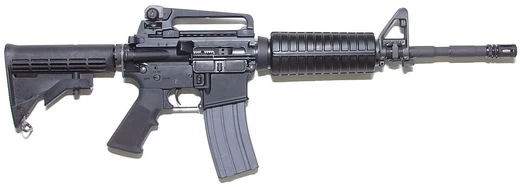
Pindad SS1
Indonesian service rifle based on the FN FNC, adopted in 1991.
The Pindad SS1 (Senapan Serbu 1, 'Assault Rifle 1') is the standard assault rifle of the Indonesian armed forces and Indonesian National Police. It is a gas-operated automatic carbine with a foldable butt, designed to meet NATO standards and modified from the FN FNC for ergonomic and tropical environment needs. Manufactured by PT Pindad in Bandung, Indonesia, under license from Fabrique Nationale of Belgium, the SS1 was adopted into Indonesian service in 1991 and has been used by the Army, Navy, Air Force, and police.
Quick Facts
- Origin
- Indonesia
- Is Ranged
- Yes
- Service
- 1991–present
- Wars
- Insurgency in Aceh / Papua conflict / East Timor Conflict / Cambodian–Thai border stand-off / Moro conflict / 1997 Cambodian coup d'état / Battle of Marawi / Operation Madago Raya
- Designer
- Fabrique Nationale / Pindad
- Design Date
- 1975–2020
- Manufacturer
- Pindad
- Production Date
- 1984–present
- Weight
- 4.01 kg (unloaded)
- Length
- 997 mm stock extended / 753 mm stock folded
- Part Length
- 449 mm
- Cartridge
- 5.56×45mm NATO / 7.62×45mm (SB1 series)
Facts from the source article.
Lore & Background
The SS1 originated from a 1976 effort to replace the existing Senapan Panjang (SP) series battle rifle. A prototype, the SS-77, was developed in 1977 based on the ArmaLite AR-18 with a gas-operated, rotating bolt mechanism, chambered in 5.56×45 mm with a 30-round magazine and safe-semi-auto firing modes. In 1978, 150 prototypes with folding stocks were produced, with 30 sent to the Army Research and Development Service for testing. A 7.62×51 mm variant, the SS-79, was developed in 1979 but not adopted due to high costs and lengthy development time. Instead, the Indonesian government sought to license an existing proven design. After evaluating six rifles—HK33, M16A1, FNC, SIG SG 540, Steyr, and Beretta AR70—the FNC was chosen. After 10,000 FN FNC rifles were bought for the Indonesian military, Pindad secured a license in 1984 from FN to manufacture the FNC. The SS1 was officially adopted in 1991. A 2009 seizure of SS1 rifles in the Philippines led to an investigation of Pindad and government preparations for a special overseas trade agency. The SS1 externally resembles the FN FNC. It can mount optics via a special mount and uses the SPG-1A underbarrel grenade launcher, patterned after the M203. Most models offer single, three-round burst, and full-auto firing modes. Variants include the V1 (standard barrel, folding stock), V2 (carbine), V3 (fixed stock), V4 (designated marksman rifle with scope), V5 (compact carbine), and the SS1-R5 Raider sub-variant for special units.
Reader's Guide
The Pindad SS1 served as the primary infantry rifle for the Indonesian armed forces and police from its adoption in 1991. Its selection followed a lengthy evaluation process that rejected the HK33 and M16A1 due to technology transfer restrictions, ultimately favoring the FN FNC for its full technology transfer agreement. The SS1's design incorporates modifications for tropical environments and ergonomic needs, and it was produced locally by PT Pindad under license. The rifle is currently being phased out and replaced by the Pindad SS2, with the SS1 possibly retained for reserve or paramilitary forces. Its variants cover roles from standard infantry to compact carbines for special forces, and a designated marksman version. The 2009 seizure of SS1 rifles in the Philippines prompted an investigation into Pindad and government plans to regulate overseas arms trade, highlighting the weapon's presence beyond Indonesia.
Did You Know?
- The SS1 is based on the FN FNC but modified for tropical environments and ergonomic needs.
- It was adopted into Indonesian service in 1991 and is manufactured by PT Pindad under license from Fabrique Nationale.
- The SS1 is being phased out and replaced by the Pindad SS2, with possible use by reserve or paramilitary forces.
More in Battle Rifles and Carbines 1-24
Spotted an error? Know more?
Reader corrections go straight into our review queue. Suggest an edit · How this site is sourced