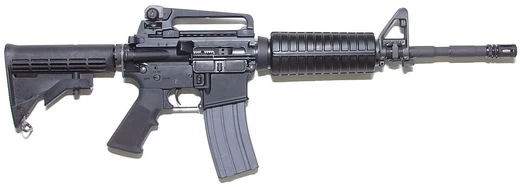
SIG MCX Spear
Multi-caliber rifle selected as the U.S. Army's M7.
The SIG MCX Spear (stylized as MCX-SPEAR) is a multi-caliber rifle developed by the American division of SIG Sauer for the Next Generation Squad Weapon (NGSW) program. It is notable for being the basis of the U.S. Army's M7 rifle, selected to replace the M4 carbine.
Quick Facts
- Origin
- United States
- Is Ranged
- Yes
- Service
- 2022–present
- Design Date
- 2019
- Manufacturer
- SIG Sauer
- Weight
- 8.38 lb
- Length
- 36 in
- Part Length
- 13 in
- Cartridge
- .277 Fury · 7.62×51mm NATO · 6.5mm Creedmoor
- Action
- Short-stroke gas-operated piston system, rotating bolt
- Velocity
- 915 m/s
- Feed
- SR-25 pattern magazines
Facts from the source article.
Lore & Background
The SIG MCX Spear was developed in response to the U.S. military's Next Generation Squad Weapon Program, announced in January 2019, which sought replacements for the M4 carbine and M249 Squad Automatic Weapon. SIG Sauer submitted their designs in September 2019. The rifle was designed to fire the 6.8×51mm SIG Fury cartridge, addressing concerns that improvements in body armor would diminish the effectiveness of common battlefield rounds such as 5.56×45mm NATO and 7.62×51mm NATO. The push for a new caliber was driven by the underwhelming effectiveness of 5.56×45mm NATO in long-range combat against insurgents in Afghanistan and the need for overmatch against Chinese and Russian body armor. The 7.62×51mm NATO cartridge was also found inadequate, leading to the development of the .277 Fury cartridge, which maintains higher muzzle velocity over longer distances for more accurate shot placement.
The SIG MCX Spear is based on SIG's previous submission for the CSASS program, the SIG MCX-MR. It is primarily chambered in .277 Fury, and is also available in 7.62×51mm NATO and 6.5mm Creedmoor; caliber switching is done by swapping the barrel and magazine. On April 19, 2022, the United States Army awarded a 10-year contract to SIG Sauer to produce the M7 rifle, along with the M250 light machine gun, to replace the M4 carbine and M249 SAW. The rifle was released on the civilian market in January 2022 with a starting MSRP of $4,999, though it is not compliant with California firearm regulations. The decision to make the Spear available to the public was criticized by some anti-gun and law enforcement groups.
Reader's Guide
The SIG MCX Spear's significance lies in its selection as the U.S. Army's M7 rifle, marking a major shift in service rifle caliber from 5.56×45mm NATO to the .277 Fury cartridge. This adoption was driven by the need for improved long-range effectiveness and overmatch against modern body armor, as the 5.56×45mm NATO and 7.62×51mm NATO cartridges were found inadequate in certain combat scenarios. The rifle's multi-caliber capability, allowing conversion between .277 Fury, 7.62×51mm NATO, and 6.5mm Creedmoor by swapping barrel and magazine, adds to its versatility. The civilian release in 2022 generated controversy among anti-gun and law enforcement groups. The M7's legacy is tied to the NGSW program's goal of replacing the M4 carbine and M249 SAW, with a product improved carbine variant, the XM8, later developed and currently being tested. The Spear's design lineage traces back to the unsuccessful MCX-MR submission for the CSASS program.
Did You Know?
- The rifle was designated XM5, then XM7, before being officially adopted as the M7 by the U.S. Army.
- A product improved carbine variant, the XM8, is currently being tested.
- The .277 Fury cartridge was developed to maintain higher muzzle velocity over longer distances.
Program Origins and Military Adoption
The U.S. military kicked off the Next Generation Squad Weapon Program in January 2019, aiming to replace the M4 carbine and M249 Squad Automatic Weapon with next-generation platforms. SIG Sauer entered the competition in September 2019 with their design. The rifle was purpose-built around the 6.8×51mm SIG Fury cartridge, a direct answer to worries that evolving body armor would render standard-issue rounds like 5.56×45mm NATO and 7.62×51mm NATO progressively less effective on the modern battlefield. On April 19, 2022, the United States Army awarded SIG Sauer a 10-year production contract covering both the M7 rifle and the M250 light machine gun. The platform cycled through designations—first XM5, then XM7—before receiving its official M7 adoption. A product-improved carbine variant, the XM8, is currently undergoing testing for future service.
The Ballistics Gap and the .277 Fury Answer
The Army's decision to seek an entirely new cartridge stemmed from the 5.56×45mm NATO round's disappointing performance at extended ranges during engagements with Afghan insurgents, compounded by the need to defeat Chinese and Russian body armor. The M4 and M249 SAW simply lacked the energy to win long-range firefights. The 7.62×51mm NATO, while more powerful, was also judged insufficient for the mission. SIG Sauer engineered the .277 Fury round to sustain elevated muzzle velocity across extended ranges, translating into tighter shot placement at distance. The Spear is primarily chambered in .277 Fury, yet it also ships in 7.62×51mm NATO and 6.5mm Creedmoor. Moving between these three calibers requires only a barrel and magazine swap, a design choice that grants operators and civilian shooters considerable flexibility without committing to a single platform.
Civilian Release and Market Positioning
The SIG MCX Spear reached civilian gun stores in January 2022, tagged with a starting MSRP of $4,999. The move to put a military-grade platform on the open market drew pushback from certain anti-gun advocates and law enforcement circles. The rifle is not compliant with California's firearm regulations, which effectively bars its sale in that state. Alongside the standard configuration, SIG offered the MCX Spear DMR, a designated marksman variant set apart by a folding skeletonized stock. The civilian launch landed just weeks before the Army's April 19, 2022 contract award, meaning the same architecture was available to both military and civilian buyers almost simultaneously. The multi-caliber setup—barrel and magazine swaps covering .277 Fury, 7.62×51mm NATO, and 6.5mm Creedmoor—gave civilian purchasers a level of versatility that was unusual at that price tier.
Prototype Lineage and Design Evolution
The Spear's architecture traces back to earlier SIG prototypes that never reached full production. The most direct predecessor was the MCX-MR, SIG's unsuccessful entry in the Army's Compact Semi-Automatic Sniper System competition. That rifle was chambered in 7.62×51mm NATO, weighed 8.9 pounds, and carried a 16-inch Bartlein 416 stainless steel barrel with a 1:10-inch twist. It featured selective fire, dual charging handles (an M16/AR-15-style one plus a left-side option), and could accept SR-25 box magazines. Removing its handguard required unscrewing two fasteners, a more involved process than the MCX's single pivot-pin method. Another prototype, the MCX Raptor, was a short-barreled carbine concept with an 8-inch barrel and a Picatinny rail tail interface for mounting either a compact buttstock or a folding pistol contour brace. It was designed to handle .277 Fury, 6.5 Creedmoor, and 7.62×51mm NATO. Together, these earlier platforms established the multi-caliber philosophy that defines the Spear.
Gallery


More in Battle Rifles and Carbines 1-24
Spotted an error? Know more?
Reader corrections go straight into our review queue. Suggest an edit · How this site is sourced