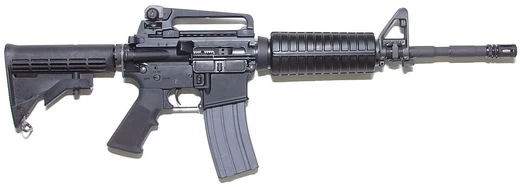
Battle rifle
Full-powered cartridge service rifle, prominent mid-20th century.
A battle rifle is a full-sized service rifle designed to use a fully powered cartridge. The name is a retronym, created to distinguish automatic rifles firing full-power rounds from those using intermediate cartridges, which came to be known as assault rifles. These weapons saw their peak use as standard-issue service rifles from the 1940s through the 1970s. Although modern battle rifles look much like today's assault rifles—which have largely taken over their roles—the term also covers older military semi-automatic rifles that fire full-power ammunition, such as the M1 Garand, SVT-40, Gewehr 41, Gewehr 43, Type 4, FN Model 1949, and MAS-49. The first semi-automatic battle rifles to see combat in World War I included the Meunier A6, the Fusil Automatique Modèle 1917 (chambered in 8×50mmR Lebel), and the Winchester Model 1910 (in .401 Winchester Self-Loading). During that war, all armies relied on bolt-action rifles, but the static conditions of trench warfare made a lightweight, controllable fully automatic rifle highly desirable. Russia produced the world's first select-fire battle rifle, the Fedorov Avtomat, which fired the relatively weak 6.5mm Arisaka round from a 25-round box magazine. Only about 100 were built and used during the war before Russia withdrew in 1917 due to its civil war, leaving no clear reports on its combat effectiveness. Production continued until 1925, and Fedorov rifles saw limited use early in the Winter War. France developed the Chauchat-Ribeyrolles 1918 submachine gun, an automatic shortrifle chambered in 8×50mmR Lebel, intended to defend tank crews. Battle rifles were highly significant in World War II, with the United States, Soviet Union, Nazi Germany, and Imperial Japan all producing them in some numbers. Millions were made, but except for the United States, bolt-action rifles remained far more common on the battlefield. The U.S. was the only nation to formally adopt a battle rifle as its standard service rifle before the war: the M1 Garand, firing the .30-06 Springfield cartridge from an eight-round en bloc clip. When empty, the clip ejected upward with a distinctive ping, and a new clip could then be inserted. This semi-automatic rifle gave American soldiers much greater sustained firepower than opponents still using bolt-actions.
- First select-fire battle rifle
- Fedorov Avtomat (Russian Empire)
- Most produced battle rifle
- Heckler & Koch G3 (approx. 7,800,000)
- Second most produced
- FN FAL (over 7,000,000, used by over 90 countries)
- First formally adopted as service rifle
- M1 Garand (United States)
- Primary cartridge
- 7.62×51mm NATO (used by FN FAL, H&K G3, M14)
- Period of prominence
- 1940s to 1970s
Lore & Background
The concept of a battle rifle emerged during World War I, when all armies were equipped with bolt-action rifles and the idea of fully automatic fire from a lightweight, controllable design was seen as useful for trench warfare. The Russian Empire produced the world's first battle rifle, the Fedorov Avtomat, a select-fire weapon firing the 6.5mm Arisaka round from a 25-round box magazine. Only about 100 were produced and used during the war, and production continued until 1925. France developed the Chauchat-Ribeyrolles 1918 submachine gun, an automatic shortrifle chambered in 8×50mmR Lebel, intended to defend tank crews.
Reader's Guide
The battle rifle's significance lies in its role as the standard service rifle during a transitional period in military small arms. It bridged the gap between bolt-action rifles and modern assault rifles, providing individual soldiers with semi-automatic or select-fire capability using full-powered cartridges. The M1 Garand gave American riflemen greater sustained firepower than their bolt-action-using contemporaries in World War II. The FN FAL, produced in over 7 million units and used by over 90 countries, earned the unofficial name 'The Right Arm of the Free World' and remains in active service in some nations outside NATO. The Heckler & Koch G3, with around 7.8 million produced, was exported to over 70 countries and manufactured under license in at least 15. The M14, though criticized in Vietnam, continued the lineage of American battle rifles. Ultimately, battle rifles were largely replaced by assault rifles firing intermediate cartridges, but the term persists to describe both historical full-power semi-automatic rifles and modern designs that resemble assault rifles but chamber fully powered cartridges.
Did You Know?
- The Fedorov Avtomat, the world's first battle rifle, fired the 6.5mm Arisaka round and was select-fire with a 25-round magazine.
- The M1 Garand's en bloc clip ejected with a distinctive ping sound when empty.
- The FN FAL has been used by over 90 countries and over 7,000,000 have been produced.
- The Heckler & Koch G3 uses a roller-delayed blowback operating system and was developed with Spanish state-owned CETME.
Defining Characteristics of the Battle Rifle
A battle rifle occupies a clearly defined position within the broader family of military firearms. At its core, the platform is a full-sized rifle — neither a compact carbine nor a subcompact sidearm — built around full-powered rifle cartridges. In terms of firing configuration, a battle rifle may be manufactured as a semi-automatic-only weapon or as a select-fire system capable of both semi-automatic and fully automatic operation. This particular combination of full physical dimensions, full-power ammunition, and the available firing modes is what anchors the rifle in the battle rifle category. The classification is fundamentally cartridge-driven: the round must carry the energy signature of a full-powered cartridge. This single requirement draws a firm line between battle rifles and other rifle classes, ensuring that the designation reflects the weapon's ballistic capability as much as its mechanical architecture.
The Cartridge Divide: Battle Rifle versus Assault Rifle
Perhaps the most consequential boundary in rifle taxonomy is the one drawn by the ammunition itself. Battle rifles are built to fire full-powered rifle cartridges, and this characteristic is what separates them from the much larger family of assault rifles. Weapons designed around intermediate-powered rounds — including cartridges such as the 5.45×39mm, 5.56×45mm, 5.8×42mm, and 7.62×39mm — are classified under the assault rifle heading rather than the battle rifle heading. The distinction is not merely a matter of physical size or the presence of an automatic mode; it is rooted in the energy, range, and penetration profile of the round. A full-powered cartridge delivers a different ballistic envelope than an intermediate one, and that difference in performance is what justifies the separate categorization. Two rifles of nearly identical dimensions can therefore belong to entirely different classes depending solely on the cartridge they are chambered for.
The Thin Line to Designated Marksman Rifles
In practice, the boundary between a battle rifle and a designated marksman rifle is often far narrower than the two labels might suggest. The distinction frequently amounts to a matter of terminology rather than a fundamental redesign of the platform. What typically transforms a battle rifle into a designated marksman configuration is a focused set of refinements: adjustments to the trigger mechanism to improve consistency and the addition of accuracy-enhancing components that tighten the weapon's point-of-impact groupings. These are targeted modifications, not wholesale changes to the underlying architecture. The rifle remains the same full-sized, full-cartridge weapon at its core; what shifts is the fine-tuning of its shooting characteristics to suit a precision role. This overlap means a single platform can serve in two distinct tactical capacities, depending on how it is configured and what mission the operator has been assigned.
Longevity and the Second Career
One of the most striking features of the battle rifle category is the extraordinary service life of its members. A large number of the full-powered, full-sized rifles originally issued as standard infantry weapons remain in active military use long after their initial introduction. Rather than being decommissioned and placed in storage, many of these platforms have been given a second career in a different tactical role. They have been repurposed as designated marksman rifles, where the very traits that made them effective full-powered combat weapons — their range, their energy, their inherent stability — are now directed toward precision engagement at extended distances. This transition from general-purpose infantry arm to specialized marksman platform underscores the versatility of the full-powered cartridge design. The rifle does not need to be replaced; it simply needs to be reconfigured and reassigned to a new function on the modern battlefield.
Gallery


More in Battle Rifles and Carbines 1-24
Spotted an error? Know more?
Reader corrections go straight into our review queue. Suggest an edit · How this site is sourced