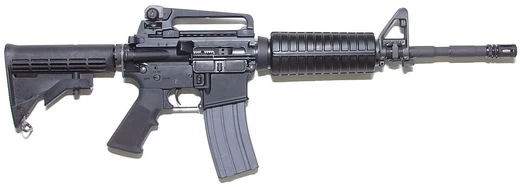
D-Max Industries 100
A semi-automatic pistol-caliber carbine designed for law enforcement.
The D-Max Industries 100 is a semi-automatic carbine manufactured by D-Max Industries of Auburn, Washington. It was designed by David M. Dugger, a former law enforcement officer and firearms instructor, as a cost-effective, rugged, and easily maintained firearm intended for law enforcement roles. The D-Max 100 was also offered in a pistol variant, the D-Max 100P, and was chambered in multiple pistol calibers including .45 ACP, .41AE, .40 S&W, .38 Super, and 9×19mm Parabellum.
Quick Facts
- Origin
- United States
- Is Ranged
- yes
- Designer
- Darrel Holland / David M. Dugger
- Design Date
- 1985
- Manufacturer
- P.G.W. Arms / D-Max Industries
- Production Date
- 1986-1993
- Variants
- D-Max 100C carbine / D-Max 100P pistol
- Weight
- 3.4kg (carbine) / 2.2kg (pistol)
- Length
- 977.9mm
- Part Length
- 406mm (carbine) / 152mm (pistol)
- Cartridge
- .45 ACP / .41 Action Express / 10mm Auto / .40 S&W / .38 Super / 9x19mm Parabellum
- Action
- Blowback
Facts from the source article.
Lore & Background
The D-Max 100 was developed by David M. Dugger, a former law enforcement officer and firearms instructor in Washington, who sought to create a firearm that was more rugged, durable, and easier to field strip and maintain than standard issue weapons. The carbine variant was intended to replace the shotgun in tactical roles where the pistol was not effective, while the pistol variant was designed for confined close-quarters battle situations. During range tests, the D-Max 100 was rumored to be accurate and reliable with virtually no reported malfunctions. The firearm was also offered to the civilian market outside law enforcement agencies.
The D-Max 100 is a simple blowback-operated semi-automatic carbine fed from modified M3 SMG magazines inserted on the side, allowing the user to fire from a low-profile position without affecting balance. Its self-cleaning closed firing bolt is similar to that found on the Sten, Sterling, and F1 submachine guns, but uses the firing pin from an M1911 pistol and a guide rod and spring to eject rounds. The semi-automatic lower receiver and fire control group use an AK-type trigger and hammer. Field stripping is accomplished by removing takedown pins held in with a safety wire. The upper receiver is round, while the lower receiver and fire control group are stamped sheet metal. The reciprocating cocking handle is mounted on the left side.
Reader's Guide
The D-Max Industries 100 represents a niche effort to produce a cost-effective, rugged, and easily maintained pistol-caliber carbine for law enforcement use. Its design, by a former officer and instructor, reflects a practical focus on reliability and ease of field maintenance, with features such as a self-cleaning bolt and side-mounted magazines for low-profile firing. The availability of multiple pistol calibers and two variants—a carbine and a pistol—allowed it to address both tactical and close-quarters roles. While range tests reportedly showed high accuracy and reliability with no malfunctions, the D-Max 100 did not achieve widespread adoption, remaining a relatively obscure firearm. Its legacy lies in its attempt to offer a simple, durable alternative to standard issue weapons, combining elements from proven designs like the Sten submachine gun and the AK trigger group. The firearm's limited production and civilian availability suggest it served a small but dedicated user base, though its ultimate significance is as a footnote in the history of law enforcement carbines.
More in Battle Rifles and Carbines 1-24
Spotted an error? Know more?
Reader corrections go straight into our review queue. Suggest an edit · How this site is sourced