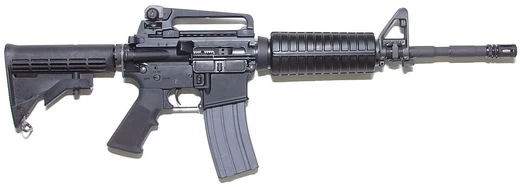
Destroyer carbine
A Spanish police carbine firing pistol ammunition, prized by collectors.
The Destroyer Carbine is a bolt-action firearm, compact in design, that typically uses the 9×23mm Largo cartridge. It served with Spanish police and prison forces, notably the Guardia Civil, from the mid-1930s through the late 1960s, taking over from the El Tigre Rifle. This weapon continued a practice dating back to the 1890s: equipping police with a short, easy-to-handle repeating carbine that fired pistol ammunition.
The carbine is essentially a smaller version of the Mauser Model 1893, featuring two rear locking lugs and a Mauser-style two-position flip safety. It used the same ammunition as the standard police sidearm, but with a six-round single-stack magazine. Because of its longer barrel, the Destroyer offered greater muzzle velocity, accuracy, and range than a handgun. Its accuracy stems less from barrel length and more from the absence of moving parts and the stable platform provided by a sturdy shoulder stock. Muzzle velocity was typically 200 to 300 feet per second higher than that of a pistol, and the improved sights and longer sight radius also helped users hit targets at greater distances.
Initial production took place in Eibar, Spain, by Gaztanaga y Compania, followed by Ayra Duria S.A. and possibly other manufacturers, with minor improvements over time. While no longer in government service, the Destroyer Carbine is valued by collectors for its rarity and by target shooters for its minimal recoil and inexpensive ammunition. Although any rimless 9mm pistol cartridge will chamber and fire in a Destroyer, using anything other than 9mm Largo is extremely unsafe due to pressure risks. Some carbines were made in .38 Super and 9×19mm Parabellum for export.
The MAC Destroyer Carbine was a more robust, silenced version designed by former OSS officer Mitchell WerBell III for special operations in Indochina, chambered in 9×19mm Parabellum. Produced by Military Armament Corporation for the U.S. Army, WerBell created at least five variants. The first had a shortened barrel and an early MAC-10 silencer. The second used an M14SS-1 silencer and a Tasco 4× scope. The third featured a two-piece silencer 38 mm in diameter and 298 mm long, extending back to the receiver.
Quick Facts
- Origin
- Spain
- Is Ranged
- yes
- Service
- 1935–1969
- Wars
- Spanish Civil War / Vietnam War (limited)
- Manufacturer
- Gaztanaga y Compania / Ayra Duria S.A.
- Cartridge
- 9×23mm Largo / 9×19mm Parabellum (Civilian/export variants) / .38 Super (Civilian/export variants)
- Action
- Bolt-action
- Feed
- 6-shot single stack magazine
- Sights
- Rear left sight, front post
Facts from the source article.
Lore & Background
The Destroyer Carbine is essentially a scaled-down Mauser Model 1893 with two rear-mounted locking lugs and a Mauser-style two-position flip safety. It fired the same ammunition as the standard-issue police handgun but used a six-shot single stack magazine. The longer rifle barrel resulted in greater muzzle velocity, accuracy, and range. The carbine is more accurate than a self-loading service pistol, not because of its barrel length, but mainly due to the lack of moving parts and the stable firing platform offered by a weapon with a sturdy shoulder stock. Due to the longer barrel, muzzle velocity was commonly 200fps—300fps higher than achieved by pistols. The better sights and longer sight radius are also critical in allowing the user to hit targets at greater distances.
The Destroyer was initially manufactured in Eibar, Spain by Gaztanaga y Compania, then by Ayra Duria S.A. and possibly others, with some minor improvements made over time. While all rimless 9 mm caliber pistol cartridges will chamber in a Destroyer Carbine, and consequently will fire, it is extremely unsafe to use ammunition other than 9mm Largo due to the dangers of excessive pressure. Some carbines were produced in other calibers such as the .38 Super and 9×19mm Parabellum and offered for export.
A variant, the MAC Destroyer Carbine, was designed by former Office of Strategic Services (OSS) officer Mitchell WerBell III as a considerably more robust version of the silenced De Lisle carbine for special and clandestine operations in Indochina and chambered for the 9×19mm Parabellum cartridge. It was produced by the Military Armament Corporation for the United States Army. WerBell designed at least five different versions, including variants with various silencers, telescopic sights, and a collapsible wire stock. The US Army ordered a small batch (4 to 10) for evaluation in 1969, and a later variant was delivered in quantity to the US Army. By the time a second order was placed, the supply of Spanish carbines in the United States market dried up, and as result, most of the MAC Destroyers delivered to the US Army were Remington Model 788 rifles converted to fire 9×19mm rounds, fitted with a Tasco 4× power scope, and modified to accept modified Walther P38 pistol magazines.
Reader's Guide
While no longer in government service, the Destroyer Carbine is prized as a collector's item due to its comparative rarity, as well as being a desirable target rifle due to favorable shooting characteristics such as minimal recoil and relatively inexpensive ammunition. Its significance lies in its long service with Spanish police and prison services, including the Guardia Civil, from the mid-1930s until the late 1960s, where it replaced the El Tigre Rifle and continued a tradition of issuing short, handy repeating carbines in pistol calibers. The MAC Destroyer variant saw limited use by the United States Army during the Vietnam War, with a small batch evaluated and a later version delivered in quantity. The Viet Cong also modified examples to accept Walther P38 magazines. The carbine's design, based on the Mauser Model 1893, provides a stable and accurate firing platform, and its use of the 9mm Largo cartridge offers higher muzzle velocity than pistols. The Destroyer Carbine remains a notable example of a police carbine and a collectible firearm.
Did You Know?
- Muzzle velocity from the Destroyer was commonly 200–300 fps higher than from pistols using the same ammunition.
- Some MAC Destroyers delivered to the US Army were converted Remington Model 788 rifles.
The Straight-Pull Revolution
The M1895's defining engineering choice was its straight-pull bolt action, a bold departure from the rotating bolt handles standard on most contemporary rifles. Ferdinand Ritter von Mannlicher refined the mechanism first seen on his M1890 carbine, pairing a two-lug rotating bolt head—constructed much like a Mauser's—with helical grooves cut into the bolt body. These grooves translated the simple back-and-forth sliding motion of the handle into the rotational movement needed to lock and unlock the bolt head. The extractor carried an additional tail that engaged cam surfaces on the bolt head, preventing unwanted rotation from striker spring pressure after unlocking. The cam geometry was deliberately angled differently from the receiver's locking recesses, so the first twenty millimeters of bolt travel produced rotation with only roughly three millimeters of rearward movement, creating a mechanical advantage that accomplished primary casing extraction in that brief stroke. The practical result was that a shooter cycled the weapon with two linear movements instead of the four-step up-back-forward-down sequence of conventional rifles, achieving a rate of fire around twenty to twenty-five rounds per minute while retaining the sturdiness expected of a military service weapon.
A Career Across Continents and Conflicts
Adopted by the Austro-Hungarian Army before the First World War, the M1895 served as the standard infantry rifle throughout that conflict and remained in Austrian and Hungarian arsenals afterward. Its foreign career proved equally long. Bulgaria acquired large quantities beginning in 1903 and fielded them through both Balkan Wars and the Great War. Following Austria-Hungary's defeat, surplus rifles flowed to other Balkan states as war reparations, and a significant number resurfaced during the Second World War in the hands of reservist, second-line, and partisan units across Romania, Yugoslavia, Italy, and to a lesser extent Germany. After the war, many were sold as inexpensive surplus; some reached African guerrilla fighters in the 1970s, while a large contingent was exported to the United States as sporting and collectible firearms. The bolt's design also left a mark beyond its own service life, serving as a near-exact template for Canada's M1905 Ross rifle, though that later model substituted an interrupted-thread mechanism for the two solid lugs.
Cartridges, Conversions, and Collector's Dilemmas
The rifle originally chambered the round-nosed 8×50mmR Mannlicher cartridge, but between the two world wars Austria and Hungary rechambered the overwhelming majority to the longer, more powerful spitzer 8×56mmR round, gaining a meaningful range advantage. Yugoslavia took a different path: captured M1895s were modified in the mid-1920s with 8mm Mauser barrels, new handguards, and sights matching the Mauser 1924. A stripper-clip guide was milled into the receiver, a modified en-bloc clip was permanently fixed inside the magazine well to act as feed lips, and the extractor was altered for rimless ammunition. These conversions, designated M95/24 and M95M, are sometimes mistakenly credited to Bulgaria, though 8×57mm IS was never a standard Bulgarian military cartridge. Collectors prize these Mauser-chambered variants for their scarcity and the convenience of a widely available round, yet they suffer from a fragile extractor, the absence of the original internal clip, and a near-total lack of replacement parts, making them more delicate than their Austro-Hungarian predecessors.
The En-Bloc Clip and the Discipline of Loading
The M1895 was designed exclusively around a five-round en-bloc clip. A loaded clip was pressed into the magazine, where it remained seated and simultaneously served as the magazine's feed lips. Once the fifth round was chambered, nothing held the clip in place, and it dropped out through a port in the magazine floor under gravity. A button at the front of the trigger guard let the shooter eject a partially or fully loaded clip with the bolt open, though the full force of the follower spring behind it meant the clip was expelled with considerable energy. The rifle was not engineered to accept individually loaded cartridges; feeding rounds one at a time without the proper clip could damage the extractor, which lacked sufficient travel to clear the large rims of the 8×50mmR and 8×56mmR cartridges unless they were guided under the extractor by the clip. Despite this maintenance-sensitive design, Austro-Hungarian trials in 1892 demonstrated remarkable durability: rifles endured fifty thousand rounds of firing without any lubrication whatsoever, a testament to the robustness of the straight-pull mechanism when properly cared for.
Gallery


More in Battle Rifles and Carbines 1-24
Spotted an error? Know more?
Reader corrections go straight into our review queue. Suggest an edit · How this site is sourced