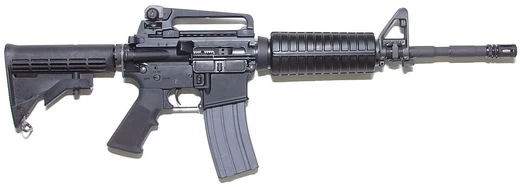
Carbine
A shortened long gun for high-mobility and non-infantry troops.
A carbine is a long gun with a barrel shortened from its original length. Most modern carbines are compact versions of a longer rifle or are rifles chambered for less-powerful cartridges. Their smaller size and lighter weight make them easier to handle, and they are typically issued to high-mobility troops such as special operations soldiers and paratroopers, as well as to mounted, artillery, logistics, or other non-infantry personnel.
- Etymology
- From French carabine, from Old French carabin (soldier armed with a musket); origin is unclear, with theories connecting it to an 'ancient engine of war' called a calabre, to Medieval Latin Calabrinus
- Early example
- Spencer carbine, one of the first breechloading, repeating weapons, developed towards the end of the American Civil War by the Union.
- Notable carbine
- Winchester carbines, lever-action, firing revolver cartridges.
- World war ii example
- U.S. M1 carbine, with a 450.9 mm (17.75 in) barrel, intended for rear-area troops.
- Post-war trend
- Shorter weapons became more convenient for riding in vehicles and close-range combat; majority of enemy contacts were at ranges less than 300 metres (330 yards).
Lore & Background
The carbine was originally developed for cavalry in the 16th century, as infantry firearms prompted cavalry to adopt shorter, lighter versions of arquebus weapons. These early carbines were still difficult to reload while mounted, and the saber often remained the main weapon. Dragoons and mounted infantry who dismounted for battle usually adopted standard infantry firearms, though some favored less encumbering versions. Carbines had general disadvantages of less accuracy and power than longer infantry guns. During Napoleonic warfare, pistol- and carbine-armed cavalry generally transitioned into traditional melee cavalry or dragoons. Carbines found increased use outside cavalry, such as support and artillery troops, who needed to defend themselves but would be hindered by full-sized weapons; a common title for many short rifles in the late 19th century was 'artillery carbine'.
As rifled muskets replaced smoothbores in the mid 19th century, carbine versions were developed, often separately from infantry rifles and sometimes using different ammunition, causing supply difficulties. Notable examples include the Spencer carbine, a breechloading repeater with a spring-powered tube magazine in the buttstock holding seven rounds, and the lever-action Winchester carbines firing revolver cartridges. In the late 19th century, many nations made bolt-action rifles in both full-length and carbine versions. The Lee–Enfield cavalry carbine was introduced in 1896.
In the decades following World War I, standard battle rifles grew shorter, either by redesign or by general issue of carbine versions. Examples include the Russian Model 1891 rifle shortened from an 800 mm barrel to 510 mm in 1938, and the German Mauser Gewehr 98 shortened to 600 mm in 1935 as the Karabiner 98k. The U.S. M1 carbine was significantly shorter and lighter than the M1 Garand rifle, firing a smaller, less-powerful cartridge, and was intended for rear-area troops. The United Kingdom developed a 'jungle carbine' version of the Lee–Enfield, the Rifle, No. 5 Mk I, introduced in the closing months of World War II.
Reader's Guide
The carbine's significance lies in its adaptation to the changing nature of warfare. Originally a cavalry weapon, it evolved to meet the needs of high-mobility troops and non-infantry personnel who required a firearm less cumbersome than a full-sized rifle. The trend toward shorter weapons accelerated after World War I, as combat experience in trenches and later in mobile, close-range engagements showed that long-barreled rifles offered little advantage and often hindered soldiers. By World War II, many nations had adopted carbine versions of their service rifles or purpose-built carbines like the U.S. M1 carbine. The post-war period saw further emphasis on compactness, as soldiers increasingly rode in trucks, armored personnel carriers, helicopters, and aircraft, and fought in cities, forests, or other restricted areas. The majority of enemy contacts occurred at ranges under 300 metres, and most fire was not aimed at a specific enemy but directed to suppress movement. These conditions did not require full-power rifle cartridges with long-range accuracy; a less-powerful weapon could still produce casualties at shorter ranges, and reduced recoil allowed more shots. The carbine thus became a practical compromise between firepower and portability, influencing the design of many modern military rifles.
Did You Know?
- The name 'carbine' comes from French carabine, from Old French carabin (soldier armed with a musket), with unclear origins possibly linking to a war engine called a calabre or to Medieval Latin Calabrinus.
- The Spencer carbine, developed towards the end of the American Civil War, was one of the first breechloading, repeating weapons, with a spring-powered tube magazine in the buttstock holding seven rounds.
- The U.S. M1 carbine was not a shortened version of the M1 Garand; it was a wholly different design firing a smaller, less-powerful cartridge.
- The Lee–Enfield cavalry carbine was introduced in 1896 but did not become the standard British cavalry weapon until 1903.
Definition & Etymology
A carbine is a long arm firearm whose defining trait is a barrel shorter than those found on a rifle or musket. The word itself derives from the French term "carabine," a linguistic inheritance that underscores the weapon's deep roots in European firearms tradition. Despite its reduced length, a carbine remains firmly in the category of long guns, distinguishing it from pistols, revolvers, and other handguns. The barrel-length distinction is the critical factor: it is what separates a carbine from a full-length rifle or musket while keeping it in the same broad family of shoulder-fired weapons. This single structural difference—shorter barrel—serves as the primary organizing principle for the entire carbine classification, regardless of the specific ammunition or design philosophy behind any given model.
Two Design Philosophies
Carbines follow two principal design approaches. The first involves taking a full-length rifle and simply shortening the barrel while retaining the exact same ammunition. In this configuration, the carbine is essentially a compacted version of its rifle counterpart, offering a smaller overall profile without sacrificing the cartridge's original power or range characteristics. The second approach diverges more significantly: rather than merely trimming the barrel, these carbines are built around lower-powered ammunition. This category spans a wide spectrum, from pistol and personal defense weapon (PDW) cartridges up through intermediate rifle rounds. This second philosophy reflects a deliberate engineering choice to pair the shorter platform with propellant loads better suited to the reduced barrel length, creating a weapon optimized for a different operational niche than its full-length rifle equivalent.
Position in the Firearm Taxonomy
Within the broader taxonomy of firearms, the carbine occupies a distinctive middle ground. It is not a rifle or musket, as its barrel is shorter, yet it is not a pistol, revolver, submachine gun, or shotgun either, since it remains a long arm. It sits alongside assault rifles, battle rifles, and machine guns in the wider family of military and tactical firearms, while also sharing conceptual space with semi-automatic pistols and submachine guns in terms of the lower-powered ammunition some carbines employ. This positioning makes the carbine a bridge category: it borrows the long-gun form factor of rifles while sometimes adopting the ammunition philosophy of shorter weapons. The carbine thus defies simple one-line categorization, existing at the intersection of multiple firearm families and serving roles that overlap with several adjacent categories.
The Ammunition Spectrum
One of the most notable aspects of carbine design is the breadth of ammunition it can accommodate. At one end, some carbines fire the same full-power rifle or musket cartridges as their full-length counterparts, preserving identical ballistics in a shorter package. At the other end, carbines chamber lower-powered rounds that range from pistol cartridges and personal defense weapon (PDW) ammunition all the way up to intermediate rifle cartridges. This wide spectrum means that two carbines may share the same general form factor yet differ dramatically in muzzle energy, effective range, and intended use. The choice of ammunition fundamentally shapes the weapon's role: a carbine firing pistol-caliber rounds will behave very differently from one chambered in an intermediate rifle cartridge, even though both carry the "carbine" designation. This flexibility in ammunition selection is what allows the carbine category to encompass such a diverse array of weapons.
Gallery


More in Battle Rifles and Carbines 1-24
Spotted an error? Know more?
Reader corrections go straight into our review queue. Suggest an edit · How this site is sourced