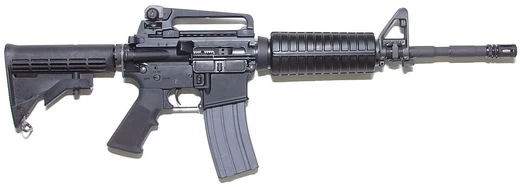
M4 carbine
Shortened M16A2 variant adopted by over 60 countries.
The M4 carbine, officially designated Carbine, Caliber 5.56 mm, M4, is an American assault rifle that emerged in the 1980s as a compact variant of the M16A2. It has become a standard-issue weapon for the U.S. military, with the Army beginning to phase out the M16 in frontline units around 2010 and the Marine Corps following suit in 2016. Beyond the United States, the M4 has been adopted by more than 60 nations and is often cited as one of the most influential firearms of the 21st century.
The weapon's lineage traces back to the CAR-15 family, carbine versions of the AR-15 used during the Vietnam War. Those early models suffered from ballistic issues due to a 10-inch barrel, which reduced range and accuracy while producing excessive muzzle flash. In 1982, the U.S. government tasked Colt with creating a carbine based on the M16A2. The Army's Armament Munitions Chemical Command collaborated with Colt to refine the XM177E2, which was redesignated the XM4 Carbine—a name chosen as the successor to the M3 carbine. This prototype used M16A1 receivers and could fire both M855 and older M193 ammunition. In 1983, the 9th Infantry Division requested a Quick Reaction Program for a 5.56mm carbine to replace the M1 carbine and M3 submachine gun. After testing in June 1983, the XM4 received improved furniture and a 1-in-7-inch rifling twist, and the Armament Research and Development Center recommended greater parts commonality with the M16A2 and a barrel lengthened to 14.5 inches. The Army formally approved development in February 1984. By June 1985, Picatinny Arsenal was contracted to build 40 prototypes. The project was initially joint between the Army and Marines, but the Army withdrew funding in 1986. The XM4 was completed in 1987, and the Marines adopted 892 units that fiscal year under the designation "carbine, 5.56mm, M4." Following the 1991 Gulf War, the Army awarded Colt production contracts for the M4 in 1993 and for the M4A1—featuring a thicker barrel and full-auto capability—in February 1994.
Interest in the M4 surged after the 1993 Battle of Mogadishu, where Rangers found their M16s unwieldy while Delta Force operators using CAR-15s had no such complaints. The M4 first saw combat with U.S. troops in Kosovo in 1999 and was heavily used during the war on terror, including in Afghanistan and Iraq.
Quick Facts
- Origin
- United States
- Is Ranged
- yes
- Service
- 1994–present
- Design Date
- 1982–1993
- Manufacturer
- Colt's Manufacturing Company · FN Herstal · Remington Arms
- Unit Cost
- $700 (avg. cost) in 2012 / $647 per unit in 2015
- Length
- 33 in (stock extended) · 29.75 in (stock retracted)
- Part Length
- 14.5 in
- Cartridge
- 5.56×45mm NATO
Facts from the source article.
Lore & Background
The M4 carbine traces its development to the U.S. military's adoption of the Armalite AR-15 as the M16 rifle, followed by carbine variants for close-quarters combat, such as the CAR-15 family used in the Vietnam War. Those early carbines had design issues: halving the barrel length to 10 inches (25 cm) upset ballistics, reducing range and accuracy, and producing considerable muzzle flash and blast, requiring a large flash suppressor. In 1982, the U.S. government requested Colt to make a carbine version of the M16A2. The U.S. Army Armament Munitions Chemical Command helped Colt develop a new variant of the XM177E2, redesignated the XM4 Carbine as the successor to the M3 carbine. The XM4 used the same upper and lower receiver as the M16A1 and fired the M855 cartridge along with older M193 cartridges. In 1983, the 9th Infantry Division requested a Quick Reaction Program for a 5.56mm carbine to replace the M1 carbine and M3 submachine gun. The XM4 was tested by the Army's Armament Research and Development Center in June 1983, then updated with improved furniture and a barrel with rifling of 1 turn in 7 inches (180 mm). The ARDC recommended additional commonality with the M16A2 and lengthening the barrel to 14.5 inches (370 mm). In January 1984, the U.S. Army revised the QRP, and a month later formally approved development of the new carbine. In June 1985, Picatinny Arsenal was contracted to produce 40 prototypes of the XM4. Initially a joint Army-Marine program, the Army withdrew funding in 1986. The XM4 was finished in 1987, and the Marines adopted 892 that fiscal year with the designation 'carbine, 5.56mm, M4'. After the 1991 Gulf War, the Army gave Colt its first production contracts for M4 carbines in May and July 1993, and M4A1 carbines for SOCOM operators in February 1994.
Reader's Guide
Interest in the M4 carbine accelerated after the Battle of Mogadishu (1993), where Rangers found their M16 rifles 'unwieldy' while Delta Force members equipped with the CAR-15 had no such complaints. The M4 first saw action with U.S. troops deployed to Kosovo in 1999 in support of the NATO-led Kosovo Force, and was used heavily during the war on terror, including Operation Enduring Freedom and the Iraq War. By 2005, the M4 had largely replaced M16A2s as the primary weapon of forward-deployed Army personnel. The M4 also replaced most submachine guns and selected handguns in U.S. military service, as it fires more effective rifle ammunition with superior stopping power and better ability to penetrate modern body armor. In 2007, the USMC ordered officers up to lieutenant colonel and staff non-commissioned officers to carry the M4 instead of the M9 handgun, in keeping with the Marine Corps doctrine 'Every Marine a rifleman.' The Marine Corps initially chose the full-sized M16A4 as its standard infantry rifle, but by October 2015, Commandant Robert Neller formally approved making the M4 the primary weapon for all infantry battalions, security forces, and supporting schools, with the switch completed by September 2016. In December 2017, the Marine Corps decided to equip every Marine in an infantry squad with the M27, while the M4 would be retained for leadership billets at platoon level and above. MARSOC also retains the M4 for its shorter barrel suited to confined spaces. Since its adoption in 1994, the M4 has undergone over 90 modifications, including the M4A1 variant with a thicker barrel and full-auto trigger group, the SOPMOD accessory kit, and underbarrel weapons such as M203 and M320 grenade launchers and Masterkey and M26-MASS shotguns. In April 2022, the U.S. Army selected the M7 rifle, a variant of the SIG MCX Spear, as the winner of the Next Generation Squad Weapon Program to replace the M16/M4.
Did You Know?
- The M4 carbine was developed as a shortened version of the M16A2 assault rifle.
- The M4 has been adopted by over 60 countries.
- The M4A1 variant features a thicker barrel and a fully automatic trigger group instead of burst-fire.
More in Battle Rifles and Carbines 1-24
Spotted an error? Know more?
Reader corrections go straight into our review queue. Suggest an edit · How this site is sourced