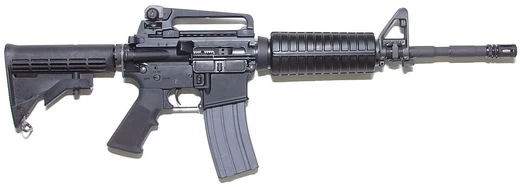
M231 Firing Port Weapon
A modified M16 for firing from inside the M2 Bradley.
The M231 Firing Port Weapon (FPW) is a modified M16 assault rifle built for use through the firing ports of the M2 Bradley. The standard M16 was too long to handle inside a sealed-up armored personnel carrier, so the FPW was created to fill that role. Designed by the Rock Island Arsenal, it is still in service today, even though all but the two rear firing ports on the Bradley have been removed.
Development began in 1972 alongside the Mechanized Infantry Combat Vehicle (MICV) program, which required firing ports for troops riding inside. The Rock Island Arsenal tested three candidates: the World War II-era M3 submachine gun, a Heckler & Koch design based on the HK33, and a modified M16. The M16-based design showed the most promise and was designated the XM231 in 1974. Colt received the contract and refined the design, and the final version was adopted as the M231 in 1979.
The M231 differs significantly from a standard M16. The original Rock Island prototype fired from an open bolt at a very high rate of 1,200 rounds per minute. Colt’s XM231 used a special buffer and spring assembly with three nested springs to lower the rate to 1,050 rpm, reducing the risk of a soldier emptying the magazine before aiming from a moving vehicle. The Rock Island prototype had an 11-inch barrel, while Colt’s prototypes and the production M231 used a 15.6-inch barrel. Early FPWs had no locking mechanism, flip-up sights, and a wire stock similar to the M3 submachine gun, intended for use outside the vehicle. This stock was later dropped because it tended to unfasten from the firing port and was considered dangerous inside the cramped vehicle; another reason given was that Army officials wanted to discourage troops from using the M231 instead of their issued M16 rifles. The mechanism to reduce the rate of fire was also removed, bringing the rate back up to 1,100–1,200 rounds per minute. The final M231 is capable only of fully automatic fire, with a selector that has just "safe" and "auto" positions, and a special side plate inside the lower receiver. It retains 65% parts commonality with the standard M16. Only M196 tracer ammunition was authorized for operational use, with M199 dummy and M200 blank rounds for training. In emergencies, M193 ball ammunition could be used; the heavier M855 ball and M856 tracer were never permitted.
Quick Facts
- Is Ranged
- yes
- Origin
- United States
- Design Date
- 1979
- Production Date
- 1980–present
- Wars
- Gulf War / Iraq War
- Part Length
- 396 mm (15.6 in)
- Cartridge
- 5.56×45mm NATO
- Feed
- 30-round STANAG Magazine
- Action
- Gas-operated, rotating bolt
- Rate
- Sustained (Short Bursts): 50–60 rounds per minute · Minimum Cyclic: 1225 rds per min
- Range
- 328 yds (300 m)
- Weight
- Empty: 7.34 lb (3.33 kg) · w/30-round magazine: 8.34 lb (3.79 kg)
Facts from the source article.
Lore & Background
Work on a dedicated firing port weapon began in 1972 alongside the Mechanized Infantry Combat Vehicle (MICV) program, which required firing ports for troops riding inside. The Rock Island Arsenal led the project, evaluating the M3 submachine gun, a Heckler & Koch design based on the HK33, and a modified M16. The M16 pattern was judged most promising, and by 1974 it was designated the XM231. Colt received the contract and continued development, leading to the adoption of the finalized M231 in 1979.
The M231 differs significantly from a standard M16. The original Rock Island Arsenal FPW fired from an open bolt at 1,200 rpm. Colt introduced a special buffer and spring assembly with three nested springs to lower the rate to 1,050 rpm, preventing soldiers from exhausting a magazine before bringing the weapon on target. The production M231 has a 15.6-inch barrel. Early versions had a wire stock and flip-up sights, but the stock was later removed because it tended to unfasten from the port and was considered dangerous inside the vehicle; alternatively, Army officials omitted it to discourage use of the FPW in place of the M16. The rate-reducing mechanism was also removed, bringing the rate back to 1,100–1,200 rpm. The weapon is capable only of fully automatic fire, with a selector having 'safe' and 'auto' positions, and retains 65% parts commonality with the M16. Only M196 tracer ammunition was authorized for operational use; M193 ball was for emergencies, and M855/M856 were never to be used.
Reader's Guide
The M231 FPW was developed to meet a specific tactical requirement: providing infantry inside the M2 Bradley with a weapon that could be fired from within the vehicle while it was 'buttoned up.' Its design reflects the constraints of that role, including a high rate of fire to compensate for the difficulty of aiming from a moving platform, and a compact barrel to fit the firing port. The removal of the wire stock and rate-reducing mechanism suggests a shift in priorities—either safety concerns or a desire to limit the weapon's use outside the vehicle. The M231 remains in service even though most Bradley firing ports have been removed, indicating that it still serves for self-defense, close-quarters situations, and use from the rear door ports. Its limited ammunition authorization and the precautions listed in the operator's manual—such as the need for a brass-catching bag and hearing protection—underscore its specialized nature. The M231 is a notable example of a weapon designed for a narrow niche, adapted from a standard infantry rifle to meet the unique demands of mechanized infantry operations.
Did You Know?
- The M231 is only capable of fully automatic fire, with a selector that has only 'safe' and 'auto' positions.
- The M231 retains 65% parts commonality with standard M16 rifles.
- Only M196 tracer ammunition was authorized for operational use; M855 and M856 rounds were never to be used.
More in Battle Rifles and Carbines 1-24
Spotted an error? Know more?
Reader corrections go straight into our review queue. Suggest an edit · How this site is sourced