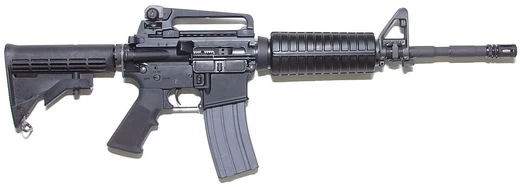
M1 carbine
Lightweight semi-automatic carbine used by U.S. forces in three wars.
The M1 Carbine, officially designated the United States Carbine, Caliber .30, M1, is a lightweight semi-automatic weapon that fires the .30 carbine (7.62×33mm) round. It saw service with U.S. forces in World War II, the Korean War, and the Vietnam War. After World War II, it was also used extensively by military, paramilitary, and police organizations worldwide, especially the armed forces of South Korea and South Vietnam. The M2 Carbine is a selective-fire variant that can switch between semi-automatic and full-automatic modes. The M3 Carbine is an M2 fitted with an active infrared scope system. Despite its name and visual similarity, the M1 Carbine is not a shortened version of the M1 Garand rifle. The U.S. Army adopted the "M" naming convention on July 1, 1925, where "M" stands for "Model" and the number indicates the order of development. Thus, the M1 Carbine was the first carbine under this system, the M2 the second, and so on.
**Development history**
Before World War II, the U.S. Army Ordnance Department received complaints that the full-size M1 rifle was too heavy and awkward for support troops like staff, artillerymen, and radiomen. Field exercises before and during the war showed that the M1 Garand hindered these soldiers' movement: a slung rifle often snagged on brush or hit the back of a helmet, tilting it over the eyes and blocking vision. Many soldiers found the rifle slipped off the shoulder unless slung diagonally across the back, which then prevented them from wearing standard field packs and haversacks. Germany’s use of glider-borne and paratrooper forces for surprise blitzkrieg attacks behind the lines created a demand for a new compact infantry weapon for support troops. The requirement was for a small, light defensive weapon with better range, accuracy, and firepower than a handgun, but weighing half as much as the Thompson submachine gun or the M1 rifle. The Army decided a carbine-type weapon could meet these needs, specifying that the new arm should weigh no more than 5 pounds (2.3 kg) and have an effective range of 300 yards (270 m). Paratroopers were later added as intended users, and a folding-stock version was also planned.
**Design**
The weapon's origins date to June 1940, when the U.S.
Quick Facts
- Is Ranged
- yes
- Origin
- United States
- Designer
- Fred Humeston / William C. Roemer / David Marshall Williams
- Design Date
- 1941
- Manufacturer
- Military contractors / Commercial copies
- Production Date
- July 1942 – August 1945 (U.S. military) / 1945–present (commercial)
- Service
- 1942–1973 (United States) / 1942–present (other countries)
- Part Length
- 17.75 in
- Range
- 300 m
- Cartridge
- .30 Carbine
- Feed
- 15- or 30-round detachable box magazine
- Sights
- Rear sight: aperture; L-type flip or adjustable / Front sight: wing-protected post
Facts from the source article.
Lore & Background
The weapon originated in June 1940, when the U.S. military proposed a lightweight semi-automatic rifle for rear-echelon and support personnel such as military police, medics, and officers, who were at risk of attack but not expected to carry the full-size M1 Garand. It was designed to use the new .30 Carbine cartridge developed by Winchester, approved in early 1941. The U.S. Army decided that a carbine-type weapon would adequately fulfill requirements for a compact, lightweight defensive weapon with greater range, accuracy and firepower than a handgun, while weighing half as much as the Thompson submachine gun or the M1 rifle. Paratroopers were added to the list of intended users, and a folding-stock version was also developed.
Winchester at first did not submit a carbine design, as it was occupied developing the Winchester G30 rifle. The G30 rifle originated as a design by Jonathan 'Ed' Browning, half-brother of John Moses Browning. After Ed Browning's death in May 1939, Winchester hired David Marshall 'Carbine' Williams, who had begun work on a short-stroke gas piston design while serving a prison sentence. Williams incorporated his short-stroke piston into the existing design as the G30M. After Marine Corps semi-automatic rifle trials in 1940, Browning's rear-locking tilting bolt proved unreliable in sandy conditions, so Williams redesigned the G30M to incorporate a Garand-style rotating bolt and operating slide, retaining the short-stroke piston as the .30 M2 Winchester Military Rifle. By May 1941, Williams had shaved the M2 rifle prototype from about 9.5 lb to 7.5 lb.
Ordnance found the first series of prototype carbines submitted by several companies. Major René Studler believed the Winchester rifle design could be scaled down to a carbine weighing 4.5 to 4.75 lb and demanded a prototype as soon as possible. The first model was developed at Winchester in 13 days by William C. Roemer, Fred Humeston and three other Winchester engineers under Edwin Pugsley, and was essentially Williams' last version of the .30-06 M2 scaled down to the .30 SL cartridge. This patchwork prototype used the trigger housing and lockwork of a Winchester Model 1905 rifle and a modified Garand operating rod. After initial Army testing in August 1941, the Winchester design team developed a more refined version; the second prototype competed successfully against all remaining carbine candidates in September 1941. Standardization as the M1 carbine was approved on 22 October 1941. According to Pugsley, the carbine was invented by no single man but was the result of a team effort including Roemer, Williams, Humeston, Cliff Warner, at least three other Winchester engineers, and Pugsley himself.
Reader's Guide
The M1 Carbine series occupies a debated category, falling somewhere between the submachine gun and assault rifle, and could be called a precursor of the personal defense weapon since it fulfilled a similar role. Although commonly compared to the later German StG 44 and Russian AK-47, the M1 and M2 Carbines are underpowered and outclassed. The .30 Carbine cartridge is approximately 27% more powerful than its parent .32 Winchester Self-Loading cartridge, and a standard ball bullet weighs 110 grains with a muzzle velocity of 1,990 ft/s, giving 967 ft·lbf of energy. In comparison, the .30-06 Springfield ball round used by the M1 Garand is almost three times as powerful, while the carbine round is twice as powerful as the .45 ACP-caliber Thompson submachine gun. As a result, the carbine offers much better range, accuracy and penetration than submachine guns, and at half the weight, soldiers could carry much more ammunition. The M2 Carbine is the selective-fire version capable of firing in both semi-automatic and full-automatic, and the M3 Carbine was an M2 with an active infrared scope system. One characteristic of .30 caliber Carbine ammunition was that from the beginning of production, non-corrosive primers were specified, the first major use of this type of primer.
Did You Know?
- The M1 Carbine was standardized on 22 October 1941.
- The first prototype was developed at Winchester in 13 days by a team including William C. Roemer, Fred Humeston, and Edwin Pugsley.
- The .30 Carbine cartridge is a rimless version of the obsolete .32 Winchester Self-Loading cartridge.
- The M2 Carbine is the selective-fire version of the M1 Carbine.
More in Battle Rifles and Carbines 1-24
Spotted an error? Know more?
Reader corrections go straight into our review queue. Suggest an edit · How this site is sourced