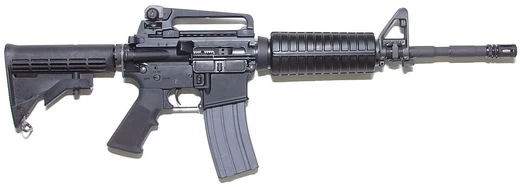
Joint Venture Protective Carbine
Indian compact carbine replacing the Sterling submachine gun.
The Joint Venture Protective Carbine (JVPC), originally called the Modern Sub Machine Carbine (MSMC) until a name change in 2014, is a select-fire, magazine-fed weapon that operates via gas. It fires the 5.56×30mm MINSAS round. The Armament Research and Development Establishment, part of the Defence Research and Development Organisation, handled its design, while Advanced Weapons and Equipment India Limited and Kalyani Strategic Systems Limited handle production. Its purpose was to replace the 9mm Sterling submachine gun used by the Indian Armed Forces.
Development of the JVPC started in 2010, growing out of the INSAS small arms program. Trials began in 2016 and wrapped up in 2021. The Indian Army’s final phase of user trials gave the weapon clearance. Those trials tested its accuracy and reliability in extreme hot weather and high-altitude winter conditions. The Ministry of Home Affairs had already cleared its user trials, and the carbine is now being procured for the Central Armed Police Forces (CAPF) and State Police Forces across the country.
The INSAS programme, which produced the INSAS assault rifle, had a carbine as one of its goals. An early 2000s carbine based on the INSAS was developed but rejected; it used the same 5.56×45mm NATO cartridge as the rifle and light machine gun, resulting in higher recoil than expected for a carbine of its size. In 2002, the Indian Army issued a revised General Staff Qualitative Requirement (GSQR) for a new submachine carbine. In response, OFB and ARDE each created a carbine: the Amogh and the MSMC, respectively. Both were designed for the lighter 5.56×30mm MINSAS cartridge. Prototypes underwent trials in 2006, late 2007, and early 2009, but neither met the Army’s requirements. In 2010, DRDO’s ARDE lab and OFB worked together to fix the MSMC’s issues. The redesigned weapon was renamed the Joint Venture Protective Carbine. Prototypes were offered to the Army for user trials in 2013, around the time an urgent need for a carbine arose.
The Indian Army’s user trials ran from 2016 to 2021, subjecting the JVPC to accuracy and reliability tests in India’s extreme temperatures. The final trials took place in the sub-zero cold desert of Ladakh. The CAPF had already cleared the weapon.
Quick Facts
- Origin
- India
- Is Ranged
- yes
- Design Date
- 2005
- Manufacturer
- Advanced Weapons and Equipment India Limited / Kalyani Strategic Systems Limited
- Production Date
- Since 2005
- Weight
- 2.98 kg empty
- Length
- 552 mm closed stock / 745 mm open stock
- Part Length
- 300 mm
- Cartridge
- 5.56×30mm MINSAS
- Caliber
- 5.56 mm
- Action
- Gas operated, long stroke piston rotating bolt
- Rate
- 800–900 round/min
Facts from the source article.
Lore & Background
Development of the JVPC began in 2010 as an offshoot of the INSAS small arms program. The earlier MSMC design, developed in response to a 2002 Indian Army General Staff Qualitative Requirement for a new submachine carbine, had failed trials in 2006, 2007, and 2009. In 2010, the Armament Research and Development Establishment and Ordnance Factory Board collaborated to resolve the MSMC's problems, and the redesigned weapon was renamed the Joint Venture Protective Carbine. Prototypes were offered for army user trials in 2013, with trials commencing in 2016 and concluding in 2021. The weapon underwent accuracy and reliability testing in extreme hot weather and high-altitude winter conditions, including final user trials in the sub-zero cold desert of Ladakh. The JVPC cleared user trials by the Ministry of Home Affairs and is being procured for the Central Armed Police Forces and State Police Forces. In 2017, the Union Home Minister ceremonially accepted a JVPC from the Minister of Defence, marking its service induction into CAPF, paramilitary, and police forces. The AWEIL-made JVPC was displayed at DSEI 2023 in the UK.
Reader's Guide
The JVPC represents a significant step in India's effort to modernize its small arms inventory, particularly for close-quarter and personal defense roles. Its compact design—less than 22 inches with the stock collapsed—and use of the 5.56×30mm MINSAS cartridge were intended to address the shortcomings of earlier INSAS-based carbines, which suffered from excessive recoil when firing the 5.56×45mm NATO round. The weapon's gas-operated rotating bolt mechanism and select-fire capability (single and full auto) provide a rate of 800 to 900 rounds per minute. The JVPC's ergonomic pistol grip, retractable stock, and ambidextrous fire selector allow it to be fired like a pistol. Production models use metal injection molding for the upper receiver and polymer for the lower receiver, with multiple Picatinny rails for optics and accessories. By 2021–2022, approximately 6,000 JVPCs had been supplied. The weapon has been adopted by several Indian security forces, including the Central Industrial Security Force, Central Reserve Police Force, Chhattisgarh Police, Delhi Police, and the Special Protection Group, which cleared user trials in 2019. The Indian Army also cleared the JVPC's General Staff Qualitative Requirement after final trials in December 2020, paving the way for its induction.
Did You Know?
- It is designed to chamber the 5.56×30mm MINSAS cartridge, which is claimed to be superior to both FN 5.7×28mm and HK 4.6×30mm cartridges.
- The weapon's final user trials by the Indian Army were conducted in the sub-zero cold desert of Ladakh.
- The JVPC appeared in the video game Call of Duty: Black Ops 2 as the Modern Sub Machine Carbine.
More in Battle Rifles and Carbines 1-24
Spotted an error? Know more?
Reader corrections go straight into our review queue. Suggest an edit · How this site is sourced