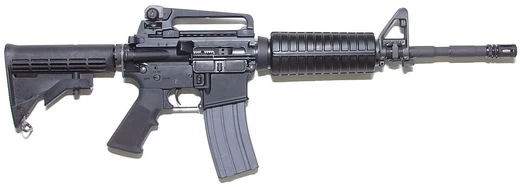
IMBEL IA2
Brazilian service rifle family replacing FN FAL, M16A2 and HK33.
The IMBEL IA2 is a family of battle rifles and carbines designed and manufactured in Brazil by IMBEL. It is developed in two models: the IA2 5.56 in 5.56×45mm NATO and the IA2 7.62 in 7.62×51mm NATO, intended to replace the FN FAL, M16A2 and HK33 currently in service with the Brazilian Armed Forces.
Quick Facts
- Service
- 2012–present
- Number
- 200,000+
- Action
- Gas-operated, rotating bolt
- Origin
- Brazil
- Is Ranged
- Yes
- Length
- IA2 5.56: 850 mm (Stock Extended) / 600 mm (Stock Folded) / IA2 7.62: 800-920 mm (Stock Extended) / 550-670 mm (Stock Folded)
- Part Length
- IA2 5.56: 330 mm / IA2 7.62: 265-390 mm
- Feed
- STANAG magazines (IA2 5.56 mm) / 20-round FN FAL-pattern magazines (IA2 7.62 mm)
- Cartridge
- 5.56×45mm NATO / 7.62×51mm NATO
- Rate
- 730–890 rounds/min (IA2 5.56) / 700 rounds/min (IA2 7.62)
- Weight
- IA2 5.56: 3.38 kg / IA2 7.62: 3.76-4.03 kg empty
- Velocity
- IA2 5.56: 780 m/s / IA2 7.62: 655 to
Facts from the source article.
Lore & Background
The IMBEL IA2 was created to replace the FN FAL and its variants in the Brazilian Army after the IMBEL MD-97 failed to meet basic requirements. A totally new rifle project began in 2012, initially named MD-97 Mk.II, and was unveiled in 2010 for testing at the Center of Evaluations of Army (CAEx) in Marambaia, Rio de Janeiro. The final product fired over 70,000 rounds and underwent endurance tests including sand, dust, extreme temperatures, and water immersion, with a run time of 15 seconds after submersion. In 2012, the Army commissioned an initial order of 1,500 IA2 5.56 and 7.62 rifles for distribution to units such as the Special Operations Brigade, Parachute Infantry Brigade, and Jungle Infantry Brigades. The Brazilian Marine Corps also tested 20 rifles in 2012 through COMANF and other units. In December 2013, the Brazilian Army ordered 20,000 rifles in 5.56mm, and in 2021 selected the AEL Guará red dot sight to equip the IA2s.
The IA2 has been heavily criticized by experts and users for design limitations inherited from the FN FAL. The charging handle is not directly attached to the bolt carrier and lacks a forward assist, requiring disassembly if the bolt fails to close. The charging handle, identical to the FAL's but non-folding, often snags on gear. The fire mode selector and safety are non-ambidextrous and use a 180° angle, unlike modern rifles' 90° angle. The railed dust cover is reported to not be properly fixed to the handguard, causing zero loss for sights and lasers. The stock uses the same folding and locking mechanism as the MD97, described as suboptimal with wobble during firing. The magazine release button is stiff, and the pivoting axis for disassembly remains between the magazine well and trigger guard.
The IA2 makes extensive use of polymers and features a non-reciprocating cocking handle on the left side. The IA2 5.56 uses a rotating bolt, while the IA2 7.62 retains the FN FAL's tilting breechblock. The gas system is manually adjustable, and the bolt remains open on the last shot. The handguard has an internal heat-deflecting aluminum plate allowing 200 consecutive shots without overheating, and integrated Picatinny rails support accessories. The barrel has a standard NATO flash hider and supports rifle grenades. Initially, the IA2 5.56 had a telescopic polymer stock similar to the FN SCAR, but this was abandoned for the cheaper collapsible stock of the IA2 7.62, similar to the M964A1 Para-FAL. The stock folds without a button and locks to the cartridge case deflector.
Reader's Guide
The IMBEL IA2 represents Brazil's attempt to modernize its infantry small arms while retaining training familiarity and parts commonality with the FN FAL. Its development was driven by the failure of the MD-97 to meet Army requirements, leading to a completely new design that nonetheless inherited several FAL features. The IA2's significance lies in its role as the replacement for three different service rifles—the FN FAL, M16A2, and HK33—across the Brazilian Armed Forces. However, its legacy is mixed due to persistent ergonomic and reliability criticisms. The non-ambidextrous controls, stiff magazine release, and charging handle that snags on gear have drawn user complaints. The railed dust cover's instability undermines its utility as a precision platform, and the stock's wobble detracts from firing stability. Despite these issues, the IA2 underwent extensive testing including jungle, parachuting, and special operations environments, and the Brazilian Army committed to large orders. The selection of the AEL Guará red dot sight in 2021 indicates ongoing efforts to equip the rifle. The IA2's use of STANAG magazines in 5.56mm and FAL-pattern magazines in 7.62mm reflects an attempt to balance interoperability with legacy logistics. Its legacy will likely be shaped by whether future refinements address the operational feedback that has accompanied its introduction.
Did You Know?
- The IA2 was initially named MD-97 Mk.II before becoming a totally new rifle.
- The handguard's internal aluminum plate allows 200 consecutive shots without overheating, compared to the FAL's 60.
- A .22 LR conversion kit is available for training with the IA2 5.56.
More in Battle Rifles and Carbines 1-24
Spotted an error? Know more?
Reader corrections go straight into our review queue. Suggest an edit · How this site is sourced