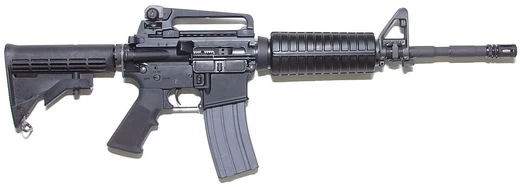
DI MA-1
Burmese Galil-derived assault rifle family, standard issue since the early 2000s.
The DI MA-1 is a family of Burmese-made assault rifles chambered for 5.56×45mm NATO, produced by the Myanmar Directorate of Defence Industries. The MA designation stands for Myanmar Army, and the series is sometimes erroneously referred to as the EMERK-3. Based on the IMI Galil with localized modifications, the MA-1 replaced the earlier BA63 (a licensed Heckler & Koch G3A3) as the standard infantry weapon of the Tatmadaw.
Quick Facts
- Origin
- Myanmar
- Service
- 2002–present
- Wars
- Ethnic conflicts in Myanmar / Myanmar civil war
- Designer
- Yisrael Galili of Israel Military IndustriesMinor adaptions were made to the original Israeli Galil design.
- Length
- 978 mm (Mk. I-II) / 1065 mm (Mk. I-II) / 508 mm (Barrel Length, Mk. II)
- Action
- Gas-operated, rotating bolt
- Is Ranged
- yes
- Design Date
- 1991
- Manufacturer
- Ka Pa Sa No. 1 / Myanmar Fritz Werner Industries
- Weight
- 4 kg (No Magazine, Mk. I-II) / 4.42 kg (No Magazine, Mk. II) / 4.66 kg (With Magazine, Mk. I-II)
- Cartridge
- 5.56×45mm NATO
- Rate
- 950 rounds/min (Mk. I-II) / 600-700 rounds/min (Mk. II)
Facts from the source article.
Lore & Background
The Tatmadaw was previously armed with the BA63, a Myanmar-made version of the Heckler & Koch G3A3 produced under license from West Germany. The G3 was considered too heavy for jungle warfare. A team of engineers from IMI reportedly visited Yangon in 1991 to help establish production of the MA-1, despite repeated denials by Israeli officials. Serial production began in 2002 after an agreement with IMI, at the Ka Pa Sa No 1 factory near Inya Lake.
The MA-1 series is based on the IMI Galil but features ventilated handguards and a horizontal charging handle, unlike the Galil's vertical handle. Early Mk. I models had curved cheekpieces on the buttstock; Mk. II models omitted this. Initial versions used brown polymer furniture with rounded pistol grips; later Mk. II versions used black furniture with clear-cut Galil grips. The rifles are compatible with Galil magazines and can also use polymer magazines. An indicator of a rifle optimized for rifle grenades is tall iron sights; the rifles can fire the MG-2 rifle grenade. Selector positions are safe, semi-auto, and full-auto.
The MA-1 was first spotted in the early 2000s at Tatmadaw Armed Forces Day parades. By 2009 the Tatmadaw was almost fully equipped with the MA series. From 2014 the Mk II variant became the standard rifle. Plans to adopt the MA-1 Mk. III were halted due to quality issues. MA rifles have been captured by insurgent groups and have been documented in use by the People's Defence Force since May 2023. Some MA-3s were confiscated in raids in Manipur in July 2024.
Reader's Guide
The DI MA-1 represents Myanmar's shift from a licensed European battle rifle to a locally produced assault rifle adapted from Israeli design, reflecting the country's effort to modernize its small arms for jungle warfare. Its development with Israeli assistance, despite official denials, underscores the geopolitical dimensions of arms procurement. The MA-1's widespread adoption by the Tatmadaw by 2009 and its continued use through the 2020s, including the Mk II variant, demonstrates its role as the backbone of Myanmar's infantry. The series has also proliferated to non-state actors, including the Karen National Liberation Army, Karenni Army, People's Defence Force, Shan State Army, and Ta'ang National Liberation Army, often through captures. The MA-S designated marksman rifle, chambered in 7.62×51mm NATO and based on the MA-2, shows an attempt to fill a sniper role. Quality issues with the Mk. III halted its adoption, and reports that foreign-made 5.56mm NATO ammunition cannot be used in MA rifles while Myanmar-made ammunition works in foreign rifles highlight compatibility constraints. The MA-4 with its permanently fixed underbarrel grenade launcher (an unlicensed clone of the MKEK T-40) and the MA-3 carbine with a difficult-to-operate folding stock illustrate the series' varied adaptations.
Did You Know?
- The MA-1's horizontal charging handle differs from the vertical handle of the IMI Galil on which it is based.
- Early MA-1 Mk. I models had curved cheekpieces on the buttstock, later omitted in the Mk. II.
- The MA-4's underbarrel grenade launcher, the BA203, is an unlicensed clone of the MKEK T-40 and is permanently fixed.
- Foreign-made 5.56mm NATO ammunition reportedly cannot be used in MA rifles, but Myanmar-made ammunition works in foreign rifles of the same caliber.
More in Battle Rifles and Carbines 1-24
Spotted an error? Know more?
Reader corrections go straight into our review queue. Suggest an edit · How this site is sourced