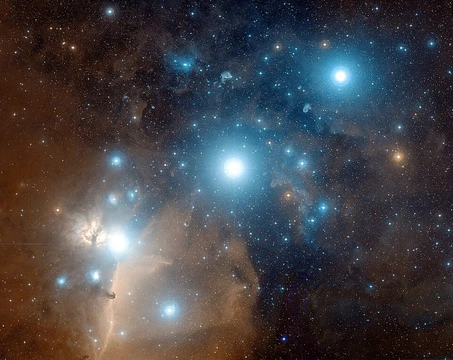
Barn door tracker
A simple mount that cancels Earth's rotation for astrophotography.

A barn door tracker—also called a Haig mount or Scotch mount—counteracts Earth’s diurnal motion so that astronomical objects can be observed or photographed. It offers a straightforward alternative to using a camera on a motorized equatorial mount.
George Haig invented the barn door tracker, with his plans first appearing in the April 1975 issue of *Sky & Telescope*. Modified versions followed in the magazine’s February 1988 and June 2007 editions. During late 2002 and early 2003, NASA astronaut Don Pettit, a member of International Space Station Expedition 6, built a barn door tracker from spare parts collected on the station. This allowed him to capture sharper, high-resolution images of city lights at night from the ISS.
A simple single-arm barn door tracker can be made by joining two pieces of wood with a hinge. A camera, often attached via a ball joint for flexible aiming, sits on the top board. The hinge aligns with a celestial pole, and the boards are driven apart or together at a constant rate—typically by turning a threaded rod or bolt—in what is called a tangent drive. With a 50 mm lens, this setup works well for about 5 to 10 minutes before tracking errors become noticeable due to tangent error. Using an isosceles mount extends that time to roughly 20 minutes. A curved drive bolt, instead of a straight tangent or isosceles mount, greatly increases useful tracking time.
Dave Trott improved these designs, publishing his work in the February 1988 issue of *Sky & Telescope*. By adding a second arm to drive the camera platform—making construction slightly more complex—tracking accuracy improves significantly, enabling exposures up to one hour. The most accurate of these is the Type-4 design. A modified double-arm version reduces tangent error by raising the rotation point of the camera arm, tilting the arc it traces backward to follow a better path.
Basic geometric analysis shows that tangent error can be fully corrected by inserting a specially shaped piece between the threaded rod and the top board—a solution known long before Haig’s original publication. Most of these designs are manually operated, though an optional electric or stepper motor (considered in Trott’s original design) automates tracking, improves accuracy, and reduces platform vibrations from manual advancement.
- Creator
- George Haig
- First publication
- Sky & Telescope magazine, April 1975
- Modified versions published
- February 1988 and June 2007 editions of Sky & Telescope
- Notable user
- NASA astronaut Don Pettit, part of International Space Station Expedition 6
- Construction location
- International Space Station, late 2002 and early 2003
- Maximum exposure time single arm
- 5–10 minutes with a 50 mm lens
- Maximum exposure time isosceles mount
- about 20 minutes
Lore & Background
The barn door tracker was created by George Haig, with plans first published in Sky & Telescope magazine in April 1975. Modified versions appeared in the magazine's February 1988 and June 2007 editions. In late 2002 and early 2003, NASA astronaut Don Pettit, part of International Space Station Expedition 6, constructed a barn door tracker using spare parts he had accumulated from around the space station, permitting sharper high resolution images of city lights at night from the ISS.
A simple single-arm barn door tracker can be made by attaching two pieces of wood together with a hinge. A camera is mounted on the top board, usually with a ball joint to allow pointing in any direction. The hinge is aligned with a celestial pole and the boards are driven apart at a constant rate, usually by turning a threaded rod or bolt, called a tangent drive. This type is good for approximately 5–10 minutes before tracking errors become evident when using a 50 mm lens, due to tangent error. That length of time can be increased to about 20 minutes when using an isosceles mount. A curved drive bolt in lieu of either a straight tangent or isosceles mount will greatly extend the useful tracking time.
These designs were further improved upon by Dave Trott, whose designs were published in the February 1988 issue of Sky & Telescope. By using a second arm to drive the camera platform, tracking accuracy is greatly increased, allowing exposure times of up to one hour. The most accurate of these designs is Type-4. A modified double arm design minimizes tangent error by raising the point of rotation of the arm on which the camera is mounted, tilting the arc traced by the camera arm backwards to follow a better path. A basic geometrical analysis shows tangent error can be fully compensated for by inserting a specially shaped piece between the threaded rod and the top board, a solution known long before Haig's publication.
Reader's Guide
The barn door tracker is significant as a low-cost, accessible alternative to motorized equatorial mounts for astrophotography. Its history, from George Haig's original 1975 plans to modifications published in Sky & Telescope in 1988 and 2007, shows a continuous refinement of design. The device's notable use by NASA astronaut Don Pettit on the International Space Station in 2002–2003 demonstrates its adaptability even in space, where it enabled sharper images of city lights at night. Dave Trott's double-arm Type 4 design, published in 1988, represents a major advancement, potentially reducing trailing error to 1 arc second per hour and allowing exposures up to one hour, though detailed building plans have never been published. The design's legacy includes manual and motorized versions, with a 1 RPM stepper motor on a 1/4" 20 pitch drive rod recommended for ideal performance. Gerard Prins later provided detailed 1:1 building plans with modifications such as hinged suspension of the drive rod to avoid binding and a central tripod mount adjustable along supporting truss tubes for balance. The tracker remains a practical tool for amateur astrophotographers, with proper polar alignment requiring a 3-way tripod or azimuth wedge.
Did You Know?
- NASA astronaut Don Pettit built a barn door tracker on the International Space Station in 2002–2003 using spare parts.
- Dave Trott's double-arm Type 4 design can potentially reduce trailing error to 1 arc second per hour.
Frequently Asked Questions
What is a barn door tracker?
A barn door tracker is a simple mechanical mount designed to cancel out Earth's daily rotation so that photographers can capture longer exposures of the night sky. It is also commonly referred to as a Haig mount or a Scotch mount.
Who invented the barn door tracker?
George Haig is credited with creating the design, and his original plans were published in the April 1975 issue of Sky & Telescope magazine. Updated versions of the design appeared in the February 1988 and June 2007 editions of the same publication.
How long can you photograph with a barn door tracker?
With a single arm and a 50 mm lens, the tracker can support exposures of roughly five to ten minutes before field rotation becomes a problem. This makes it a practical option for wide-field astrophotography without needing a full motorized equatorial setup.
Did anyone use a barn door tracker in space?
Yes—NASA astronaut Don Pettit, serving on International Space Station Expedition 6, constructed one aboard the station during late 2002 and early 2003. It remains one of the most memorable real-world demonstrations of the device's simplicity.
Why do astrophotographers still use a barn door tracker?
It offers a low-cost, mechanically simple way to track the sky that avoids the complexity and expense of a motorized equatorial mount. For casual or wide-field shooting, its straightforward design makes it an accessible entry point into long-exposure astrophotography.
More in Astrophotography 1-24
Spotted an error? Know more?
Reader corrections go straight into our review queue. Suggest an edit · How this site is sourced