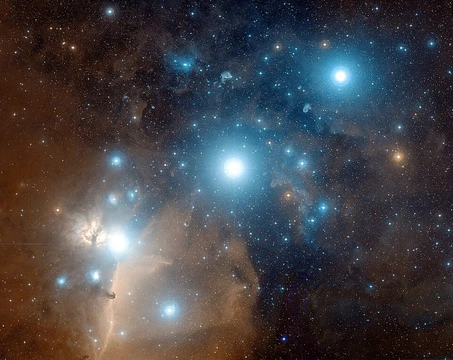
Association (astronomy)
Co-added HST exposures cleaned of cosmic rays.

In astronomy, an "association" refers to a set of astronomical exposures that have been combined, or co-added, after removing cosmic rays. One specific type is the WFPC2 association, which is a tool in the Hubble Space Telescope (HST) archive for working with data from the Wide Field and Planetary Camera 2 (WFPC2). These associations first appeared in the HST archive in early 1998. Since then, astronomers have been able to obtain on-the-fly re-calibrated, co-added WFPC2 images—already cleaned of cosmic rays—from the archives of the Space Telescope European Coordinating Facility (ST-ECF), the Canadian Astronomy Data Centre (CADC), and the Space Telescope Science Institute (STScI).
A new pipeline for creating associations was initiated in early 1999. It used standard cross-correlation methods to determine the offsets between WFPC2 observations from the same proposal that employed the same filter. The second generation of WFPC2 Associations, called type B associations, was released by CADC and ST-ECF in November 2001. Type B associations include all exposures that meet the same criteria as type A, but they do not rely on the availability or accuracy of jitter information.
- Introduced in hst archive
- beginning of 1998
- Type b release date
- November 2001
- Type b released by
- CADC and ST-ECF
- Pipeline development start
- early 1999
- Associated instruments
- WFPC2
- Archives providing associations
- ST-ECF, CADC, STScI
Lore & Background
The development of a new association pipeline was started in early 1999. Standard cross-correlation techniques were used to measure the offsets among WFPC2 observations belonging to the same proposal and using the same filter. CADC and ST-ECF released the second generation of WFPC2 Associations, known as type B associations, in November 2001. Type B associations contain all the exposures that follow the same criterion of association as type A, but do not depend on the availability or the accuracy of the jitter information.
Reader's Guide
Associations are significant because they provide astronomers with co-added WFPC2 images that have been automatically cleaned of cosmic rays, saving substantial processing time. Introduced in the HST archive at the beginning of 1998, they became available on-the-fly from three major archives: ST-ECF, CADC, and STScI. The development of a second generation (type B) in November 2001 by CADC and ST-ECF expanded the utility by removing the dependency on jitter information, making associations available even when such data were inaccurate or unavailable. The pipeline used standard cross-correlation techniques to align exposures from the same proposal and filter. Their legacy is as a practical tool within the HST archive that streamlined the use of WFPC2 data for the astronomical community.
Did You Know?
- Type B associations were released in November 2001 by CADC and ST-ECF.
- Standard cross-correlation techniques were used to measure offsets among WFPC2 observations.
Origins & Pioneering Moments
The story of astrophotography begins with a spectacular failure. In 1839, Louis Jacques Mandé Daguerre—himself the inventor of the photographic process that bears his name—attempted to capture an image of the Moon. The result was a blurry, indistinct smudge, a casualty of tracking errors during the long exposure. It took until March 23, 1840, before John William Draper, a chemistry professor at New York University who was also a physician and experimenter, succeeded where Daguerre had not. Using a 5-inch reflecting telescope, Draper exposed a daguerreotype plate for twenty minutes to produce the first successful photograph of the Moon. The Sun followed: French physicists Léon Foucault and Hippolyte Fizeau may have captured the first solar image in an 1845 daguerreotype. Meanwhile, Italian physicist Gian Alessandro Majocchi recorded a failed attempt during a total solar eclipse in his home city of Milan on July 8, 1842, describing in a written account how a plate exposed to the thin crescent's light produced a distinct image while another plate exposed under different conditions did not. These early, hard-won experiments laid the groundwork for what would become an entire scientific discipline.
The Technical Revolution
The core challenge of astronomical imaging is straightforward in concept but demanding in execution: gathering enough faint light to build a usable picture. Both film and digital sensors solve this by accumulating photons over extended exposure times, while larger objective diameters collect more light per unit time. But Earth's rotation introduces a relentless complication—telescopes must be driven in the opposite direction to track the apparent diurnal motion of stars overhead. This is handled through equatorial or computer-controlled altazimuth mounts, yet mechanical sag, imperfect motor drives, and atmospheric refraction all introduce tracking errors. The solution is guiding: a secondary guide scope or an off-axis beam splitter lets the operator, or an automated system, keep a reference star centered throughout the exposure. For moving targets like comets, the telescope must continuously re-center on the object itself. In the professional realm, CCD cameras can be cooled to suppress thermal noise and capture infrared wavelengths, while specialized optical filters restrict incoming light to narrow spectral bands. Schmidt cameras and other wide-field instruments serve specific survey purposes, and the entire apparatus has evolved from manual crosshair adjustments to fully computerized tracking systems.
Impact on Professional Astronomy
Long-exposure photography fundamentally reshaped how professional astronomers cataloged the universe. By recording hundreds of thousands of stars and nebulae invisible to the naked eye, photographic plates turned the night sky into a measurable, reproducible archive. Specialized telescopes of ever-increasing size were built essentially as giant cameras, their primary purpose being to project images onto photographic plates for later analysis. Astrophotography played a foundational role in early sky surveys and stellar classification, and over time it branched into numerous subdisciplines—star cartography, astrometry, photometry, spectroscopy, polarimetry—each demanding its own instrumentation. The technique also proved indispensable for discovering new objects: asteroids, meteors, comets, variable stars, novae, and even previously unknown planets. Because nearly all modern observational astronomy relies on imaging in some form, the term "astrophotography" has gradually shifted in common usage to describe the amateur practice, while the professional field simply calls it astronomical imaging or observational astronomy.
The Amateur Renaissance & Modern Practice
As professional astronomy absorbed photography into its standard toolkit, the term "astrophotography" came to denote primarily the amateur pursuit—capturing aesthetically compelling images of the night sky rather than extracting scientific data. Amateur practitioners employ a wide spectrum of specialized equipment and techniques, from small refractors to large reflectors, from manual tracking to fully automated guiding systems. One persistent obstacle is light pollution: urban skies flood sensors with stray photons, so serious imaging is often conducted at remote dark-sky sites where long exposures can proceed without the detector being overwhelmed. The community draws on the same fundamental physics that govern professional work—photon accumulation, optical filtering, and precise tracking—but the goals differ. Where a professional might cool a CCD to record infrared spectra of a distant galaxy, an amateur might stack dozens of short exposures of the Moon, Sun, or a planetary surface to reveal color and structure invisible to the unaided eye. The result is a vibrant subculture where artistic vision and technical skill converge under the stars.
Frequently Asked Questions
What is an Association in the context of Hubble astrophotography?
An association is a pre-processed stack of individual Hubble exposures that have been co-added together after cosmic-ray hits have been identified and removed. In practice, it gives the user a single, cleaner composite image rather than a raw set of frames.
When did WFPC2 associations first become available in the Hubble archive?
They appeared in the HST archive at the beginning of 1998. Pipeline development to produce them had started in early 1999, and the Type B variant was formally released by CADC and ST-ECF in November 2001.
Which archives can I download WFPC2 associations from?
They are distributed through three main repositories: the Space Telescope European Coordinating Facility (ST-ECF), the Canadian Astronomy Data Centre (CADC), and the Space Telescope Science Institute (STScI). Each provides on-the-fly re-calibrated, co-added images that are already free of cosmic-ray artifacts.
What exactly does the co-adding and cosmic-ray removal process do?
Multiple exposures of the same field are aligned and averaged, which boosts the signal-to-noise ratio while statistical outlier detection strips out the bright pixels caused by cosmic-ray strikes. The result is a smoother, more reliable image than any single raw frame.
Why do astrophotographers and researchers prefer associations over raw WFPC2 frames?
Associations save hours of manual stacking, calibration, and bad-pixel correction work. Because the data arrive pre-cleaned and co-added, a researcher can move straight into scientific analysis or image processing without rebuilding the pipeline from scratch.
More in Astrophotography 1-24
Spotted an error? Know more?
Reader corrections go straight into our review queue. Suggest an edit · How this site is sourced