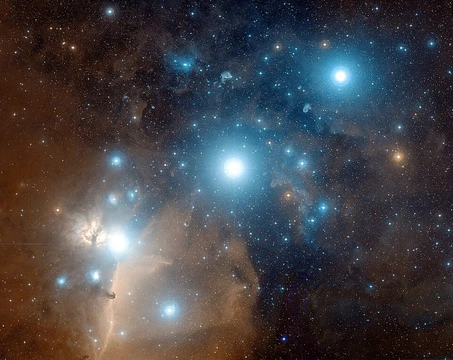
Astronomical survey
A general map or image of the sky lacking a specific target.

An astronomical survey is a broad map or image of a section of the sky—or the entire sky—without a specific object in mind. It can also consist of a collection of images, spectra, or other data on objects that share a common trait or type. Because of instrument constraints, surveys usually focus on a single band of the electromagnetic spectrum, though multiwavelength surveys are possible by using multiple detectors, each tuned to a different bandwidth. These surveys are typically carried out to create an astronomical catalog. They can also aim to find transient astronomical events, and they frequently rely on wide-field astrographs.
Sky surveys, unlike targeted observations of a single object, let astronomers list celestial bodies and run statistical analyses without needing complex corrections for selection effects. Sometimes, an astronomer interested in a particular object finds that survey images are enough, making new telescope time unnecessary. Surveys also help in choosing targets for closer study with larger, more powerful telescopes. If earlier observations back a hypothesis, a telescope scheduling committee is more likely to approve new, detailed observations to test it. Because of their wide coverage, surveys are ideal for spotting moving foreground objects like asteroids and comets. An astronomer can compare existing survey images with current observations to detect changes; this task can even be automated with image analysis software. Beyond science, these surveys find potentially hazardous objects, aiding Spaceguard. For instance, the Asteroid Terrestrial-impact Last Alert System (ATLAS) scans the entire night sky every night and, like NEOSTEL, is designed to detect approaching objects. Broader surveys include the Uppsala–DLR Asteroid Survey and the 20th-century U.K. Schmidt–Caltech Asteroid Survey. Old surveys can be reviewed for precovery images. Likewise, comparing images of the same object from different surveys can reveal transient events like variable stars.
- Earliest known survey
- Hipparchus, 190-120 BC, created the first known star catalogue with more than 850 stars
- Largest photographic survey
- Astrographic Catalogue, 1887–1975, performed by 18 observatories using over 22,000 photographic plates
- Notable optical survey dates
- Sloan Digital Sky Survey (SDSS), 2000–2006 (first pass)
- Infrared survey sensitivity
- Wide-field Infrared Survey Explorer (WISE) is over a thousand times as sensitive as previous infrared surveys
- Gamma ray survey mission
- Fermi Gamma-ray Space Telescope, 2008–present, goal for telescope lifetime is 10 years
Lore & Background
Sky surveys, unlike targeted observation of a specific object, allow astronomers to catalog celestial objects and perform statistical analyses on them without complex corrections for selection effects. In some cases, an astronomer interested in a particular object will find that survey images are sufficient to make new telescope time entirely unnecessary. Surveys also help astronomers choose targets for closer study using larger, more powerful telescopes. If previous observations support a hypothesis, a telescope scheduling committee is more likely to approve new, more detailed observations to test it. The wide scope of surveys makes them ideal for finding foreground objects that move, such as asteroids and comets. An astronomer can compare existing survey images to current observations to identify changes; this task can even be performed automatically using image analysis software. Besides science, these surveys also detect potentially hazardous objects, providing a service to Spaceguard. For example, the Asteroid Terrestrial-impact Last Alert System (ATLAS) system surveys the entire night sky every night and, like NEOSTEL, is intended to detect objects as they approach. Broader surveys include the Uppsala–DLR Asteroid Survey and the 20th-century U.K. Schmidt–Caltech Asteroid Survey. Old surveys can be reviewed to find precovery images. Similarly, images of the same object taken by different surveys can be compared to detect transient astronomical events such as variable stars.
Reader's Guide
Astronomical surveys have been foundational to modern astronomy, enabling the creation of comprehensive catalogs and statistical studies without selection biases. They allow astronomers to identify targets for detailed follow-up with larger telescopes, and their wide-field nature makes them essential for detecting moving objects like asteroids and comets. Surveys also serve a practical purpose in planetary defense, as exemplified by systems like ATLAS and NEOSTEL, which scan the entire night sky nightly for potentially hazardous objects. Historical surveys, such as the Astrographic Catalogue (1887–1975) involving 18 observatories and over 22,000 photographic plates, have provided a basis for comparison for all subsequent surveys. The Sloan Digital Sky Survey (2000–2006) advanced optical and spectroscopic mapping, while infrared surveys like WISE (launched December 2009) achieved over a thousand times the sensitivity of previous infrared surveys. Multiwavelength surveys, such as GAMA, combine data from multiple observatories to study galaxy physics and mass structures. The legacy of surveys includes not only scientific discovery but also the detection of transient events and the provision of precovery images from older datasets.
Did You Know?
- The first known star catalogue was created by Hipparchus between 190-120 BC, containing more than 850 stars.
- The Astrographic Catalogue (1887–1975) used over 22,000 photographic plates from 18 observatories.
- The Wide-field Infrared Survey Explorer (WISE) is over a thousand times as sensitive as previous infrared surveys.
Origins and the First Faint Images
The story of capturing the night sky on photographic media begins in the 1830s and 1840s, when a handful of curious experimenters—often called "gentleman scientists," though not exclusively men—pushed the boundaries of what was optically and chemically possible. Louis Jacques Mandé Daguerre, the very inventor of the daguerreotype process, made the first known attempt to photograph the Moon in 1839. The result was a blurry, indistinct smudge, a victim of tracking errors during the long exposure. It took until March 23, 1840, before John William Draper, a chemistry professor at New York University, succeeded with a twenty-minute daguerreotype of the Moon using a five-inch reflecting telescope. The Sun followed shortly after; French physicists Léon Foucault and Hippolyte Fizeau may have captured it as early as 1845. Even a total solar eclipse in Milan in 1842 drew the attention of Italian physicist Gian Alessandro Majocchi, whose partial success with an iodized plate during totality showed both the promise and the fragility of early astronomical imaging.
The Fight Against Motion and Darkness
Because the Earth never stops spinning, every serious astronomical image is a battle against diurnal motion. Telescopes must be rotated in the opposite direction to keep a target centered, a task handled by equatorial or computer-controlled altazimuth mounts. Even with these systems, imperfect motor drives, mechanical sag, and atmospheric refraction introduce tracking errors, so a dedicated guide star is kept locked on a crosshair throughout the entire exposure. In the early days, a human observer stood at—or even rode inside—the telescope, making manual corrections by eye. Today, automated guiding systems using a co-mounted guide scope or an off-axis beam splitter handle this in both professional and amateur setups. Light collection is maximized by increasing the diameter of the primary optics, and long exposures allow film or digital sensors to accumulate photons that the naked eye could never register. Urban light pollution forces many imaging stations into remote locations where stray photons do not swamp the detector.
Revolutionizing Scientific Discovery
The ability to expose a photographic plate for minutes, hours, or even longer transformed astronomy from a discipline limited to what the human eye could perceive in a single glance. Extended exposures revealed hundreds of thousands of stars and nebulae that had never been catalogued, and large optical telescopes were essentially built as enormous cameras to record these images on glass plates. From this foundation, the field branched into a remarkable array of subdisciplines, each with its own specialized goals: star cartography, astrometry, stellar classification, photometry, spectroscopy, polarimetry, and the discovery of new objects ranging from asteroids and comets to variable stars, novae, and even previously unknown planets. Equipment evolved to match these needs—Schmidt cameras for wide fields of view, telescopes tuned to precise wavelengths, and CCD sensors cooled to suppress thermal noise so that infrared and other non-visible spectra could be recorded. Specialized optical filters further isolate particular wavelengths, opening windows into the universe that no unaided observer could ever see.
The Amateur Renaissance and Modern Practice
Ironically, because nearly all observational astronomy today relies on photographic or digital imaging, the term "astrophotography" has drifted in popular usage to describe the amateur pursuit of aesthetically compelling night-sky images rather than the collection of scientific data. Amateur practitioners employ a wide and ever-expanding range of specialized equipment and techniques, from cooled CCD cameras and narrowband filters to computer-guided equatorial mounts, mirroring tools once reserved for professional observatories. The practical challenges remain the same as they were for the nineteenth-century gentleman scientists: securing a dark, remote site free of urban light pollution, maintaining rigid optical alignment over long exposures, and compensating for the Earth's rotation with precision tracking. Yet the barrier to entry has dropped dramatically. Where Draper once needed a dedicated five-inch reflector and a twenty-minute wet-plate exposure to capture the Moon, a modern hobbyist can accumulate photons on a digital sensor, apply wavelength-selective filters to reveal nebulae and galaxies, and produce images that would have been unimaginable to the pioneers of the daguerreotype era.
Frequently Asked Questions
What exactly is an astronomical survey in astrophotography?
It is a wide-area imaging or data-gathering effort that maps a large portion of the sky without targeting any single object. The goal is usually to build a catalog of celestial objects or to catch short-lived events such as supernovae. Surveys can also group objects by a shared characteristic rather than just by position.
Who created the earliest known astronomical survey?
Hipparchus, working between roughly 190 and 120 BC, compiled the first recognized star catalogue. His list contained over 850 stars and laid the groundwork for centuries of systematic sky mapping.
What was the largest photographic sky survey in history?
The Astrographic Catalogue, carried out between 1887 and 1975, stands as the biggest photographic survey ever attempted. A network of 18 observatories contributed more than 22,000 glass plates to the project.
How sensitive is WISE compared to earlier infrared surveys?
The Wide-field Infrared Survey Explorer is more than a thousand times more sensitive than any infrared survey that came before it. That dramatic jump in sensitivity lets it detect much fainter and more distant objects in the infrared.
Why do most astronomical surveys stick to a single wavelength band?
Instrument and detector limitations make it hard to cover the full electromagnetic spectrum in one pass, so surveys generally target one band at a time. Multiwavelength coverage is possible by pairing several detectors, each calibrated to a different bandwidth, but that adds considerable complexity and cost.
More in Astrophotography 1-24
Spotted an error? Know more?
Reader corrections go straight into our review queue. Suggest an edit · How this site is sourced