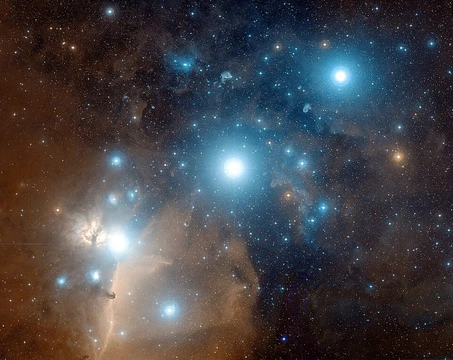
Astronomical seeing
Atmospheric turbulence blurs astronomical images, limiting telescope resolution.

Astronomical seeing is the degradation of an astronomical object's image caused by Earth's atmospheric turbulence, resulting in blurring, twinkling, or variable distortion. It arises from rapidly changing variations in the optical refractive index along the light path from the object to the detector. Seeing is a major limitation to angular resolution in telescopes that would otherwise be limited only by diffraction through the aperture size.
- Seeing disk excellent
- smaller than 0.4 arcseconds
- Fried parameter excellent
- larger than 30 centimeters
- Reference wavelength
- 500 nanometers
- Typical r0 at best locations
- 20 cm at visible wavelengths
- Typical r0 at sea level
- 5 cm at visible wavelengths
- Good seeing disk value
- 1.0 arcseconds
- Best seeing disk value
- 0.4 arcseconds
Lore & Background
The effects of astronomical seeing include the breakup of point-source images into rapidly changing speckle patterns, which in long exposures produce a blurred seeing disc. Scintillation, or twinkling, causes fluctuations in star brightness, and seeing causes fringes in astronomical interferometers to move rapidly. The distribution of seeing through the atmosphere, described by the CN2 profile, degrades adaptive optics image quality farther from the reference star.
Historically, seeing effects were indirectly responsible for the belief that Mars had canals. When viewing a bright object like Mars, occasional still patches of air provided brief moments of clarity. Before charge-coupled devices, observers had to remember and draw these fleeting images, making the result dependent on memory and preconceptions, which led to the belief in linear features on Mars.
Seeing is characterized by the full width at half maximum of the seeing disk, the Fried parameter r0, and the time constant t0. The Fried parameter describes the size of an imaginary telescope aperture for which diffraction-limited resolution equals seeing-limited resolution. The best conditions are typically found at high-altitude observatories on small islands, such as Mauna Kea or La Palma.
Reader's Guide
Astronomical seeing is a fundamental constraint on ground-based optical astronomy, as it sets the effective resolution limit for telescopes larger than the Fried parameter r0. For telescopes with diameters exceeding r0, the image resolution becomes independent of telescope size and is determined solely by the atmosphere, equivalent to a telescope of diameter r0. This parameter also dictates the spacing of actuators in adaptive optics systems, while the Greenwood time constant t0 determines the required correction speed. The seeing disk diameter, typically measured in arcseconds, varies from place to place, night to night, and even minute to minute, with good nights at average sites around 1.0 arcsecond and excellent conditions below 0.4 arcseconds. The effects are qualitatively similar across visible and near-infrared wavebands, though longer wavelengths yield slightly higher resolution and slower speckle pattern changes. Modern large ground-based telescopes employ adaptive optics to overcome seeing, but the fundamental limitation remains a key consideration in observatory siting and instrument design.
Did You Know?
- A seeing disk smaller than 0.4 arcseconds or a Fried parameter larger than 30 centimeters is considered excellent seeing.
- The Fried parameter r0 is named after David L. Fried, and the atmospheric time constant t0 is named after Darryl Greenwood.
- At visible wavelengths, r0 varies from 20 cm at the best locations to 5 cm at typical sea-level sites.
- The effects of atmospheric seeing were indirectly responsible for the belief that there were canals on Mars.
Origins and the Pioneers of Celestial Imaging
The story of capturing the night sky on a permanent medium begins in the 1830s and 1840s, a period when photography itself was still in its infancy. Louis Jacques Mandé Daguerre, the very inventor of the photographic process that carries his name, made the first known attempt to photograph an astronomical object—the Moon—in 1839. His image, however, turned out as nothing more than a blurry, indistinct smudge, a casualty of tracking errors during the lengthy exposure. It fell to John William Draper, a New York chemistry professor and physician, to produce the first successful lunar photograph on March 23, 1840, using a five-inch reflecting telescope and a twenty-minute daguerreotype exposure. The Sun followed soon after, with French physicists Léon Foucault and Hippolyte Fizeau likely capturing it in an 1845 daguerreotype, while Italian physicist Gian Alessandro Majocchi documented a failed eclipse attempt in Milan in 1842. These early experiments were largely driven by amateur astronomers and so-called "gentleman scientists" who had to solve fundamental engineering problems—building rigid enough mounts, developing reliable clock drives, and finding ways to hold a steady aim over long periods—simply to get a usable image.
The Mechanics of Capturing Faint Light
At the heart of astronomical imaging lies a deceptively simple principle: both film and digital sensors can accumulate photons over extended periods, allowing even the faintest celestial objects to register a signal. In practice, this demands a chain of carefully engineered solutions. The diameter of the primary optical element must be large enough to gather sufficient light, and the entire assembly must remain rigid so that mechanical sag does not shift the image out of focus during what can be a very long exposure. Because the Earth is perpetually rotating, the telescope must be driven in the opposite direction to track the apparent diurnal motion of stars across the sky. This is handled by equatorial or computer-controlled altazimuth mounts, yet even these systems suffer from imperfect motor drives and atmospheric refraction. To compensate, a dedicated guide star is kept centered throughout the exposure, either through a secondary guide scope or an off-axis guider that splits the optical path. In the earliest days, a human observer stood at the telescope, manually nudging a crosshair back onto the guide star for the entire duration. Today, automated computer systems perform this correction in both professional and amateur instruments.
A Revolution in Scientific Discovery
Long-exposure photography fundamentally transformed professional astronomy from a discipline limited to what the human eye could perceive in a single glance. By accumulating light over minutes or hours, photographic plates revealed hundreds of thousands of stars, nebulae, and other objects that had been invisible to naked-eye observers. Specialized telescopes were built essentially as enormous cameras, their primary purpose being to record images on photographic plates for systematic sky surveys and stellar classification. From this foundation, the field branched into a remarkable array of subdisciplines—astrometry, photometry, spectroscopy, polarimetry, and star cartography—each demanding its own tailored equipment. Telescopes were designed for precise imaging, wide fields of view such as Schmidt cameras, or specific wavelength ranges. Astronomical CCD cameras added the ability to cool sensors, reducing thermal noise and extending detection into infrared and other non-visible spectra, while specialized optical filters isolated particular wavelengths. The discovery catalog grew to include asteroids, meteors, comets, variable stars, novae, and even previously unknown planets, all made possible by the simple act of letting a detector sit still and collect light.
The Amateur Tradition and the Search for Beauty
Because virtually all modern observational astronomy now relies on photographic or digital imaging, the term "astrophotography" has gradually shifted in common usage to describe the amateur practice rather than the professional one. Where researchers pursue quantitative data, the amateur astronomer typically aims for aesthetically compelling images of the Moon, planets, nebulae, and distant galaxies—objects that extend well beyond the visible spectrum into wavelengths the human eye can never detect. This pursuit requires a wide range of specialized equipment and techniques, from cooled CCD sensors that suppress thermal noise to narrow-band optical filters that isolate specific wavelengths of light. A persistent practical challenge is light pollution: because long exposures are essential to accumulating enough photons from faint sources, imaging sessions are often conducted at remote sites far from urban glow, where stray ambient light would otherwise swamp the detector. The result is a vibrant community that, while not producing the same catalogues of new discoveries as professional surveys, has made the wonder of the deep sky accessible to anyone willing to point a telescope at the night and let the camera do the waiting.
Frequently Asked Questions
Who is Astronomical seeing?
Astronomical seeing refers to the way Earth's turbulent atmosphere scrambles incoming starlight before it reaches your camera sensor. The result is a smeared, shimmering, or wobbling image instead of the crisp point the telescope could theoretically produce.
What are Astronomical seeing's powers/role?
Its main 'power' is capping your angular resolution, overriding the diffraction limit set by your aperture diameter. It works by constantly shifting the refractive index of air cells along the light's path, so the wavefront arrives at the detector warped and unpredictable.
Why is Astronomical seeing important?
It is the practical ceiling on detail you can pull from a ground-based scope, because the Fried parameter (r₀) at a typical sea-level site is only around 5 cm at the 500 nm reference wavelength. Even the finest high-altitude platforms top out near 20 cm, so any aperture beyond that gains no extra sharpness without correction.
What are Astronomical seeing's key stats?
A commonly cited 'good' seeing disk is roughly 1.0 arcsecond, and conditions below 0.4 arcseconds are considered excellent. The Fried parameter threshold for excellent seeing is above 30 cm, all measured at the standard 500-nanometer reference wavelength.
More in Astrophotography 1-24
Spotted an error? Know more?
Reader corrections go straight into our review queue. Suggest an edit · How this site is sourced