
Star catalogue
Mapping the heavens: from clay tablets to billions of stars.

CielProfond · CC BY-SA 4.0
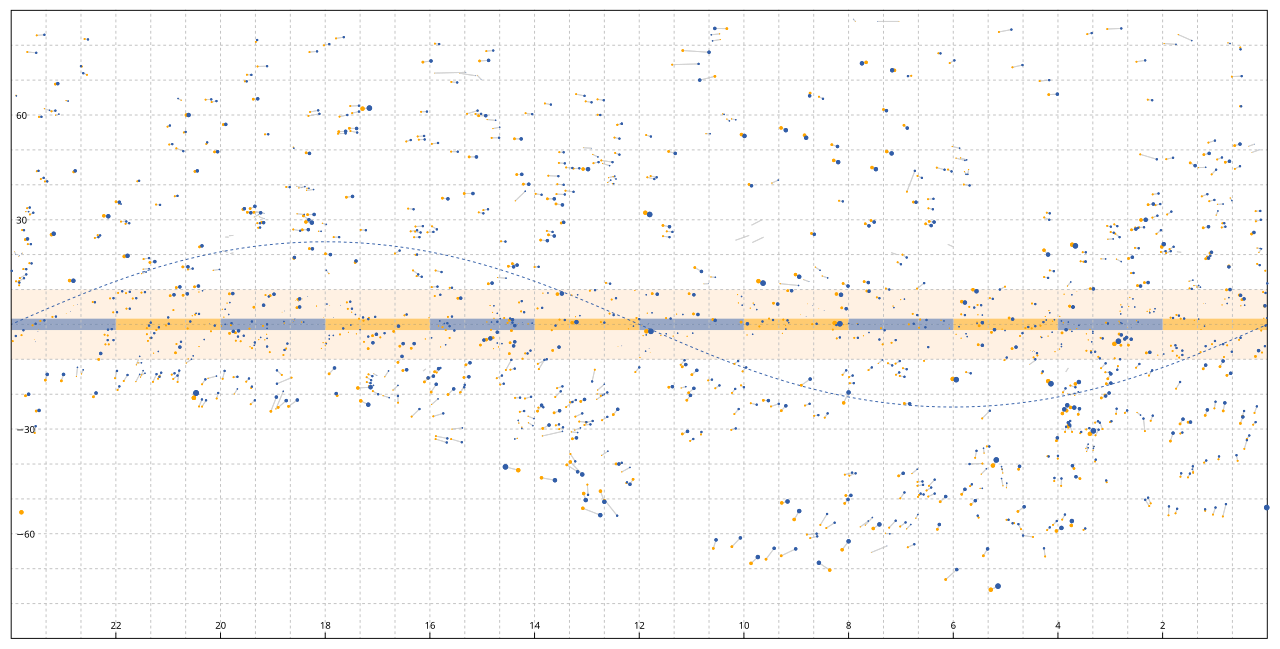
A star catalogue is an astronomical catalog that lists stars, typically including their positions, magnitudes, and other identifying characteristics. These compilations have been fundamental to navigation, timekeeping, and the scientific understanding of the cosmos, evolving from ancient clay tablets to modern digital databases.
- Earliest known systematic list
- Mul.Apin tablets (c. 7th century BC, Assyria/Babylonia)
- First comprehensive Western catalogue
- Hipparchus's star catalogue (c. 129 BC, based on earlier observations)
- Most stars in a single historical catalo
- Gaia DR3 (2022) – over 1.8 billion stars
- Key modern catalogue
- Hipparcos Catalogue (1997) – 118,218 stars with high precision
- Common naming system
- Bayer designations (1603) and Flamsteed numbers (1712)
Lore & Background
The oldest surviving star catalogues are the Babylonian Mul.Apin tablets, compiled around the 7th century BC. These tablets list constellations and stars, primarily for calendrical and agricultural purposes, but they are not exhaustive catalogues of all visible stars. Earlier 'Three Stars Each' lists, sometimes cited as precursors, are debated by scholars as being too fragmentary or astrological in nature to qualify as full star catalogues in the modern sense.
The Greek astronomer Hipparchus is credited with creating the first comprehensive star catalogue in the Western tradition around 129 BC, possibly inspired by a nova. His work, later expanded by Ptolemy in the Almagest (2nd century AD), listed about 1,022 stars with positions and magnitudes. This catalogue remained the standard for over a millennium until the Renaissance, when Tycho Brahe and later Johannes Hevelius improved accuracy.
Modern star catalogues began with the introduction of telescopic observations and photography. The Henry Draper Catalogue (1918–1924) classified over 225,000 stars by spectral type. Today, space-based missions like Gaia have revolutionized the field, producing catalogues of billions of stars with unprecedented positional and kinematic data, enabling studies of galactic structure and stellar evolution.
Reader's Guide
Star catalogues have served as fundamental tools for astronomy across millennia. The earliest known catalogues from the Babylonians established patterns later seen in Greek constellations. Hipparchus completed his star catalogue in 129 BC, the earliest known attempt to map the entire sky, which he compared to Timocharis' and discovered that the longitude of the stars had changed over time, leading him to determine the first value of the precession of the equinoxes. Ptolemy's catalogue in the Almagest, based almost entirely on Hipparchus, remained the standard in the Western and Arab worlds for over eight centuries. Islamic astronomers such as al-Sufi and Ulugh Beg updated it. In China, star catalogues were attributed to Shi Shen and Gan De, possibly active in the 4th century BC, and later Han dynasty astronomers compiled extensive lists. Modern catalogues, such as those from the Gaia spacecraft, now list over a billion stars and are freely available electronically.
Did You Know?
- The Hipparcos satellite (1989–1993) measured stellar positions with an accuracy of about 1 milliarcsecond, equivalent to the width of a human hair seen from 1,000 km away.
- The Bayer designation system uses Greek letters (e.g., Alpha Centauri) but often ranks stars by brightness within a constellation, not strictly by order.
- The Henry Draper Catalogue was funded by the widow of a physician and was the first major catalogue to classify stars by spectral type using the Harvard system.
- The Gaia mission's third data release (2022) includes positions, parallaxes, and proper motions for over 1.8 billion stars, making it the largest and most precise star catalogue ever created.
Defining the Catalogue
An astronomical catalogue is fundamentally a structured listing or tabulation of celestial objects. What unifies the entries within any given catalogue is a shared characteristic — whether that is a common type, a particular morphology, a shared origin, a specific means of detection, or a common method of discovery. These catalogues do not arise in isolation; they are typically the product of an astronomical survey, meaning that a systematic effort to observe and record a portion of the sky precedes the compilation of the list. The result is a reference tool that allows astronomers to identify, locate, and cross-reference objects that share a defining property. From the material at hand, we see catalogues covering everything from X-ray sources detected by satellites like Ariel V and ROSAT, to gamma-ray sources found by the Fermi telescope's Large Area Telescope, to infrared surveys like 2MASS, to radio sources mapped by the Cambridge series. Each catalogue serves as a window into one particular observational channel or object class, and together they form the backbone of modern astronomical reference.
The Language of Prefixes
The catalogue system relies heavily on a compact prefix-and-number scheme that encodes the source, the type of observation, and sometimes the version. A single letter or number at the front can signal an entirely different instrument or survey. The Cambridge radio surveys, for instance, run sequentially from 1C through 10C, with 3CR marking a revised edition of the Third Cambridge Catalogue. X-ray sources from the Ariel V satellite appear under 1A, 2A, and 3A, while the Einstein Observatory's soft X-ray list carries the 2E prefix. The ROSAT mission split its output into 1RXH for pointed high-resolution observations and 1RXS for all-sky bright and faint source catalogues. Gamma-ray detections from the Fermi satellite's Large Area Telescope are tagged 1FGL and 2FGL. The Two Micron All Sky Survey alone spawned a family of variants — 2MASP for the prototype, 2MASSI for incremental releases, 2MASSW for the working database, 2MASX for the extended catalogue, 2MUCD for ultracool dwarfs, and 2MASS-GC for globular clusters. This prefix architecture lets a researcher instantly recognise which instrument, which survey, and which release a given entry belongs to.
A Mosaic of Contributors
The catalogue landscape is built by a vast and diverse community of astronomers, each contributing lists focused on a particular class of object. Double stars alone are catalogued under dozens of names — Abt, Alden, Aller, Anderson, Argelander, Baillaud, Baize, Barnard, Barton, and Burnham, among others. Open star clusters carry the marks of Alessi, Alter, Alves and Yun, Andrews and Lindsay, Arce and Goodman, Aravamudan, Auner, Antalová, Aveni and Hunter, and many more. Planetary nebulae are associated with Acker, Allen, and Baade. Globular clusters appear in the works of Abel, Abell, and Balbinot. Peculiar galaxies are documented by Arp in his Atlas of Peculiar Galaxies and by Agüero in a catalogue drawn from the Palomar Observatory Sky Survey. Even ultracool dwarfs and emission-line objects have their own dedicated lists. This breadth of contributors and object classes means that a single celestial object may appear under multiple catalogue designations, as seen when Abt 1 is simultaneously Byurakan 4, Markarian 6, and Stock 7, or when Basel 1 is also known as the Apriamashvili cluster.
Living Documents: Versioning and Evolution
Astronomical catalogues are not static; they grow, are revised, and spawn new editions as observational capabilities improve. The Cambridge radio series illustrates this trajectory vividly, progressing from 1C all the way to 10C, with 3CR representing a revised version of the third edition. The Einstein Slew Survey similarly distinguishes between version 0 (0ES) and version 1 (1ES), reflecting iterative refinements of the same dataset. The 2MASS family shows an even more elaborate evolution: a prototype (2MASP), an incremental release (2MASSI), a working database (2MASSW), an extended source catalogue (2MASX), a specialised list of ultracool dwarfs (2MUCD), and globular cluster sub-lists (2MASS-GC 01 and 02, also referenced as Hurt 1 and Hurt 2). The Bologna Sky Survey at 408 MHz likewise produced two successive releases — B2 with nearly ten thousand radio sources and B3 with over thirteen thousand — both performed with the Northern Cross Radio Telescope. Each new version absorbs additional objects, corrects earlier measurements, or extends coverage, ensuring the catalogue remains a living reference rather than a fixed snapshot.
Gallery

Frequently Asked Questions
What is a star catalogue?
A star catalogue is a compiled list of stars, most often identified by catalogue numbers rather than proper names. Multiple catalogues have been produced across history for different observational or navigational purposes, and today the majority are stored digitally and made freely available through space-agency data centres.
Who made the earliest known star catalogues?
The Babylonians are credited with the oldest surviving star catalogues, dating to the late second millennium BC. Other ancient civilisations—Greeks, Chinese, Persians, and Arabs—also assembled their own lists, sometimes pairing them with hand-drawn star charts.
What is Ptolemy's Almagest and why is it famous?
Published in the second century, Ptolemy's Almagest catalogued 1,022 stars and became the dominant Western reference for roughly a millennium. It remains the single most-cited historical star catalogue in astronomical literature.
What is the largest star catalogue in existence?
The Gaia spacecraft mission currently holds that title, with its ongoing catalogue already surpassing one billion entries. Because Gaia is still operational, its data set continues to grow with each new data release.
How do Bayer letters and Flamsteed numbers work?
Bayer letters, introduced in 1603, assign a Greek-letter-plus-constellation label (e.g., Alpha Centauri) to each star, while Flamsteed numbers, published in 1725, use an Arabic numeral within a constellation. Both systems remain the most common ways astronomers refer to stars by catalogue designation.
More in Astronomical catalogues 1-24
Spotted an error? Know more?
This is a living reference — every entry is fact-audited, and reader corrections feed straight into our audit queue. Suggest an edit · See this site's audit record