
Astronomical catalogue
Lists of astronomical objects grouped by type, origin, or discovery method.

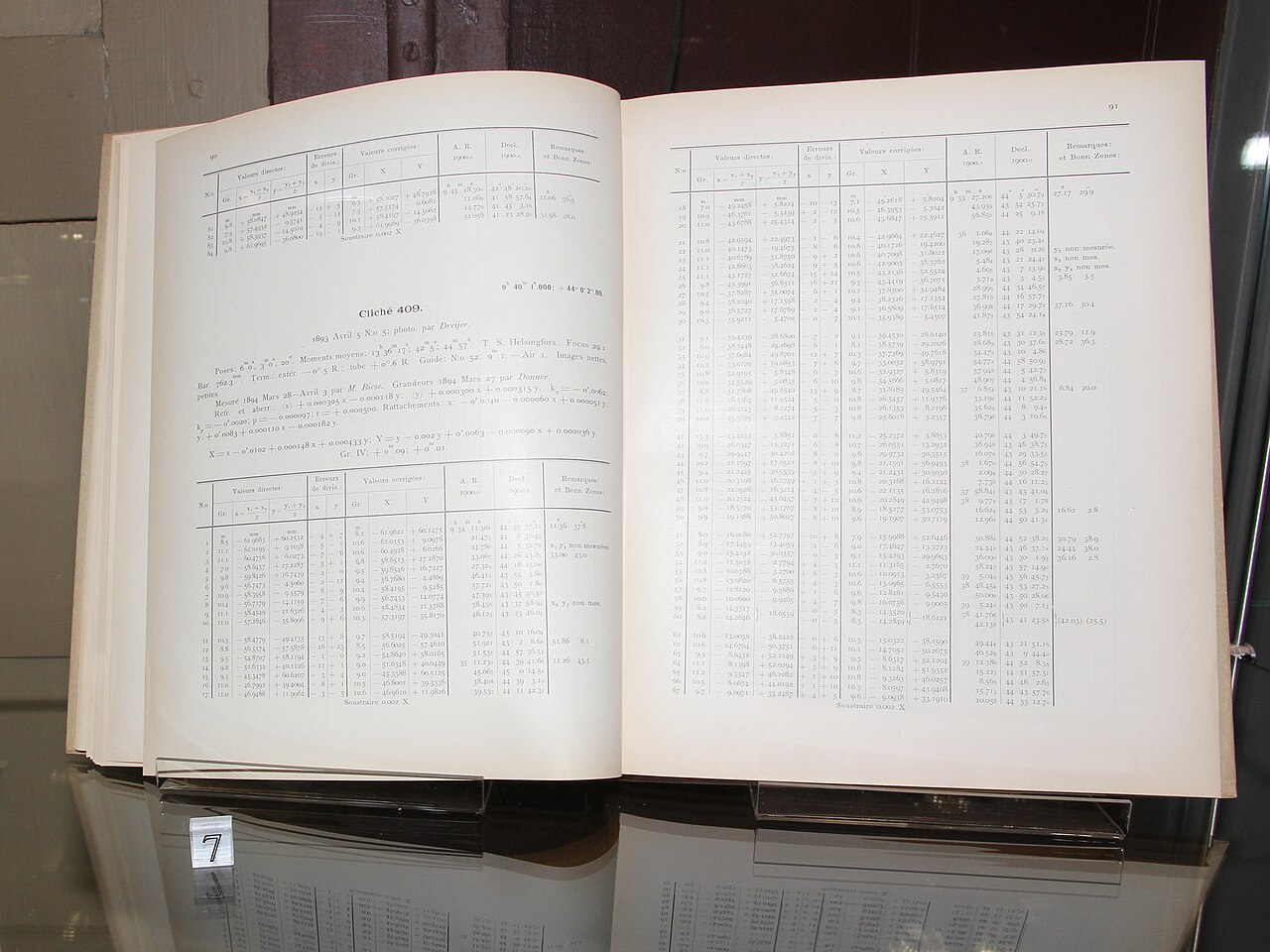
Dreyer, J. L. E. (John Louis Emil), 1852-1926 · Public domain
An astronomical catalogue is a compiled list of celestial objects, usually sorted by shared traits like type, structure, origin, how they were detected, or how they were found. The earliest and most extensive of these are star catalogues, with hundreds created over time. These include general lists as well as specialized ones for infrared stars, variable stars, giant stars, multiple star systems, star clusters, and more. Large general catalogues also exist for deep-sky objects and non-stellar items, alongside specialized versions for nebulas, galaxies, X-ray sources, radio sources, quasars, and other categories. The same holds true for asteroids, comets, and other bodies in the solar system. Some catalogues, like those for asteroids, draw from multiple sources, but most modern ones come from a specific astronomical survey. Since the late 1900s, catalogues have increasingly been generated by computers from automated surveys and distributed as digital files rather than printed on paper.
Some notable catalogues
Ptolemy's Almagest, released in the 2nd century AD, was the leading astronomy reference for more than 1,500 years. It catalogues 1,022 stars with their positions, ecliptic coordinates, and magnitudes, and also details how to build astronomical instruments. Abd al-Rahman al-Sufi's Book of Fixed Stars, from 964, offers detailed descriptions of more than a thousand stars and includes the first known descriptions of the Andromeda Galaxy and the Large Magellanic Cloud. Tycho Brahe finished his catalogue in 1598, listing the positions and magnitudes of 1,004 fixed stars, marking a major advance in astronomy since Ptolemy's time, with significantly improved positional accuracy. Johann Bayer's Uranometria star atlas, published in 1603, contains over 1,200 stars, naming them with a Greek letter and a constellation, such as Alpha Centauri. John Flamsteed's Historia coelestis Britannica star atlas, from 1725, lists stars using numbers with constellation names—like 61 Cygni—ordered by right ascension. The Messier catalogue, first listed by French astronomer Charles Messier in 1771, was published as Nebulae and Star Clusters in 1781, covering objects M1 through M110. The New General Catalogue, or NGC, compiled by J. L. E. Dreyer in the 1880s, includes objects NGC 0001 to NGC 7840 and is one of the largest historical comprehe
- oldest known
- Hipparchus star catalogue (c. 129 BC)
- largest historical comprehensive
- New General Catalogue (NGC, 1880s)
- largest early star catalogue
- Henry Draper Catalogue (1918–1924, over 225,000 stars)
- notable early star atlas
- Johann Bayer's Uranometria (1603, over 1200 stars)
- notable amateur catalogue
- Caldwell catalogue (Sir Patrick Moore, 1995, 109 objects)
- first descriptions of galaxies
- Abd al-Rahman al-Sufi's Book of Fixed Stars (964, Andromeda Galaxy and Large Magellanic Cloud)
Lore & Background
The oldest known star catalogue is the Hipparchus star catalogue, compiled around 129 BC. The most influential early star catalogue is Ptolemy's Almagest, published in the 2nd century AD, which catalogued 1,022 stars along with their positions, ecliptic coordinates, and magnitudes. It remained the most authoritative text on astronomy for over 1500 years and also described the construction of astronomical instruments. In 964, Abd al-Rahman al-Sufi's Book of Fixed Stars described more than a thousand stars in detail and provided the first descriptions of the Andromeda Galaxy and
Reader's Guide
Astronomical catalogues have been foundational to the organization and study of the cosmos, enabling systematic identification and classification of celestial objects. The Messier catalogue, first listed by Charles Messier in 1771 and published in 1781 with objects M1–M110, remains a key reference for amateur and professional astronomers. The New General Catalogue (NGC), compiled by J. L. E. Dreyer in the 1880s, lists objects NGC 0001 through NGC 7840 and is one of the largest historical comprehensive catalogues, including all types of non-stellar deep space objects. The Henry Draper Catalogue (1918–1924) lists more than 225,000 of the brightest stars, using HD followed by a six-digit number. In 1995, Sir Patrick Moore compiled the Caldwell catalogue of 109 bright star clusters, nebulae, and galaxies as a complement to the Messier catalogue for amateur astronomers, though it is a list of deep-sky objects of interest rather than a professional science catalogue. Since the late 20th century, catalogues are increasingly compiled by computers from automated surveys and published as computer files, reflecting a shift from paper-based to digital astronomy.
Did You Know?
- Ptolemy's Almagest, published in the 2nd century AD, remained the most authoritative text on astronomy for over 1500 years.
- Abd al-Rahman al-Sufi's Book of Fixed Stars (964) provided the first descriptions of the Andromeda Galaxy and the Large Magellanic Cloud.
- The Henry Draper Catalogue, published between 1918 and 1924, lists more than 225,000 of the brightest stars.
- The Caldwell catalogue, compiled in 1995 by Sir Patrick Moore, lists 109 bright star clusters, nebulae, and galaxies for amateur astronomers.
Definition and Survey Origins
An astronomical catalogue is fundamentally a structured listing or tabulation of celestial objects. These objects are typically grouped together because they share a common characteristic—whether that be their type, their morphology, their origin, the means by which they were detected, or the method through which they were discovered. The vast majority of these catalogues are the direct product of an astronomical survey of some kind, meaning they represent the organized output of systematic sky observations rather than ad hoc collections. This survey-driven origin gives catalogues a particular character: they are comprehensive within their scope, methodologically consistent, and designed to serve as reference tools for the broader astronomical community. The very act of tabulating objects into a list implies a standardization of how we identify, classify, and record what we see in the sky, transforming raw observational data into a reusable scientific resource.
The Cambridge Radio Survey Legacy
No single series of catalogues illustrates the long-term commitment to systematic sky mapping quite like the Cambridge radio surveys. Beginning with the First Cambridge Catalogue of Radio Sources (designated 1C), the series progressed through the Second (2C), Third (3C and its revised form 3CR), Fourth (4C), Fifth (5C), Sixth (6C), Seventh (7C), Eighth (8C), Ninth (9C), and ultimately the Tenth (10C) Cambridge Survey of Celestial Radio Sources. This unbroken chain of ten numbered catalogues represents decades of incremental refinement in radio astronomy, each edition building upon and expanding the reach of its predecessor. The progression from a single 'catalogue' to a 'survey of celestial radio sources' in the later entries hints at an evolving scope and ambition. Together, these catalogues form one of the most sustained collaborative efforts in the history of astronomical cataloguing, tracking radio-emitting objects across the sky with ever-greater completeness and precision over many years of dedicated observation.
The 2MASS Ecosystem
The Two Micron All Sky Survey (2MASS) stands as a remarkable example of how a single survey can generate an entire family of specialized catalogues. Beyond the primary 2MASS catalogue itself, the survey spawned a prototype release (2MASP), an incremental release (2MASSI), a working database (2MASSW), and an extended source catalogue (2MASX). The survey's output was further mined for specific scientific purposes: the 2MUCD catalogue extracted ultracool dwarfs from the main dataset, while the 2MASS-GC catalogues (specifically 2MASS-GC 01 and 2MASS-GC 02, also known as Hurt 1 and Hurt 2) identified infrared globular clusters. This branching structure demonstrates that a modern astronomical survey is rarely a single deliverable. Instead, it functions as a foundational dataset from which multiple sub-catalogues can be derived, each tailored to a particular class of object or a particular stage in the data processing pipeline. The 2MASS family thus embodies the modern philosophy of cataloguing: one survey, many lenses.
A Mosaic of Individual Contributors
The catalogue entries in the 'A' section alone reveal the extraordinary breadth of individual contributors who have shaped astronomical cataloguing. There are double-star catalogues attributed to figures like Giorgio Abetti, Alvan Clark, Alvan Graham Clark, Harold Lee Alden, H. Ali, R.M. Aller, John August Anderson, Friedrich Wilhelm Argelander, René Baillaud, Paul Baize, and E. E. Barton. Open star cluster catalogues bear the names of Bruno Sampaio Alessi (sometimes in collaboration with Philipp Teutsch), S. P. Apriamasvili, Anna Antalová, Aveni and Hunter, and others. Planetary nebulae are catalogued by Agnès Acker, David Anthony Allen, and Walter Baade. The list extends to peculiar galaxies (Estela L. Agüero, using data from the National Geographic Society–Palomar Observatory Sky Survey), Wolf-Rayet stars in the Small Magellanic Cloud (Azzopardi and Breysacher), and even a listing of all stars within 8 parsecs. This tapestry of personal names attached to specific object types underscores that astronomical cataloguing has long been a deeply individual, collaborative, and internationally distributed enterprise.
Gallery

Frequently Asked Questions
What exactly is an astronomical catalogue?
An astronomical catalogue is a systematic collection of celestial objects organized by shared characteristics such as their type, structure, origin, or detection method. While star catalogues are the oldest and most numerous, these compilations also cover deep-sky objects, nebulas, galaxies, quasars, and various non-stellar sources.
What is the oldest known astronomical catalogue?
The Hipparchus star catalogue, compiled around 129 BC, holds the title of the earliest known list of its kind. It laid the groundwork for centuries of subsequent sky-mapping efforts.
What is the largest general-purpose astronomical catalogue in history?
The New General Catalogue (NGC), published in the 1880s, is the most extensive comprehensive catalogue ever assembled. It encompasses a wide variety of deep-sky objects well beyond just individual stars.
Who put together the Caldwell catalogue and why is it notable?
Sir Patrick Moore created the Caldwell catalogue in 1995, listing 109 objects visible to backyard astronomers. It is celebrated as a standout contribution from the amateur astronomy community rather than a professional observatory.
When were galaxies first described in a star catalogue?
Abd al-Rahman al-Sufi's Book of Fixed Stars, written in 964, contains the earliest known written descriptions of galaxies. He identified both the Andromeda Galaxy and the Large Magellanic Cloud as faint smudges in the night sky.
More in Astronomical catalogues 1-24
Spotted an error? Know more?
This is a living reference — every entry is fact-audited, and reader corrections feed straight into our audit queue. Suggest an edit · See this site's audit record