
Caldwell catalogue
A catalogue of 109 deep-sky objects for amateur astronomers.

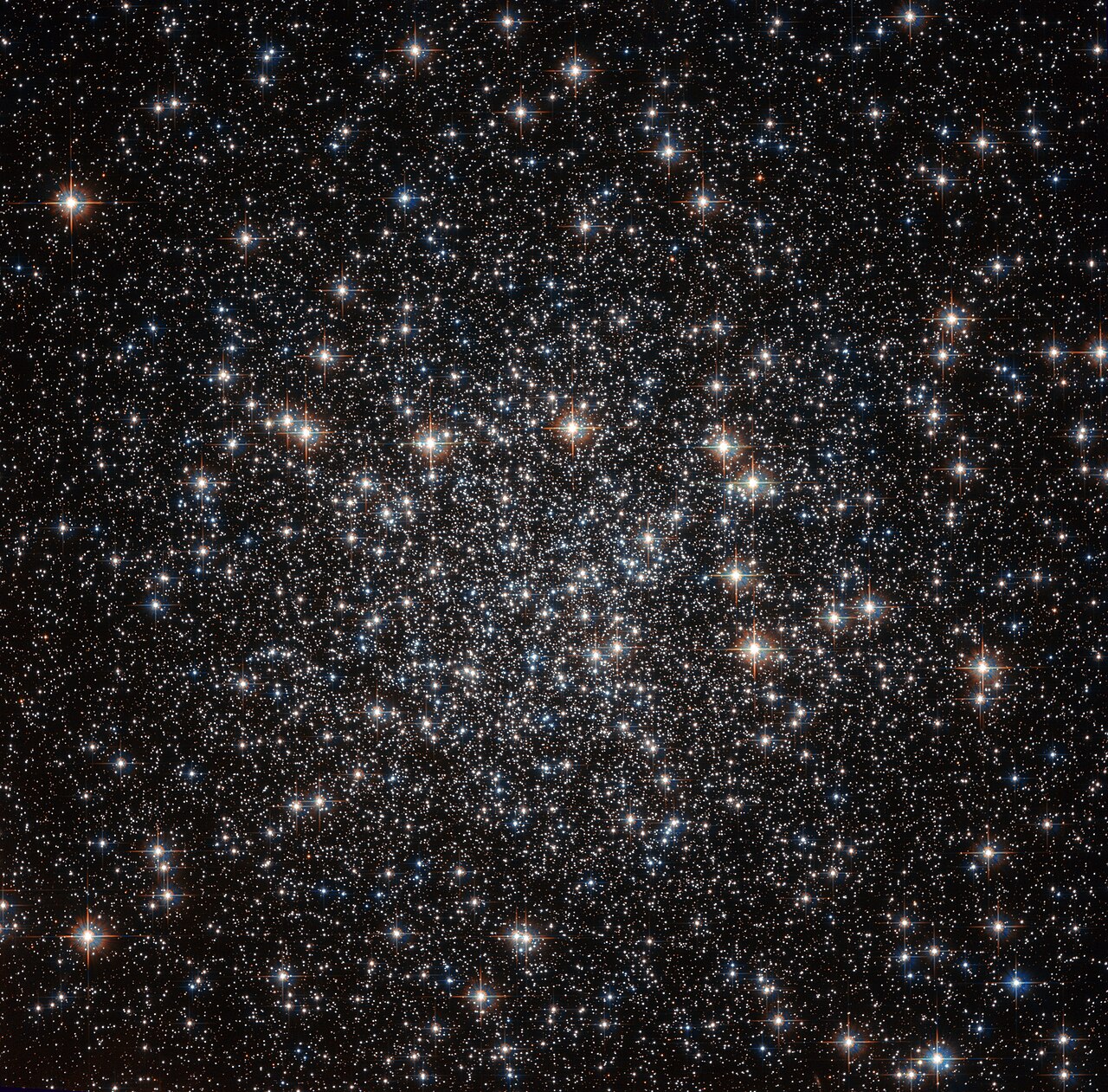
NASA Hubble · CC BY 2.0
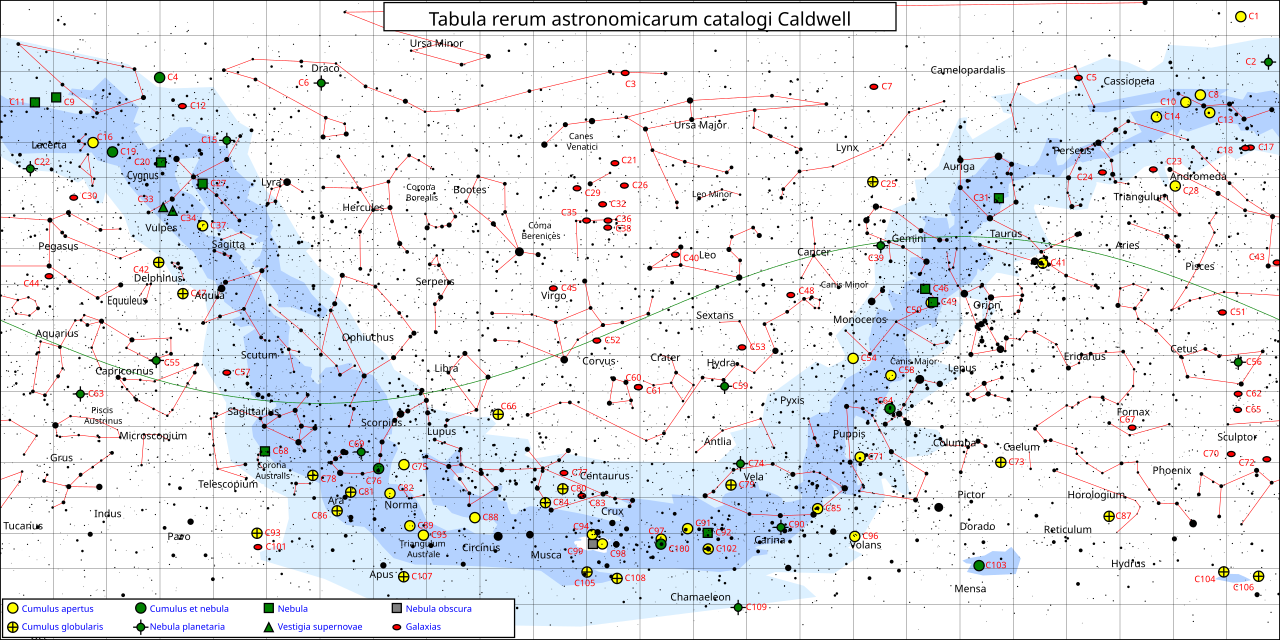
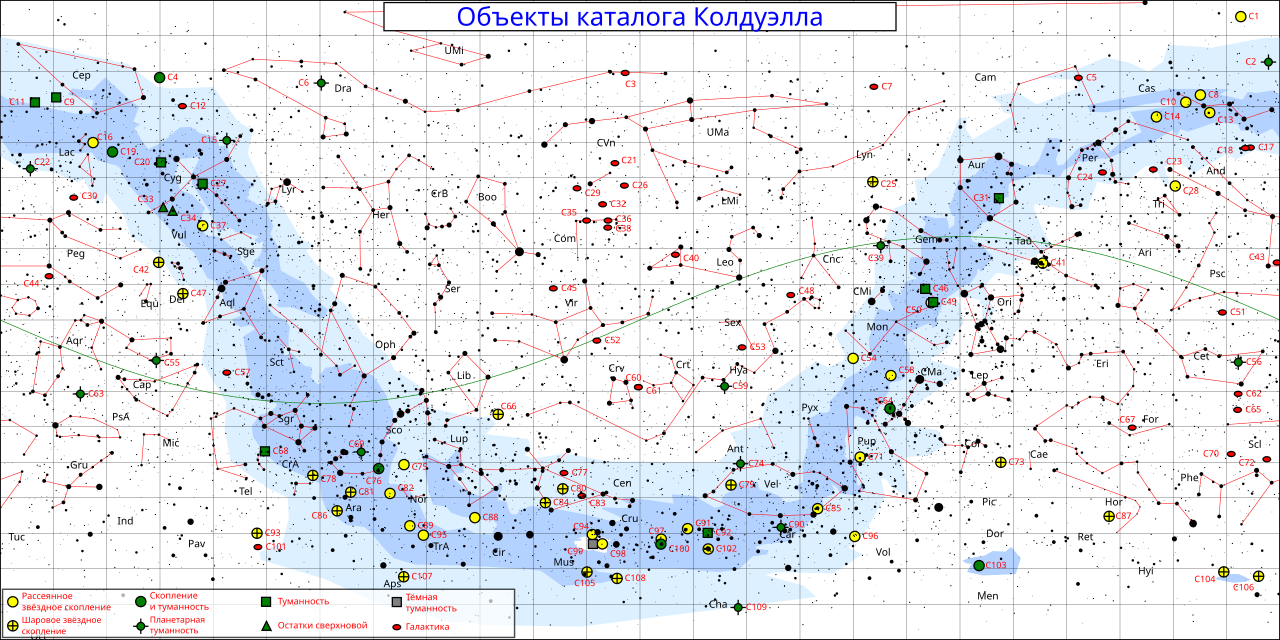
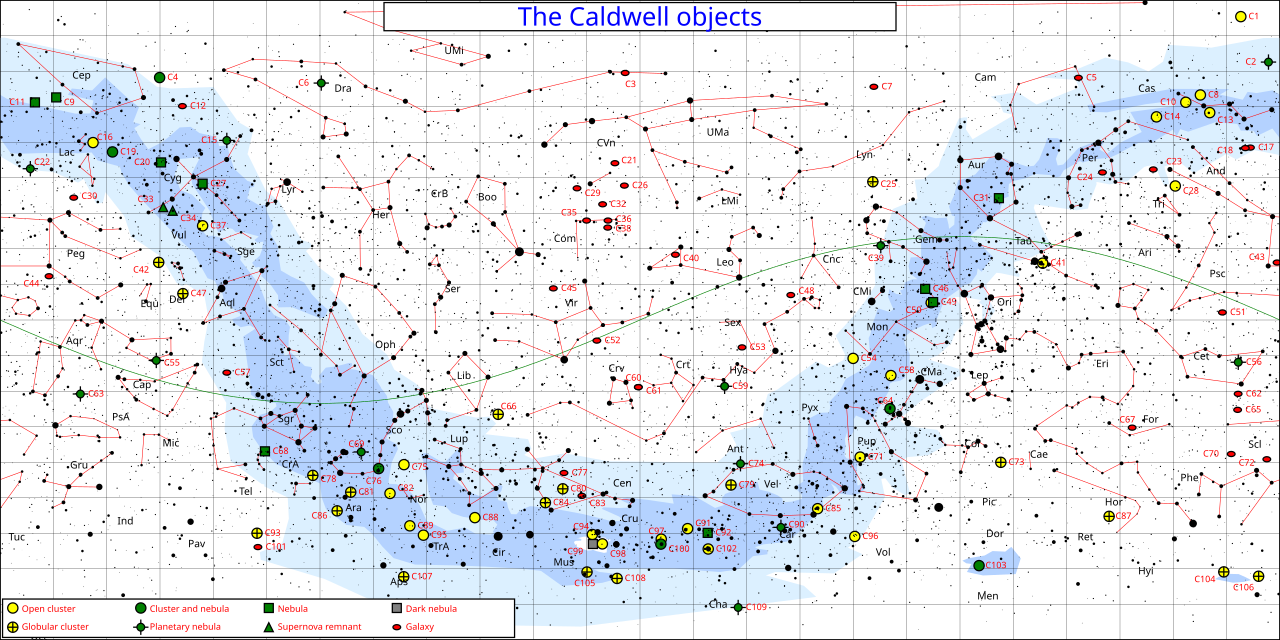
The Caldwell catalogue is an astronomical catalogue of 109 star clusters, nebulae, and galaxies intended for observation by amateur astronomers. It was compiled by Patrick Moore as a complement to the Messier catalogue, using his other surname 'Caldwell' to avoid confusion with the Messier designation. The list was published in Sky & Telescope in December 1995.
- Compiled by
- Patrick Moore
- Number of objects
- 109
- Published in
- Sky & Telescope, December 1995
- Designation prefix
- C
- Ordering
- By declination (north to south)
- Purpose
- Complement to the Messier catalogue
Lore & Background
Patrick Moore noted that the Messier catalogue, while widely used by amateur astronomers, was originally compiled as a list of objects that might be confused with comets, not as an observing list. He observed that Messier's list excluded many bright deep-sky objects, such as the Hyades, the Double Cluster, and the Sculptor Galaxy, and also omitted bright objects visible only from the Southern Hemisphere, like Omega Centauri and 47 Tucanae. Moore deliberately chose 109 objects to avoid matching the commonly accepted number of 110 Messier objects (including M110).
The catalogue is ordered by declination, with C1 being the most northerly and C109 the most southerly, though two objects (NGC 4244 and the Hyades) are listed out of sequence. Errors in the original list have since been corrected: it mislabeled NGC 6087 as the S Norma Cluster and mislabeled the Lambda Centauri Cluster as the Gamma Centauri Cluster.
The Caldwell catalogue has generated controversy. Critics note that Moore did not discover any of the objects, which are often well known and not 'neglected' as claimed. Some argue the 'C' designation is not commonly used and may cause confusion, and that the list is arbitrary, omitting easily viewable objects while including some not readily available to visual observers. Advocates, however, see it as a useful list of bright non-Messier deep-sky objects, dismissing the controversy as fabricated by older amateurs unwilling to learn the new designations, despite many telescope databases using Caldwell IDs since the late 1990s.
Reader's Guide
The Caldwell catalogue serves as a practical extension of the Messier catalogue for amateur astronomers, offering 109 additional deep-sky objects that are among the brightest and best known non-Messier targets. Its ordering by declination makes it convenient for observers at different latitudes, with northern and southern objects clearly separated. Despite controversy over its novelty and the use of 'C' designations, the catalogue has been widely adopted: NASA/Hubble lists the 109 objects by their Caldwell number, and telescope databases have used Caldwell IDs as primary designations since the late 1990s. The catalogue includes a variety of object types—open clusters, globular clusters, dark nebulae, diffuse nebulae, planetary nebulae, supernova remnants, and galaxies—providing a diverse observing program. Its legacy lies in filling gaps left by the Messier catalogue, particularly for southern hemisphere observers, and in encouraging amateur astronomers to explore beyond Messier's original list.
Did You Know?
- The Caldwell catalogue was compiled by Patrick Moore using his other surname 'Caldwell' because the initial 'M' was already used for the Messier catalogue.
- The catalogue is ordered by declination, with C1 being the most northerly object and C109 the most southerly.
- Two objects in the catalogue (NGC 4244 and the Hyades) are listed out of sequence.
- The original list contained errors: it mislabeled NGC 6087 as the S Norma Cluster and mislabeled the Lambda Centauri Cluster as the Gamma Centauri Cluster.
Origin: Filling the Gaps in Messier's List
Patrick Moore created the Caldwell catalogue to address what he saw as significant gaps in the Messier catalogue for amateur stargazers. He pointed out that Messier's original list was never intended as an observation guide—it was actually a record of objects that could be mistaken for comets. Because of this origin, many of the sky's most brilliant deep-sky targets were left out, including the Hyades, the Double Cluster (NGC 869 and NGC 884), and the Sculptor Galaxy (NGC 253). Moore also noted that since Messier worked from Paris, bright objects visible only from the Southern Hemisphere—such as Omega Centauri, Centaurus A, the Jewel Box, and 47 Tucanae—were entirely absent. To fill these gaps, Moore assembled a list of 109 objects, deliberately matching the commonly accepted count of Messier entries (with M110 excluded). The catalogue was published in Sky & Telescope in December 1995.
Structure, Naming, and Corrections
Moore chose the surname "Caldwell" for the catalogue's designation system because the letter "M" was already claimed by the Messier catalogue. Each entry carries a "C" prefix followed by a number from 1 to 109. Unlike the Messier list, which follows the rough order of discovery, the Caldwell catalogue is arranged by declination, with C1 representing the most northerly object and C109 the most southerly. Two exceptions exist: NGC 4244 and the Hyades appear out of strict declination order. The original publication also contained a couple of identification errors—the S Norma Cluster (NGC 6087) was mistakenly listed as NGC 6067, and the Lambda Centauri Cluster (IC 2944) was incorrectly labelled as the Gamma Centauri Cluster. Both mistakes have since been corrected. The catalogue spans a diverse range of deep-sky types, including open clusters, globular clusters, dark nebulae, diffuse nebulae, planetary nebulae, supernova remnants, and galaxies.
Controversy Within the Amateur Community
The Caldwell catalogue has sparked ongoing debate within the amateur astronomy community. Critics argue that Moore did not discover any of the objects himself and that many are already well-known targets rather than neglected ones, as Moore suggested. Others take issue with presenting the list as a formal catalogue with distinct designations, fearing the "C" numbering could confuse observers unfamiliar with the system. A further criticism is that the selection feels arbitrary—some easily visible objects are omitted while others that are difficult for visual observation are included, despite the catalogue being pitched as a Messier companion. Advocates, however, counter that the list serves as a practical guide to the brightest non-Messier deep-sky objects. They dismiss the controversy as resistance from older amateurs unwilling to learn new designations, pointing out that every major telescope database has used Caldwell IDs as a primary designation since the late 1990s, and even NASA's Hubble Space Telescope references the 109 objects by their Caldwell numbers.
Legacy and Widespread Adoption
Despite the initial controversy, the Caldwell catalogue has become deeply embedded in the tools and resources available to amateur astronomers. Since the late 1990s, virtually every telescope database has incorporated Caldwell designations as a primary identifier, making the "C" numbering a standard reference point for observers worldwide. NASA's Hubble Space Telescope also lists all 109 objects by their Caldwell number, lending the catalogue institutional credibility far beyond the amateur community. The catalogue sits alongside other major deep-sky references such as the Messier Catalogue, the Herschel 400 Catalogue, the New General Catalogue (NGC), the Index Catalogue (IC), and their revised counterparts (RNGC and RIC). Online resources further extend its reach, with searchable lists, clickable object tables, star charts, and dedicated clubs like the Caldwell Club providing images and observation guides. What began as Moore's personal attempt to give stargazers a more complete target list has evolved into a widely recognized shorthand for some of the most rewarding deep-sky objects outside the traditional Messier set.
Gallery


Frequently Asked Questions
Who put together the Caldwell catalogue?
Patrick Moore, the British astronomer and television presenter, compiled the list. He deliberately used his less common surname 'Caldwell' for the designation prefix so the objects would not be mistaken for Messier entries.
How many objects are in the Caldwell catalogue and what kinds are they?
The catalogue contains 109 deep-sky targets, spanning star clusters, nebulae, and galaxies. Each one is labelled with the letter C followed by a number, for example C 39 or C 109.
Why did Moore create the Caldwell catalogue in the first place?
His aim was to give amateur observers a handy set of additional deep-sky targets that sit alongside, rather than duplicate, the classic Messier list. The objects were chosen with modest backyard telescopes in mind.
How are the 109 Caldwell objects ordered?
The list is sorted by declination, running from the northernmost object down to the southernmost. This north-to-south arrangement lets observers work through the catalogue region by region instead of jumping around the sky.
Where and when was the Caldwell catalogue first published?
Patrick Moore released the full list in the magazine Sky & Telescope in December 1995. It quickly became a go-to companion reference for amateur astronomers looking to go beyond the Messier 110.
More in Astronomical catalogues 1-24
Spotted an error? Know more?
This is a living reference — every entry is fact-audited, and reader corrections feed straight into our audit queue. Suggest an edit · See this site's audit record