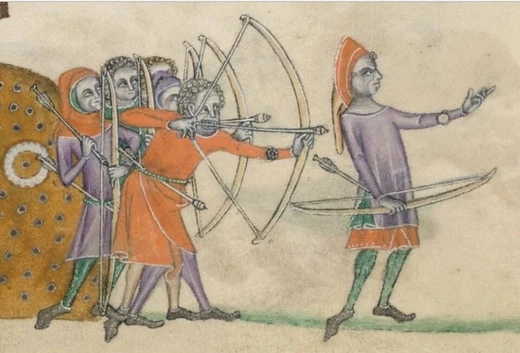
Vijaya (bow)
A divine bow granting invincibility to its wielder.

Helppublic · CC BY-SA 4.0
Vijaya, also known as Vijaya Dhanusha, is a divine bow in Hindu tradition. It was created by Vishvakarma, the celestial architect, for Shiva to use in destroying the three asura cities of Tripura during the Tripura war. After the cities were destroyed, Shiva kept the bow, later passing it to Indra, then to Parashurama, and finally to Karna. The bow is said to grant its wielder invincibility as long as they hold it.
In the Mahabharata, two distinct divine bows named Vijaya appear, associated with Karna and Rukmi. Karna's Vijaya is the supreme divine bow crafted by Vishvakarma for Shiva (and later held by Indra and Parashurama). Rukmi's Vijaya is a celestial bow he obtained from a Kimpurusha named Druma; it was originally made by Vishvakarma for Indra during a war against the asuras. Karna used his Vijaya bow only on the 17th day of the Kurukshetra War, during his final battle with Arjuna.
Quick Facts
- Used By
- Shiva / Indra / Karna / Parashurama
- Designer
- Vishvakarma
Facts from the source article.
Lore & Background
The Vijaya bow was crafted by Vishvakarma for Shiva, to be used in destroying the three asura cities of Tripura during the Tripura war. After the cities were destroyed, the bow remained with Shiva, who later passed it to Indra, then to Parashurama, and finally to Karna. The bow is said to grant its user invincibility as long as they hold it.
In the Mahabharata, both Karna and Rukmi are associated with a divine bow named Vijaya, though they represent distinct instances of divine weaponry. Karna's Vijaya bow was the supreme, divine bow crafted by Vishvakarma for Shiva (later Indra/Parashurama). Rukmi's Vijaya bow was a celestial bow obtained from a Kimpurusha named Druma, and was specially made by Vishvakarma for Indra during his war on asuras.
Karna used his Vijaya bow only on the 17th day of the Kurukshetra War, during his last battle with Arjuna.
Reader's Guide
The Vijaya bow holds significance as a weapon of divine origin, crafted by Vishvakarma for a specific cosmic purpose—the destruction of the three asura cities of Tripura. Its passage through the hands of major deities and heroes—Shiva, Indra, Parashurama, and Karna—marks it as a symbol of supreme martial power and divine favor. The bow's property of granting invincibility to its wielder underscores its legendary status. The existence of two distinct Vijaya bows in the Mahabharata—one wielded by Karna and another by Rukmi—illustrates the complexity of divine weaponry in Hindu tradition, where similar names may refer to different items with separate origins. Karna's use of the bow only on the final day of his life emphasizes its role as a weapon of last resort and ultimate confrontation. The bow is often compared to other divine bows such as Gandiva, Sharanga, and Pinaka, each associated with different heroes and gods, highlighting the rich tapestry of celestial armaments in Hindu mythology.
Divine Birth and a Luminous Identity
Arjuna occupies a singular position among the five Pandava brothers as the third-born and the one most widely celebrated for his distinction. His parentage is extraordinary: he is the offspring of Kunti, wife of King Pandu of the Kuru dynasty, and Indra, the sovereign of the gods. This divine lineage marks him as a hero of celestial origin, setting him apart in the epic's pantheon of warriors. His very name, drawn from Sanskrit roots meaning white, clear, or silver, evokes a luminous quality that permeates his character. He carries an extensive catalogue of epithets reflecting every facet of his identity—Vijaya for his invincibility, Savyasāchī for his ambidextrous mastery of the bow, Kirīṭī for the celestial diadem bestowed upon him by Indra himself, and Gāṇḍīvadhārī for his possession of the famed celestial bow Gandiva. Other names anchor him to his maternal and paternal lines: Pārtha, Kaunteya, Pāṇḍuputra. He was also born under the star Uttara Phalguni, earning the name Phālguṇa. This web of names and titles paints a portrait of a figure who is simultaneously mortal and divine, a warrior and a devotee, woven into the very fabric of Hindu cosmological storytelling.
Martial Mastery and a Code of Honour
From his earliest years under the tutelage of the warrior-sage Drona, Arjuna distinguished himself as an exceptional student of archery and celestial weaponry. His skill was so complete that he could draw and release arrows with equal precision from either hand, a trait captured in the epithet Savyasāchī. His exploits span the breadth of the epic: he won Draupadi's hand by excelling in her Swayamvar, subjugated numerous kingdoms to secure his elder brother Yudhishthira's sovereignty, and set fire to the forest of Khandavaprastha. During his period of exile, he journeyed to acquire divine weapons and earned the favour of Shiva himself. In the Kurukshetra War, wielding the celestial bow Gandiva, he proved instrumental in bringing down formidable opponents including Bhishma and Karna. Beyond combat, his versatility extended to music and dance, which he leveraged to disguise himself as a eunuch instructor to Princess Uttarā of Matsya during his final year of exile—a ruse that coexisted with his defeat of the entire Kuru army. His martial code was one of fairness and style; the epithet Bībhatsu underscores that he fought wars in a terrific yet honourable manner, never resorting to anything deemed horrible.
The Moral Crisis and the Bhagavad Gita
Perhaps the most defining moment in Arjuna's narrative occurs not on the battlefield but in the silence before it. Standing on the plains of Kurukshetra, he is confronted with a devastating sight: his own relatives, revered teachers, and beloved kin arrayed on the opposing Kaurava side. The warrior who has conquered sleep, who has felled kings and armies, is brought to a paralytic halt by the prospect of killing those he loves. In this moment of profound demoralisation, he turns to Krishna, who serves as his charioteer and spiritual guide. Krishna's response becomes the Bhagavad Gita—a discourse on dharma, karma, and liberation through devotion that reshapes Arjuna's understanding of his duty as a warrior. The culmination of this spiritual revelation is the granting of the Vishvarupa, a vision of Krishna's cosmic divine form that transcends mortal perception. This episode elevates Arjuna beyond the role of a mere fighter; he becomes the interlocutor through whom one of Hinduism's most central philosophical scriptures is delivered, binding his identity inseparably to the Krishna-centric Vaishnava tradition.
Legacy, Worship, and Cultural Resonance
Arjuna's influence extends far beyond the pages of the Mahabharata. He stands as an enduring epitome of heroism, chivalry, and devotion within the Hindu tradition, holding a particularly prominent place in the Krishna-centric Vaishnava sect owing to his pivotal role in the Bhagavad Gita. His worship is referenced in remarkably early sources: the Aṣṭādhyāyī, likely composed in the fifth or sixth century BCE, mentions his veneration alongside Vasudeva-Krishna, suggesting his devotional significance predates many later literary developments. The Puranas and a vast array of regional and folk traditions across India and Indonesia continue to carry his story forward. His narrative has inspired countless works of art, performance, and secondary literature over the centuries. Even his personal legacy endures through his descendants—the Kuru dynasty continues through his grandson Parikshit. The Mahabharata itself, a composite Sanskrit work whose oldest surviving portions may date to around 400 BCE, exists in numerous manuscript traditions with significant regional variations, yet Arjuna's core identity as the most distinguished Pandava, the divine-born archer, and the recipient of the Gita remains remarkably consistent across recensions.
Gallery




Frequently Asked Questions
What is the Vijaya bow?
Vijaya, also called Vijaya Dhanusha, is a divine celestial bow in Hindu mythology. It was forged by the architect-god Vishvakarma specifically for Shiva to use in the Tripura war against the three asura cities.
Who created the Vijaya bow and for what purpose?
The celestial architect Vishvakarma crafted the bow as a dedicated weapon for Shiva. Its intended purpose was to destroy the three asura cities of Tripura during the great Tripura war.
What power does the Vijaya bow grant its wielder?
As long as a person holds the Vijaya, they are granted invincibility in battle. This property made the bow one of the most coveted weapons in Hindu mythological tradition.
Who are the notable wielders of the Vijaya bow?
After Shiva used it in the Tripura war, the bow passed to Indra, then to the warrior-sage Parashurama, and ultimately to Karna. Each of these figures is a legendary powerhouse in Hindu epic tradition.
What role does the Vijaya bow play in the Mahabharata?
In the Mahabharata, Karna wields the Vijaya as his supreme weapon, and its invincibility-granting nature makes him a nearly unbeatable opponent on the battlefield. The bow's divine lineage from Shiva through multiple legendary hands adds to its mythic weight in the epic.
More in Archery, Part 3 1-15
Spotted an error? Know more?
Reader corrections go straight into our review queue. Suggest an edit · How this site is sourced