Fred Bear
Pioneering bow hunter and founder of Bear Archery.

Frederick Gokliz · Public domain
Fred Bear (March 5, 1902 – April 27, 1988) was an American bow hunter and the founder of Bear Archery. He didn't take up bow hunting until age 29, and it took him years to get good at it, but he's still considered a pioneer in the sport. He also traveled the world, made films, and produced hunting content.
Bear was born on a farm in Franklin County, Pennsylvania, the second of three kids, with English, Dutch, Swiss, and German roots. Before archery, he worked as a glue maker at Chrysler in Detroit and as a wood carver at Ford, building radio cabinets and dashboards. During the Great Depression, from 1929 to 1933, he ran a plant that burned down, leaving him jobless. With a former coworker named Chuck, he scraped together $1,200 and started his bow business in a garage—that was Bear Archery, founded in 1933.
In 1947, Bear and his wife moved to Grayling, Michigan, living in a tent by a river to save money while building the business. Even into 1961, money was tight. But as more states allowed bow hunting and the sport grew, things turned around. His interest in bow hunting was sparked by Art Young of the Pope and Young Club, whom Bear met in Michigan in the late 1920s and called his hero. His first bow trophy was a Michigan whitetail deer taken in 1935. Over the years, he hunted around the world, spoke to thousands of bow hunters, and appeared on TV shows like *Arthur Godfrey and His Friends*, *The American Sportsman*, and *The Tonight Show*. He also made hunting films and wrote for magazines like *Outdoor Life* and *Archery Magazine*.
Bear sold a controlling stake in his company in 1968 but stayed on as chairman. After a strike and ongoing labor issues in 1978, the manufacturing moved to Gainesville, Florida. Later in life, he had chronic emphysema. He suffered a heart attack in Florida, spent a month in a Gainesville hospital, and died from another heart attack on April 27, 1988. His body was cremated, and his ashes were spread near the Au Sable River in northern Lower Michigan, where he liked to fly fish.
Bear filed for a patent on April 21, 1950, and on January 12, 1954, he received Patent 2,665,678 for the Composite Archery Bow. He was immortalized in the song "Fred Bear" by Ted Nugent on the album *Spirit of the Wild*—Nugent was a friend. Grayling, Michigan, was Bear's home and the base of Bear Archery.
Quick Facts
- Birth Date
- 1902-03-05
- Birth Place
- Waynesboro, Pennsylvania, U.S.
- Death Date
- 1988-04-27
- Death Place
- Gainesville, Florida, U.S.
- Occupation
- Bow hunter, bowyer
Facts from the source article.
Lore & Background
Fred Bear was born in a farmhouse in Franklin County, Pennsylvania, the second of three children, with English, Dutch, Swiss and German heritage. He worked as a glue maker for Chrysler and as a wood carver for Ford Motor Company, making cabinets for radios and dashboards. During the Great Depression, he operated a plant from 1929 to 1933 that caught fire, leaving him unemployed. With a partner named Chuck, they pooled $1,200 to open a bow business in a garage, founding Bear Archery in 1933.
Bear's interest in bowhunting was stimulated by Art Young of the Pope and Young Club, whom Bear met in Michigan in the late 1920s and often called his hero. In 1947, Bear and his wife moved to Grayling, Michigan, living in a tent along a river to keep expenses low while building the business. Even as late as 1961, it was difficult making ends meet, but prosperity followed as more states permitted bow hunting. Bear traveled the world with his bow, appeared on television programs including Arthur Godfrey and His Friends, The American Sportsman, and The Tonight Show, produced films of bowhunting, and contributed articles to Outdoor Life and Archery Magazine.
Bear sold controlling interest in his company in 1968 but remained chairman. In 1978, after a strike and continuing labor problems, Bear Archery manufacturing relocated to Gainesville, Florida. Bear struggled with chronic emphysema and suffered a heart attack while living in Florida; he died after another heart attack on April 27, 1988. His body was cremated and his ashes spread near the Au Sable River in Northern Lower Michigan, where he liked to flyfish.
Reader's Guide
Fred Bear's legacy is preserved through multiple memorials and institutions. He was inducted into the Bowhunters Hall of Fame. The Fred Bear Museum originated in Grayling, Michigan in 1967, eventually becoming the largest privately held collection of archery artifacts in the world. The museum moved to Gainesville in 1985 and closed in 2003, with its collections sold to Bass Pro Shops. Artifacts were later incorporated into the Archery Hall of Fame and Museum at the Bass Pro Shop Outdoor World in Springfield, Missouri. Bear has been immortalized in the song 'Fred Bear' from the album Spirit of the Wild by Ted Nugent. Since 1999, Fred Bear Day is celebrated annually on March 5th in Grayling, Michigan, featuring a 21 Whistling Arrow Salute, trade show, and luncheon. A 7-foot bronze statue of Fred Bear is set to be erected in Grayling City Park on September 7, 2024, created by artist Ben Watts, who also made an 11-foot statue of Bear at the Wonders of Wildlife Museum in Springfield. Bear was also the first president of Michigan's oldest archery club, Detroit Archers, where a small collection of his memorabilia is housed, including a polar bear skin shot with an arrow that was stolen in 2006.
Did You Know?
- Fred Bear did not start bow hunting until age 29 and did not master the skill for many years.
- He applied for a patent on the Composite Archery Bow on April 21, 1950, which was issued on January 12, 1954.
- His first bowhunting trophy was a Michigan whitetail taken in 1935.
- A polar bear skin shot by Fred Bear was stolen from the Detroit Archers clubhouse in 2006; the case remains unsolved.
The Deep Roots of the Bow
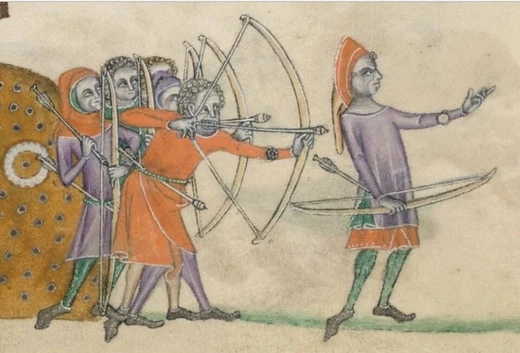
The discipline that Fred Bear devoted his life to traces its origins back roughly seventy thousand years, likely to the later Middle Stone Age in Africa. The earliest physical evidence of arrow technology surfaces in the Obi-Rakhmat Grotto in Uzbekistan, where bladelets and micro-points dating to around eighty thousand years ago show impact fractures consistent with projectile use. These tiny points, too large for blowgun darts, were probably attached to shafts with locally sourced bitumen. In South Africa's Sibudu Cave, probable arrowheads from seventy-two to sixty thousand years ago carry traces suggesting the application of poisons. Small stone points from France's Mandrin Cave, used some fifty-four thousand years ago, are so diminutive—under ten millimeters at the base—that they could serve no practical purpose other than as arrowheads. By forty-eight thousand years ago, archery in Sri Lanka's Fa Hien Cave was already tuned to hunting monkeys and squirrels, with bone points found alongside the remains of those very animals. This staggering depth of history underscores that the bow is not a modern invention but one of humanity's oldest engineered tools.
Archers on the Battlefield
For millennia, the bow was not merely a hunting tool but a central instrument of war. In the classical period, archers served as a widespread though supplemental component of armies, deploying on foot, in chariots, or mounted on horseback. The craft reached its most celebrated military peak in later medieval Europe, where the longbow's devastating reach at engagements like Agincourt became embedded in the continent's military mythology. Even in prehistoric times, the bow was a weapon of interpersonal violence: Neolithic European fortifications, recovered arrowheads, skeletal injuries, and artistic representations all point to archery as a dominant form of combat. The Beaker culture is defined in part by stone wrist-guards—likely display versions of bracers—and arrowheads regularly appear in their burial mounds. The oldest known depictions of organized combat, found in Iberian Mesolithic cave art, show nothing but archers: at Cueva del Roure, three bowmen are encircled by four; at Les Dogue, eleven are attacked by seventeen running opponents; and at Val del Charco del Agua Amarga, seven plumed archers flee before eight pursuers. These images remind us that the bow defined warfare long before firearms rendered it obsolete.
From Weapon to Sport
The bow's dominance in warfare was gradually dismantled by the rise of gunpowder technology. In Europe, the transition from archery to firearms began in the Late Middle Ages and accelerated through the early modern period. The Gunpowder empires then carried repeating firearms across Eurasia, steadily diminishing the bow's military relevance on every continent. By the close of the nineteenth century, repeating firearms had made the bow and arrow functionally obsolete as a weapon of war, though the combination persisted in hunting contexts. What survived this military displacement was the discipline itself—reframed as a target sport and a recreational pursuit. Today, archery endures as both a competitive sport and a hunting practice, a far cry from the battlefield role that defined it for thousands of years. The figures who take up the bow in modern ranges and forests are, in a very real sense, continuing a tradition that stretches back tens of thousands of years, long before the first gunpowder charge was fired. The sport preserves the physical and mental demands of a craft that once decided the outcomes of wars and fed entire civilizations.
The Material Heritage of the Bow
The physical artifacts recovered from archaeological sites reveal the extraordinary ingenuity behind early bow and arrow construction. In Denmark's Holmegaard swamp, two complete bows dating to roughly eight thousand years ago were unearthed in the 1940s. Crafted from elm, they feature flat arms, a D-shaped midsection with a biconvex center, and measure one and a half meters in length. Bows of this type remained in use until the Bronze Age, though the midsection's convexity gradually decreased over time. In Spain's La Draga lake settlement, the oldest Neolithic bow from Europe was found in anaerobic layers between seven thousand four hundred and seven thousand two hundred years before present. This intact specimen, just over a meter long, is made of yew wood with a D-shaped cross-section. In Germany's Stellmoor site, late Paleolithic arrows made of pine featured a main shaft and a fifteen-to-twenty-centimeter flint-tipped foreshaft, with shallow grooves at the base confirming bow use. Mesolithic pointed shafts found across England, Germany, Denmark, and Sweden reached up to four feet in length, fashioned from hazel, wayfaring tree, and other small woody shoots, some still bearing flint heads or blunt wooden tips for bird hunting, with fletching secured by birch tar.
Gallery


Frequently Asked Questions
Who is Fred Bear?
Fred Bear was an American bow hunter, manufacturer, and film producer who became one of the most recognized names in the archery world. He founded Bear Archery in 1933 and helped bring bow hunting into the mainstream through his global travels, films, and hunting content.
When did Fred Bear take up bow hunting?
Bear didn't start bow hunting until he was 29 years old, and it took him several years of practice before he became skilled. Despite this late start, he is still widely regarded as a pioneer of the sport.
What company did Fred Bear found?
He established Bear Archery in 1933, a company that went on to become one of the most well-known names in bow manufacturing. He also held a U.S. patent for a composite archery bow issued in January 1954.
What was Fred Bear's first bowhunting trophy?
His first bowhunting kill was a Michigan whitetail deer in 1935. That early success helped cement his commitment to the sport after years of learning.
What did Fred Bear do before getting into archery?
Before archery, he worked as a glue maker at Chrysler in Detroit and later as a wood carver at Ford, building radio cabinets and dashboards. He grew up on a farm in Franklin County, Pennsylvania, and that hands-on workshop experience likely informed his later bow-building work.
More in Archery, Part 3 1-15
Spotted an error? Know more?
Reader corrections go straight into our review queue. Suggest an edit · How this site is sourced