Ceratopteris
The only exclusively aquatic homosporous fern genus.

Ceratopteris is the only genus of homosporous ferns that lives entirely in water. It is found throughout the tropics and belongs to the subfamily Parkerioideae within the family Pteridaceae. These are moderate-sized, erect aquatic or subaquatic ferns with a short, fleshy rhizome that can be horizontal or ascending, either loosely rooted in mud or partly floating. The young parts have thin, ovate, somewhat heart-shaped, clathrate scales. The fronds have fleshy stalks with many longitudinal air canals; the sterile fronds are spreading and 2–3-pinnatifid with broad membranous lobes and net-like veins, often producing buds in the leaf axils. Fertile fronds are taller, narrower, and more divided, with the lobes curled back to cover the upper surface. Sporangia are solitary, scattered along the veins, without an indusium but protected by the rolled leaf margin; they have a broad, irregular annulus of 30–70 thickened cells (or none) and contain 16 to 32 spores. The spores are large, trilete, and ribbed with irregular long meshes.
Taxonomically, Ceratopteris was once placed in its own family, Parkeriaceae, due to its aquatic adaptations, but genetic analysis now places it with *Acrostichum* in the subfamily Parkerioideae. Some authorities once recognized only one species; others now recognize four. Recent work by Masuyama and Watano suggests that *C. thalictroides* actually comprises four cryptic species: *thalictroides*, *froesii*, *gaudichaudii*, and *oblongibloba*.
The genus contains four to six species and is widespread in humid tropical regions. It is an important model organism in pteridophyte research and genomic studies because it grows easily and quickly in the lab and has well-characterized traits; patented strains exist.
In *Ceratopteris thalictroides*, the haploid gametophyte comes in two sexual types: hermaphrodite (with both archegonia and a few antheridia) and male (with only antheridia). When *C. richardii* grows alone, it develops into a hermaphrodite. But if it grows near established genetically identical individuals, it becomes male. The hermaphrodite releases a pheromone (antheridiogen) that tells nearby plants to become male, promoting outcrossing. Self-fertilization happens when no partner is nearby.
The plants may have carcinogenic properties.
Quick Facts
- Taxon
- Ceratopteris
- Type Species
- Ceratopteris thalictroides
- Type Species Authority
- (L.) Brongn.
Facts from the source article.
Lore & Background
Ceratopteris was long placed in the monogeneric family Parkeriaceae, thought to be unique because of its aquatic adaptations. However, recent genetic analysis has shown it to be clearly allied with Acrostichum in the subfamily Parkerioideae, within the family Pteridaceae. At one time, some authorities recognized only one species; now some authorities recognize only four species. Recent work by Masuyama and Watano has suggested that C. thalictroides actually consists of four cryptic species (thalictroides, froesii, gaudichaudii, oblongibloba).
The plants are erect aquatic or subaquatic ferns of moderate size, with a short, fleshy rhizome that is horizontal and ascending to erect, loosely rooted in mud or floating. Fronds are dimorphic: sterile fronds are spreading and 2–3-pinnatifid with broad membranous lobes, while fertile fronds are erect, longer, narrower, and more divided, with strongly recurved lobes. Sporangia are solitary, scattered along the veins, exindusiate but protected by the continuous reflexed margin of the lamina. Spores are large, trilete, and ribbed with irregular long meshes.
Ceratopteris thalictroides has two types of gametophytes with different sexual expression: hermaphrodite and male. Hermaphroditic gametophytes have one or several archegonia and a few antheridia. When Ceratopteris richardii ferns are grown alone they develop into hermaphrodites, but plants that grow near established genetically identical individuals develop into males. The hermaphrodite secretes a pheromone (antheridiogen) that tells others nearby to be male, promoting outcrossing.
Reader's Guide
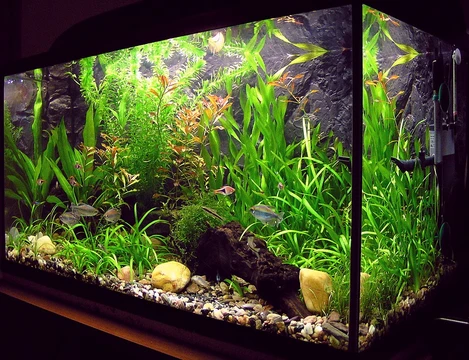
Ceratopteris is significant both as a model organism and as a practical aquarium plant. It is a commonly used model organism for genomic studies due to the ease and rapidity with which it can be grown in laboratories, as well as having well-characterized phenotypes. Patented strains of this plant have been developed. In the aquarium trade, it is often sold under the name 'water sprite' and may be grown as an emersed but natant (floating) plant, or as an immersed plant rooted in the substrate. Under bright light the plants can grow fast and be used to help cycle an aquarium. The plant is also used as a vegetable, particularly in Asia. The article notes that the plants may have carcinogenic properties. Its taxonomic history reflects a shift from placement in the monogeneric family Parkeriaceae to inclusion in the Pteridaceae based on genetic analysis, and species delimitation remains debated, with cryptic species recognized within C. thalictroides.
Did You Know?
- Ceratopteris is the only genus among homosporous ferns that is exclusively aquatic.
- The gametophyte of Ceratopteris is haploid, while the sporophyte is diploid.
- Ceratopteris richardii secretes a pheromone (antheridiogen) that causes nearby genetically identical individuals to develop as males.
More in Aquarium and Aquatic Plants 1-24
Spotted an error? Know more?
Reader corrections go straight into our review queue. Suggest an edit · How this site is sourced