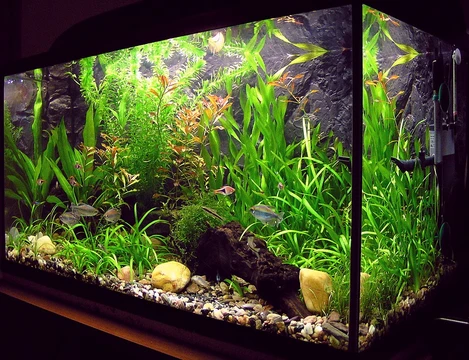
Cryptocoryne
A genus of aquatic plants known as water trumpets or Crypts.

Cryptocoryne is a genus of aquatic plants from the family Araceae, naturally distributed in tropical regions of India, Southeast Asia and New Guinea. Commonly referred to as Crypts by aquarium hobbyists, the English common name 'water trumpet' refers to their inflorescence—a spadix enclosed by a spathe—which resembles a trumpet. The genus is notable for its popularity in the aquarium hobby, with some species being very hardy and easy to grow, while others are difficult and cultivated only by dedicated experts.
Quick Facts
- Taxon
- Cryptocoryne
Facts from the source article.
Lore & Background
The first Cryptocoryne species was described in 1779 as Arum spirale by Retzius, and the genus was described by Friedrich Ernst Ludwig von Fischer in 1828. However, the scientific classification of Cryptocoryne species remains controversial. The name Cryptocoryne is derived from the Greek crypto, meaning hidden, and koryne, meaning club. The genus is closely related to Lagenandra; the two can be easily told apart since Cryptocoryne leaves exhibit convolute vernation whereas Lagenandra species exhibit involute vernation.
Cryptocoryne plants have been in cultivation in the aquarium hobby since the late 18th century, although it was not until the 1960s that more than a handful of species became known and more common in the hobby. New species still regularly crop up as interest widens and more collecting expeditions by private parties are carried out. Some species are endangered because their natural habitats are disappearing, while others, such as Cryptocoryne beckettii, are very hardy and have become invasive after being introduced in Florida.
Reader's Guide
Cryptocoryne species are popular commercially cultivated aquarium plants. Submerged plants reproduce vegetatively, while emerse plants may flower and reproduce sexually. Many species are cultivated only by dedicated experts and are very hard to grow, or are not present in culture at all. Some species are endangered because their natural habitats are disappearing. On the other hand, some water trumpets, such as Cryptocoryne beckettii, are very hardy aquarium plants, easy to grow to the point that they have become an invasive species after being introduced in Florida in North America.
Cryptocoryne is either found in peat bogs or on limestone; the latter do well in most aquaria, the former must have soft water to survive and need decomposing leaf litter to do well. Hardwater Cryptocorynes are generally the easier ones to keep; some species, such as Cryptocoryne wendtii, are said to be among the most versatile of aquarium plants, tolerating low or bright light but growing faster in more intense light. The plants range from India to New Guinea and are found in very diverse conditions—from true acid-loving plants in peat bogs to those in hard alkaline water on limestone beds. One species, Cryptocoryne ciliata, is even found in semi-brackish water and is one of the few aquarium plants that tolerates salt concentrations.
A phenomenon often encountered when planting new crypts in an aquarium is commonly called Crypt melt, whereby the plant loses all its leaves. Rapid environmental change is thought to trigger this, as these plants do not adapt well to transplantation and may need 30 days or so to become established. In the wild, crypts can grow fully submerged, but in some plant nurseries they are often grown emersed, and crypt melt could then be triggered by the change from emerse to submerse conditions. Other reports emphasize the need to change aquarium water regularly to prevent the buildup of nitrates, which are thought to trigger this condition.
Did You Know?
- The name Cryptocoryne is derived from Greek crypto, meaning hidden, and koryne, meaning club.
- One species, Cryptocoryne ciliata, is found in semi-brackish water and tolerates salt concentrations.
Taxonomy & the Puzzle of Classification
The story of Cryptocoryne's scientific identity stretches back further than most aquarium enthusiasts realize. The very first species within what we now call this genus was documented in 1779 under the name Arum spirale by the botanist Retzius, placing it within a completely different genus. It was not until 1828 that Friedrich Ernst Ludwig von Fischer formally described Cryptocoryne as a distinct group. Even so, the precise scientific classification of its many species continues to generate debate among taxonomists to this day. The genus name itself carries a poetic weight, drawn from the Greek words crypto, meaning hidden, and koryne, meaning club. Its close relative Lagenandra can be separated from Cryptocoryne by a subtle but reliable leaf characteristic: Cryptocoryne leaves unfurl through convolute vernation, while Lagenandra leaves use involute vernation. The familiar common name water trumpet, meanwhile, captures the shape of the family's characteristic inflorescence, a spadix wrapped inside a spathe that gives the flower a distinctly trumpet-like silhouette.
Natural Habitat & Geographic Reach
Cryptocoryne's native range spans an impressive arc of tropical Asia, stretching from the Indian subcontinent through Southeast Asia and reaching as far as New Guinea. In their natural settings, these plants favor streams and rivers where the current is gentle rather than swift, typically tucked into lowland forest environments. They also occupy seasonally flooded forest pools and riverbanks that are submerged only during periods of high water, meaning they must tolerate alternating wet and dry conditions. The substrate matters enormously: some species are rooted in peat bogs, while others thrive on limestone. A handful, such as C. ciliata, push the boundary further by surviving in semi-brackish waters, a tolerance that makes them one of the very few aquarium plants comfortable with salt. Borneo alone harbors a remarkable collection of endemic crypts, and the genus as a whole is represented across Sri Lanka, the Philippines, Vietnam, Myanmar, Sumatra, Kalimantan, and Papua New Guinea, among many other locales in the species catalog.
Aquarium Cultivation & the Crypt Melt Challenge
Cryptocoryne plants have been part of the aquarium hobby since the late eighteenth century, yet it was not until the 1960s that more than a handful of species became widely recognized. New species still surface regularly as private collecting expeditions push into unexplored habitats. The genus presents a fascinating spectrum of difficulty: some, like C. beckettii, are so robust that they have escaped into Florida's wild waterways and become invasive, while others are so demanding that only dedicated specialists manage to keep them alive, and some are endangered simply because their wild habitats are vanishing. Perhaps the most notorious challenge for new aquarists is Crypt melt, in which a freshly planted crypt sheds every single leaf. Two main triggers are suspected: the shock of rapid environmental change, requiring roughly thirty days for recovery and regrowth, and the transition from emersed nursery growth to fully submerged conditions. Experienced keepers recommend introducing crypts only into tanks cycled for at least three months, with regular water changes to keep nitrate levels low.
Ecological Range & Water-Tolerance Spectrum
One of Cryptocoryne's most remarkable traits is the sheer breadth of water chemistry it tolerates across its range. At one extreme, species like C. pallidnerva are true acid lovers, rooted in the tannin-stained peat bogs of Borneo. At the other, C. crispatula var. balansae and C. pontiderifolia flourish in streams with limestone beds where the water is hard and alkaline. C. ciliata stretches the envelope even further by persisting in semi-brackish conditions. For aquarists, the substrate origin matters: peat-bog species demand soft water and decomposing leaf litter to thrive, while limestone species generally do well in most standard aquarium setups. A significant shift in understanding came from fieldwork in Borneo between 2005 and 2010, which revealed that roughly half of the endemic crypts previously assumed to require tea-colored, acidic, peat-bog water actually also grow on limestone. These hardwater crypts tend to be the easier keepers; C. wendtii, for instance, is often cited as one of the most versatile aquarium plants available. Across the board, the genus handles temperatures from about 12 to 33 degrees Celsius and a slightly alkaline to neutral pH, tolerating both low and bright light while growing noticeably faster under more intense illumination.
More in Aquarium and Aquatic Plants 1-24
Spotted an error? Know more?
Reader corrections go straight into our review queue. Suggest an edit · How this site is sourced