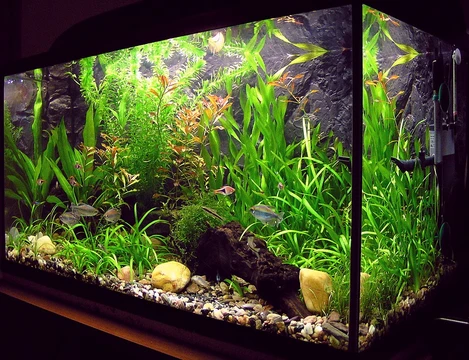
Pogostemon helferi
A Thai aquatic plant popular in the aquarium trade.

Pogostemon helferi, called dao-noi in Thai, is an aquatic plant from Thailand often used as an ornamental in aquariums. Its native range covers Myanmar and western Thailand. Surveys in 2005 recorded it in northern, northeastern, eastern, and western parts of Thailand, but a 2007 survey found it only in Kanchanaburi province, near the Myanmar border. A 2024 review expanded its known range to include the Indian Himalayan Region. The plant has two leaf forms—emersed and submerged—with irregularly shaped epidermal cells. Most specimens sold are collected from the wild. High demand from the aquarium trade has caused its population to shrink in the wild, putting it at risk of local extinction.
Quick Facts
- Genus
- Pogostemon
- Species
- helferi
Facts from the source article.
Lore & Background
Pogostemon helferi is known locally as dao-noi, meaning 'little star'. It is a popular plant in aquariums and is of high demand in the aquarium trade. The species has dimorphic leaves—two distinct types: emerged leaves, which are less durable, and submerged leaves. It has irregularly shaped epidermis cells. Most stocks of the species are harvested from the wild.
Reader's Guide
Pogostemon helferi is notable for its high demand in the aquarium trade, which has led to population decline in its natural habitat, potentially facing local extinction. As of 2016, the economic value of its production was valued at ฿252,000, while the annual market demand exceeded ฿500,000. The species is primarily wild-harvested, contributing to its vulnerability. Its distribution has been documented in multiple surveys: a 2005 survey found it in north, north-east, east, and west Thailand, but a 2007 survey found it only in Kanchanaburi province near Myanmar. A 2024 review extended its range to the Indian Himalayan Region. The plant's dimorphic leaves and irregular epidermis cells are characteristic features. Its popularity as an ornamental aquarium plant drives ongoing collection from the wild.
Did You Know?
- Pogostemon helferi is also known as dao-noi, meaning 'little star'.
- The type locality is Sangkhla Buri district, Kanchanaburi, Thailand.
- A 2007 survey found the species only in Kanchanaburi province, near Myanmar.
- As of 2016, the annual market demand for the species was more than ฿500,000.
Taxonomy & Geographic Range
Pogostemon helferi is a Thai aquatic plant species whose type locality is anchored in Sangkhla Buri district within Kanchanaburi province, Thailand. The species carries the local name dao-noi, a term translating to "little star," a descriptor that has stuck across regional botanical literature and the hobbyist community. Its natural range spans Myanmar and the western reaches of Thailand, though the precise boundaries of where it grows have shifted considerably in the scientific record over the past two decades. A 2005 survey documented the plant across four broad regions of Thailand—north, north-east, east, and west—painting a picture of a widespread species. Just two years later, a 2007 survey dramatically narrowed that picture, locating the plant only in Kanchanaburi province, in the zone bordering Myanmar. Then a 2024 review expanded the known distribution again, extending it into the Indian Himalayan Region. These successive revisions underscore how much remains uncertain about the true geographic footprint of this small aquatic species.
Conservation Pressure & the Aquarium Trade
The very popularity that makes Pogostemon helferi a staple of the planted-aquarium hobby is the same force pushing it toward the edge in the wild. Because the species is in high demand as a common ornamental plant, wild populations have been declining, and in some areas the plant is potentially facing local extinction. The commercial reality is stark: most stocks sold to hobbyists are still harvested directly from natural habitats rather than propagated in controlled settings. By 2016, the annual production value of the species stood at roughly 252,000 Thai baht, yet market demand exceeded 500,000 baht per year—a clear signal that supply cannot keep pace with what the trade requires. This gap between what growers can produce and what buyers want creates a persistent incentive to keep pulling plants from rivers and streams in Kanchanaburi and Myanmar. Research into tissue culture and hydroponic propagation has been explored as a way to reduce that wild-harvesting pressure, but the species remains overwhelmingly dependent on wild collection to satisfy the global aquarium market.
Morphology & Botanical Identity
Pogostemon helferi is a small aquatic plant whose most distinctive botanical feature is its dimorphic leaf structure. The species produces two clearly different leaf types: emerged leaves that grow above the waterline and are notably less durable, and submerged leaves that develop beneath the surface. This dual morphology is a common adaptation among aquatic plants that alternate between wetland and fully submerged conditions, allowing the plant to photosynthesize effectively in both environments. At the microscopic level, the species is further distinguished by its irregularly shaped epidermal cells, a trait that sets it apart from some of its close relatives within the broader Pogostemon genus. The plant's local Thai name, dao-noi, translates to "little star," a colloquial descriptor that has persisted in both regional botanical writing and the aquarium hobby. Despite its modest size and unassuming appearance in the wild, these morphological details—dimorphic foliage, irregular cell architecture, and its dual life above and below water—make it a subject of ongoing micromorphological study among Thai botanists.
Economic Profile & Cultivation Challenges
The economics of Pogostemon helferi tell a story of a small plant with outsized commercial significance. In 2016, the total production value of the species was recorded at 252,000 Thai baht, while annual market demand surpassed 500,000 baht. That shortfall—demand running nearly double the available supply—highlights a structural problem in how the plant reaches the global aquarium market. The root of the issue is that the vast majority of specimens sold are still collected from the wild, rather than grown through laboratory or nursery methods. Researchers have investigated ex-situ propagation techniques, including tissue culture and hydroponic systems, as potential pathways to scale up controlled production and relieve pressure on natural populations in Kanchanaburi and Myanmar. Yet the gap between what is produced and what is demanded persists, and the species' status as a high-demand ornamental continues to outpace the development of reliable, large-scale cultivation methods. For a plant whose entire commercial identity rests on its appeal to aquarium hobbyists worldwide, the challenge of moving from wild harvest to sustainable production remains the central economic and conservation question.
More in Aquarium and Aquatic Plants 1-24
Spotted an error? Know more?
Reader corrections go straight into our review queue. Suggest an edit · How this site is sourced