Anubias
A genus of hardy, low-light aquatic plants from tropical Africa.

Anubias is a genus of aquatic and semi-aquatic flowering plants from the Araceae family, native to tropical central and western Africa. They are typically found in rivers and streams, though they also occur in marshes. The plants have broad, thick, dark leaves that vary widely in shape. The genus was revised in 1979, and its naming has remained stable since then. Species are mostly identified by the characteristics of their inflorescence. Because these plants often grow in shady spots, the genus was named after Anubis, the Egyptian god of the afterlife. Heinrich Wilhelm Schott first described the genus in 1857, with *A. afzelii* as the type species.
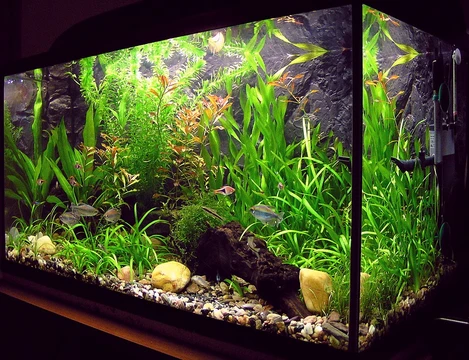
In aquariums, *Anubias*—especially the various forms of *A. barteri*—are commonly attached to rocks or bogwood. Unlike most plants, they prefer low light and can even flower underwater. They should be placed in shaded areas of the tank, or algae will grow on their leaves. Many aquarists consider them among the easiest plants to keep because they need very little light and few nutrients, and herbivorous fish (with a few exceptions) will not eat them. This makes them one of the few plants suitable for tanks with African cichlids or goldfish.
In artificial settings, *Anubias* can be propagated by dividing the stolon or taking side shoots. The stolon must stay above the substrate, or it will rot and kill the plant. Rather than burying them in soil, it is best to attach them to rock or driftwood, as they thrive when the rhizome and roots are exposed. They can also be grown from seed. All species grow slowly, typically producing a leaf every three weeks or even slower. While once thought unresponsive to added CO₂, hobbyists have seen improved growth with CO₂ and high light.
The most common species is *Anubias barteri*, which is polymorphic and split into several varieties. The largest members are *Anubias gigantea* and *Anubias heterophylla*, whose leaf-stems can reach 83 cm, with leaves up to 40 cm long and 14 cm wide, and lateral lobes up to 28 cm long and 10 cm wide. The smallest is *Anubias barteri* var. *nana*, which grows to just 10 cm tall, with leaves up to 6 cm long and 3 cm wide. *Anubias* can also be grown emersed (above water), making them useful in paludariums.
Quick Facts
- Taxon
- Anubias
- Type Species
- A. afzelii
- Type Species Authority
- Schott
Facts from the source article.
Lore & Background
The genus was named after the Egyptian god Anubis, the god of the afterlife, because of the often shady places where the plants grow. It was first described in 1857 by Heinrich Wilhelm Schott, with A. afzelii as its type species. The genus was revised in 1979, and since then its nomenclature has been stable. Species can be determined by using mostly characteristics of the inflorescence.
Anubias are characterized by broad, thick, dark leaves that come in many different forms. They are commonly used in aquariums, usually attached to rocks or bogwood. In contrast to most plants, Anubias generally prefer subdued lighting and can also produce flowers underwater. In the aquarium they should be placed in shaded areas; otherwise algae will develop on the leaves.
Reproduction in artificial environments can be accomplished by stolon division or from side shoots. The stolon must always be above the substrate in order to survive; otherwise it will rot and the plant will die. Rather than planting Anubias directly into the soil, they should be attached to a piece of rock or driftwood, as they are more likely to grow and thrive when the rhizome and roots are left exposed instead of buried. It is also possible to propagate Anubias by seed.
Reader's Guide
Anubias are considered by many aquarists to be some of the easiest plants to maintain, since their light and nutrient requirements are very low and also because herbivorous fish will not eat them (with a few exceptions). This is why Anubias are some of the few plants that can be used in aquariums with African cichlids and goldfish. The natural growth rate of all species in this genus is rather slow. Usually, they produce a leaf every 3 weeks, or even slower. And while they were once thought to be among the few plants that do not respond to CO₂ addition, hobbyists have seen great results and improved growth with CO₂ and high light intensity. The most commonly available species of this genus is Anubias barteri Schott, which is polymorphic and subdivided into several varieties. Anubias can be grown emersed (above water), and for this reason they may be used in paludariums. The largest members of the genus are Anubias gigantea and Anubias heterophylla, with leaf-stems up to 83 cm. The smallest representative is Anubias barteri var. nana, with a height up to 10 cm.
Did You Know?
- Anubias was named after the Egyptian god Anubis, the god of the afterlife, due to the shady places where it grows.
- Anubias barteri var. nana is the smallest variety, reaching only 10 cm in height.
- Anubias can produce flowers underwater, unlike most aquarium plants.
Taxonomic History & Classification
Anubias gigantea holds a place within the arum family, Araceae, as a member of the genus Anubias. Its story in botanical literature begins in 1920, when the botanist Auguste Chevalier first referenced the species after examining specimens he had gathered in Guinea, a country in West Africa. However, a full formal description would not arrive until nearly two decades later, in 1939, when John Hutchinson undertook the task of properly describing the plant. The species has carried alternative names over the years, including A. gigantea var. tripartita, attributed to Chevalier's 1920 work, and A. hastifolia var. robusta, published by Engler back in 1915. Taxonomically, A. gigantea sits very close to A. afzelii; the two are so similar that the primary distinguishing feature lies in the shape of the leaf blade. Additionally, the plant's appearance shifts noticeably between its juvenile and mature stages, meaning that young specimens can look quite different from established ones, a factor that likely complicated early identification and classification efforts.
Morphology & Floral Architecture
The physical form of Anubias gigantea is dominated by its striking foliage. The leaf blades take on a broad arrow shape, reaching lengths of up to 30 centimeters and widths of around 14 centimeters. Each blade is attached to a petiole that varies considerably, ranging from slightly shorter than the blade itself to as much as two and a half times its length. All of these leaves emerge from a thick, creeping rhizome that sends out roots and measures between one and three centimeters in diameter. When the plant produces its inflorescence, the structure follows the classic arum pattern. A spathe, measuring 3.5 to 8 centimeters, wraps around a spadix that can stretch to 9 centimeters. Because the spadix is slightly longer than the spathe, its tip pokes just beyond the hood. The spadix is supported by a long peduncle spanning 14 to 60 centimeters. The upper region bears male flowers whose four to six stamens are fused together into synandria with thecae positioned along their sides, while the lower region carries female flowers that are simplified down to just an ovary and stigma.
Native Range & Riparian Ecology
In the wild, Anubias gigantea is documented from a stretch of West African countries, specifically Guinea, Sierra Leone, Liberia, Ivory Coast, and Togo. Its ecological niche is distinctly semi-aquatic; the plant anchors itself to rocky substrates along riverbanks or settles within the riverbed itself. This riparian lifestyle places it squarely in the transitional zone between open water and land, a duality that shapes its overall growth form. The species is classified as an aquatic to riparian aroid, a designation that captures this dual existence. Flowering follows a seasonal pattern, with blooms appearing between February and April. The preference for rocky, water-adjacent terrain indicates a close relationship with flowing river systems, where the plant can grip stone surfaces and tolerate both periodic submersion and exposure to air.
Cultivation & Propagation
For those who cultivate aquatic and semi-aquatic plants, Anubias gigantea is a species that rewards patience. It performs best when only partially submerged rather than held entirely underwater, and it thrives when given open space, growing poorly when crowded by neighboring vegetation. These traits make it a natural fit for paludariums, where the waterline and air space coexist in a way that mirrors its native riverbank habitat. It can also be kept in larger aquariums, though under fully submerged conditions its growth is notably very slow. The species does not require much light, making it forgiving in terms of illumination. Temperature-wise, it is most content between 22 and 26 degrees Celsius. Propagation can be achieved by dividing the thick creeping rhizome, or alternatively through seed, a process noted as not particularly difficult. Both routes offer straightforward ways to produce new plants from a single established specimen.
More in Aquarium and Aquatic Plants 1-24
Spotted an error? Know more?
Reader corrections go straight into our review queue. Suggest an edit · How this site is sourced