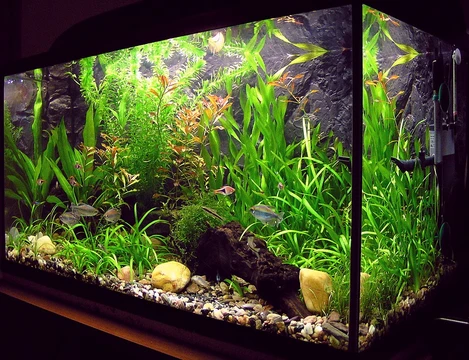
Anubias heterophylla
A slow-growing Anubias with variable leaves, used in aquariums.

Anubias heterophylla is a species of aquatic plant in the Aroid genus Anubias, first described scientifically by Adolf Engler in 1879. It is notable for its variable leaf shapes and its use in spacious aquariums and paludariums.
Quick Facts
- Genus
- Anubias
- Species
- heterophylla
Facts from the source article.
Lore & Background
Anubias heterophylla was first described by Adolf Engler in 1879. It has several synonyms, including A. congensis (with a variety A. congensis var. crassispadix), A. affinis, A. engleri, A. bequaerti, and the trade name A. undulata. The plant is distributed across Cameroon, Equatorial Guinea, Gabon, Republic of the Congo, Democratic Republic of the Congo, and Angola (including Cabinda Province). It grows on rocky grounds at the edge of watercourses and on damp banks, flowering from July to January and fruiting from July to March.
Reader's Guide
Anubias heterophylla is a slow-growing plant recommended for spacious aquariums and paludariums. It grows best when only partially submerged and not crowded by other plants, preferring a temperature range of 24 to 27 °C. Propagation is generally done by division of the rhizome, and smaller plants can be cultivated successfully in an aquarium. The plant is reportedly used as a stomachic for children. Its leaf blades can reach up to 38 cm long and 13 cm wide, with variable forms ranging from elliptic to lance- or spear-shaped. The leaf stems are generally longer than the blade, up to 66 cm. The rhizome is creeping and rooting, 5 to 17 mm thick. The spathe is 1.5 to 4.5 cm long and 2 to 4.5 times as long as wide, with a peduncle up to 27 cm long. The spadix is 1.5 to 4.5 cm long and can be up to 2 times the spathe, with male flowers fused into synandria and female flowers reduced to the ovary and stigma.
Did You Know?
- Its leaf blades can be up to 38 cm long and 13 cm wide, with shapes ranging from elliptic to spear-shaped.
- The plant is distributed across six African countries, including Angola and the Democratic Republic of the Congo.
More in Aquarium and Aquatic Plants 1-24
Spotted an error? Know more?
Reader corrections go straight into our review queue. Suggest an edit · How this site is sourced