Ceratopteris thalictroides
A versatile fern used as both floating and rooted aquarium plant.

Ceratopteris thalictroides is a fern in the genus Ceratopteris, which is one of just two genera that make up the subfamily Parkerioideae within the family Pteridaceae. It goes by several common names, including water sprite, Indian fern, water fern, oriental waterfern, and water hornfern. In the Philippines, it is called pakung-sungay, meaning "antler fern" or "horn fern."
This species is found across tropical and subtropical regions worldwide, ranging as far north as Korea and as far south as western Australia. It typically grows rooted in mud, and its appearance and size can vary. The stipes of mature plants are spongy and filled with air, measuring 3–15 mm in diameter, and the stipes are 4-60 cm long including its stipe. Fertile fronds are pale green, turning brown when mature, and can reach 15–100 cm or more in length, including the stipe, to 40 cm long. Proliferous or dormant buds, covered in overlapping dark scales and winged, appear in the axils of the fertile pinnae. The pinnae are deeply incised, with sterile segments 2–15 mm by 10–30 mm and fertile segments 1–2 mm by 10–80 mm. Chromosome counts vary by region: the north type and third type have 2n=126, while the south type has 2n=154, distinguishing it from other species. Ecologically, Ceratopteris thalictroides is often found near stagnant water or in still pockets along slow-flowing rivers, in swamps, swamp forests, sago swamps, marshes, and natural or man-made ponds. It thrives in full sun to moderate shade, from sea level up to 1,300 meters (mostly below 500 meters). It frequently masses on logs or floating vegetation, and has been recorded growing among the pneumatophores of freshwater mangroves (Sonneratia). In some areas, it shows seasonality, reaching maturity and shedding spores during the dry season, by which time most sterile fronds have been lost. It is functionally an annual in the wild, repopulating from spores the next season, but can live indefinitely in cultivation and reach full maturity in 29 days. The fronds are cooked and eaten as a vegetable in Madagascar, Swaziland, New Guinea, Nepal, Vietnam, and other parts of Asia, often used like watercress. In Malaysia and Japan, uncurled fronds are used in salads. However, some ferns are potentially carcinogenic when eaten, and this may apply to Ceratopteris thalictroides.
Quick Facts
- Genus
- Ceratopteris
- Species
- thalictroides
Facts from the source article.
Lore & Background
Ceratopteris thalictroides is widespread across tropical and subtropical regions, occurring as far north as Korea and as far south as western Australia. It is often found near stagnant water or in still pockets along slow flowing rivers in swampy areas, swamp forests, sago swamps, marshes, and natural and man-made ponds. The plant thrives in full sun to moderate shade, from sea level to 1,300 meters altitude, but mostly below 500 meters. It is often massed on or around logs or other floating vegetation, and has been recorded in a fresh-water mangrove growing among finger-like pneumatophores. The plant varies in size and appearance. The stipes of mature plants are 3–15 mm in diameter, spongy, and air-filled. Pale green fertile fronds, brown when matured, are 15–100 centimeters or more. Proliferous or dormant buds with overlapping dark scales are present in the axils of fertile pinnae. In some areas, Ceratopteris exhibits a degree of seasonality, reaching maturity and shedding spores during the dry season; plants have lost nearly all sterile fronds by this stage. The species has been reported to be functionally an annual, repopulating from spores the next season, but it is of indefinite lifespan in cultivation. It can reach full maturity in 29 days.
Reader's Guide
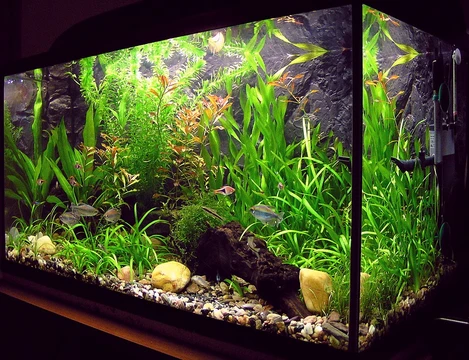
Ceratopteris thalictroides is widely used as an aquarium plant, prized for its versatility, being used both as a floating plant and a plant that can be rooted in the substrate. It grows best in soil with a pH reading of 5-9 and in very high amounts of light, usually growing quickly. It can benefit from the addition of CO2. The plant's reproductive technique is similar to other ferns: small adventitious plantlets are grown on the mother plant and are then released when ready. It can provide useful shade to shyer fish and small fry, and its dense roots are said to take nutrients out of the water, helping to prevent the growth of algae. Beyond aquariums, the fronds are cooked and eaten as a vegetable in Madagascar, Swaziland, New Guinea, Nepal, Vietnam, and other parts of Asia, and have been used similarly to watercress. In Malaysia and Japan, uncurled fronds have been used in salads. Some ferns are potentially carcinogenic when eaten; this may be the case in Ceratopteris thalictroides. The plant can also be used as green manure for rice, and medicinally as a poultice for dermatological issues in Malaysia and the Philippines, and in China it is applied to wounds to stop bleeding. In the Sepik region of New Guinea, fronds are used as a personal decoration.
Did You Know?
- The plant has two chromosome counts: 2n=126 in the north type and third type, and 2n=154 in the south type.
- It has been used as green manure for rice.
More in Aquarium and Aquatic Plants 1-24
Spotted an error? Know more?
Reader corrections go straight into our review queue. Suggest an edit · How this site is sourced