Callitriche stagnalis
A perennial aquatic plant with invasive potential via clonal spread.

Callitriche stagnalis, commonly known as pond water-starwort, is a perennial aquatic vascular plant species. It is notable for its ability to thrive in a variety of aquatic and subaquatic habitats, particularly those with slowly moving to non-moving water, and for its invasive potential due to rapid reproduction.
Quick Facts
- Genus
- Callitriche
- Species
- stagnalis
Facts from the source article.
Lore & Background
Callitriche stagnalis is native to both Europe and North Africa, where it is widespread in aquatic and subaquatic habitats. Its general appearance differs depending on whether the plant is submerged or floating: submerged leaves are linear with one vein, while floating leaves are spatulate to obovate with 5 to 7 veins. The plant is monoecious, with small distances between staminate and pistillate flowers promoting aerial self-pollination, and two distinct bracts at the base of each flower help keep them above water. Its fruit is suborbicular, composed of multiple thin, winged margin mericarps.
Reader's Guide
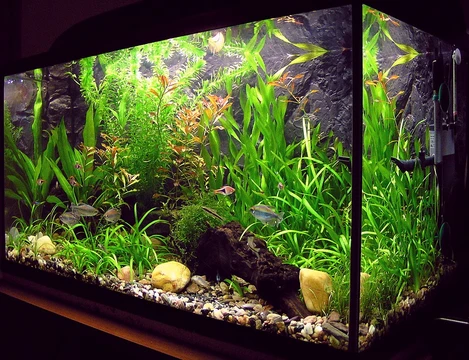
Callitriche stagnalis is significant primarily for its invasive threat to native vegetation. Although it does not pose a threat to humans, its reproductive rate—through clonal spread, prolific seed production, and self-pollination—enables it to form dense vegetative mats that out-compete native species for space and nutrients. Its distribution has expanded from its native Europe and North Africa to the United States, Asia, Australia, New Caledonia, and New Zealand. In the United States, the earliest record was in New York and New Jersey in 1861, and it was first found on the West Coast in Oregon in 1871. Its introduction is believed to have occurred accidentally through shipping, and by the end of the nineteenth century it became a popular aquarium plant, facilitating its spread to inland states. It is now found in mid-Atlantic states, Virginia, Tennessee, Alabama, Wisconsin, Montana, Washington, Oregon, California, and parts of New England. Dispersal is further aided by vectors such as birds, boats, and tires, as well as plant fragmentation.
Did You Know?
- Callitriche stagnalis can reproduce via self-pollination, which increases seed production.
- Its submerged leaves are linear with one vein, while floating leaves are wider with 5 to 7 veins.
- The earliest record in North America was in New York and New Jersey in 1861.
- It can spread through plant fragmentation and by vectors such as birds, boats, and tires.
More in Aquarium and Aquatic Plants 1-24
Spotted an error? Know more?
Reader corrections go straight into our review queue. Suggest an edit · How this site is sourced