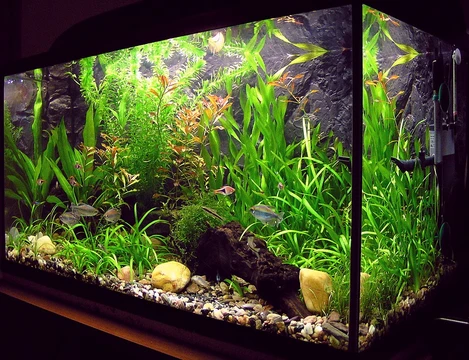
Bacopa caroliniana
A creeping herb with lemon-scented leaves and blue flowers.

Bacopa caroliniana is a flowering plant species commonly known as giant red bacopa, lemon bacopa, or water hyssop. It is notable for its ability to grow in water, making it a popular aquarium plant, and for its bioluminescent potential when modified with gold nanoparticles.
Quick Facts
- Genus
- Bacopa
- Species
- caroliniana
Facts from the source article.
Lore & Background
Bacopa caroliniana is a perennial creeping herb native to marshy areas in the southern United States. Its leaves are succulent, thick, and smell of lemon when crushed, arranged oppositely on the stem. The flowers are blue with five petals. The plant grows to 50–100 cm and will grow above water if given the chance, producing similar but waxy leaves; it occasionally flowers underwater, though those flowers soon rot. Emersed flowers do not produce seeds on their own, requiring cross pollination.
Reader's Guide
Bacopa caroliniana is widely cultivated as an aquarium plant due to its ease of growth and tolerance of slightly brackish conditions. Propagation is through cuttings. Leaf color varies with light intensity, turning bronze or almost red under high light levels. In the wild, it grows in bogs or semi-submersed conditions and adapts well to flooding. It can be grown in or by ponds in warmer locales, or as a houseplant if kept damp, and grows year-round but is frost tender, though it may regrow from roots if damaged. In aquariums, it needs good lighting for strong growth but survives low light, preferring a clean, nutrient-rich environment. A Taiwanese research team introduced gold nanoparticles into Bacopa caroliniana, causing chlorophyll to produce reddish light; the glowing plants consumed more carbon from the atmosphere than normal, as the luminescence triggers photosynthesis. Popular Science described this as a 'triple threat' for potentially cutting energy costs, reducing global warming, and keeping streets lit at night.
Did You Know?
- The leaves smell of lemon when crushed.
- It can grow in slightly brackish conditions.
- Emersed flowers require cross pollination to produce seeds.
- Gold nanoparticles can cause its chlorophyll to emit reddish light.
More in Aquarium and Aquatic Plants 1-24
Spotted an error? Know more?
Reader corrections go straight into our review queue. Suggest an edit · How this site is sourced