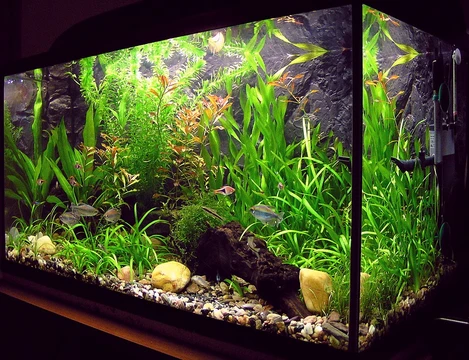
Aquatic ecosystem
Aquatic ecosystems are communities of life in and around water bodies.

An aquatic ecosystem is any ecosystem located in or near a body of water, as opposed to a terrestrial ecosystem on land. These ecosystems are made up of communities of aquatic organisms that rely on one another and their surroundings. The two broad categories are marine ecosystems and freshwater ecosystems. Freshwater ecosystems are further split into lentic systems (slow-moving water like pools, ponds, and lakes), lotic systems (faster-moving water such as streams and rivers), and wetlands (areas where the soil is waterlogged or flooded for at least part of the year).
Aquatic ecosystems serve a range of vital environmental roles. They recycle nutrients, clean water, reduce flood impacts, replenish groundwater, and offer homes for wildlife. The living organisms within them—including microorganisms, phytoplankton, higher plants, invertebrates, fish, bacteria, protists, and aquatic fungi—help the ecosystem purify itself by breaking down organic matter and filtering water. It is essential that these ecosystems remain self-sustaining, as they also provide habitats for the species that live there. Beyond environmental benefits, aquatic ecosystems are used for human recreation and are important to tourism, especially along coasts. They also hold religious significance, such as Christian pilgrimages to the Jordan River, and serve educational purposes, like using lakes for ecological research.
The living components of an aquatic ecosystem are shaped by the organisms present. For instance, wetland plants can form dense canopies covering large areas of sediment, while grazing by snails or geese can leave extensive mud flats. Because aquatic environments often have low oxygen levels, organisms must adapt; many wetland plants, for example, develop aerenchyma to transport oxygen to their roots. Other biotic factors, such as the roles of competition, mutualism, or predation, are harder to measure. Increasingly, predation by coastal herbivores like snails, geese, and mammals appears to be a major biotic influence.
Autotrophic organisms, or producers, create organic compounds from inorganic materials. Algae are likely the most important autotrophs in aquatic settings, using sunlight to turn carbon dioxide into biomass. In shallower waters, rooted and floating vascular plants contribute more biomass.
- Main types
- Marine ecosystems and freshwater ecosystems
- Freshwater subtypes
- Lentic (lakes), lotic (rivers), wetlands
- Example autotrophs
- Algae, rooted and floating vascular plants, chemosynthetic bacteria
- Example heterotrophs
- Fish, birds, amphibians, snails, geese, mammals, giant tube worms (Riftia pachyptila) 1.5 m in length, clams (Calyptogena magnifica) 30 cm long
- Key abiotic factors
- Substrate type, water depth, nutrient levels, temperature, salinity, flow, dissolved oxygen
Lore & Background
Aquatic ecosystems perform many important environmental functions, including recycling nutrients, purifying water, attenuating floods, recharging ground water, and providing habitats for wildlife. The biota—microorganisms, phytoplankton, higher plants, invertebrates, fish, bacteria, protists, aquatic fungi, and more—contribute to self-purification through organic matter destruction and water filtration. These ecosystems are reliably self-maintained and also serve human recreation, tourism (especially in coastal regions), religious purposes (such as religious tourism to the Jordan River by Christians), and educational purposes (such as the usage of lakes for ecological study).
Biotic characteristics are mainly determined by the organisms that occur. For example, wetland plants may produce dense canopies covering large areas of sediment, or snails or geese may graze vegetation leaving large mud flats. Aquatic environments have relatively low oxygen levels, forcing adaptations such as aerenchyma in many wetland plants to carry oxygen to roots. Other biotic characteristics include the relative importance of competition, mutualism, or predation, with growing cases where predation by coastal herbivores (snails, geese, mammals) appears dominant.
Autotrophic organisms, such as algae, use solar energy to generate biomass from carbon dioxide and are possibly the most important autotrophs in aquatic environments. In shallower water, rooted and floating vascular plants contribute greater biomass. Chemosynthetic bacteria in benthic marine ecosystems feed on hydrogen sulfide from volcanic vents, supporting great concentrations of animals like giant tube worms and clams. Heterotrophic organisms consume autotrophs, and euryhaline organisms tolerate salt while stenohaline species live only in freshwater.
Reader's Guide
Aquatic ecosystems are significant because they perform essential environmental functions such as nutrient recycling, water purification, flood attenuation, groundwater recharge, and wildlife habitat provision. Their self-purification capacity relies on a diverse biota including microorganisms, phytoplankton, higher plants, invertebrates, fish, bacteria, protists, and aquatic fungi. These ecosystems are also used for human recreation, tourism, religious practices, and education. Abiotic factors like substrate type, water depth, nutrient levels, temperature, salinity, flow, and dissolved oxygen determine the kinds of organisms present. Dissolved oxygen is frequently the key substance controlling organic life; fish need it to survive, though tolerance varies, and plants may produce aerenchyma or alter leaf shape. Nutrient levels, especially nitrogen and phosphorus, control algae abundance, which can become over-abundant and cause fish declines or hypoxic dead zones. Salinity determines species composition, with marine organisms tolerating salt and many freshwater organisms intolerant. Threats include physical, chemical, or biological alterations that exceed the ecosystem's ability to absorb stress, such as changes in water temperature, flow, light, nutrient loading, toxins, over-harvesting, and exotic species introduction. Human populations impose excessive stresses, and climate change disrupts distribution patterns, negatively impacting deep sea biodiversity, coastal fish diversity, crustaceans, and coral reefs. Human-made aquatic ecosystems like ditches, aquaculture ponds, and irrigation channels can harm natural ecosystems by trading off biodiversity.
Did You Know?
- The two main types of aquatic ecosystems are marine ecosystems and freshwater ecosystems.
- Freshwater ecosystems include lentic (slow moving water), lotic (faster moving water), and wetlands.
- Dissolved oxygen is frequently the key substance determining the extent and kinds of organic life in a water body.
More in Aquarium and Aquatic Plants 1-24
Spotted an error? Know more?
Reader corrections go straight into our review queue. Suggest an edit · How this site is sourced