Marsilea quadrifolia
Aquatic fern with four-parted leaves, not a true clover.

Marsilea quadrifolia is a herbaceous aquatic fern found naturally in central and southern Europe, Caucasia, western Siberia, Afghanistan, south-west India, China, Japan, and Vietnam. It is known by the common names four leaf clover and European waterclover, though it is not a true clover. In some parts of the United States it is considered a weed, having been established in the northeast for over 100 years.
Quick Facts
- Genus
- Marsilea
- Species
- quadrifolia
Facts from the source article.
Lore & Background
Marsilea quadrifolia is an aquatic fern bearing four-parted leaves that resemble a four-leaf clover (Trifolium). The leaves float in deep water or stand erect in shallow water or on land. Leaflets are obdeltoid, up to 3/4 inch long, glaucous, with petioles reaching 8 inches. The sporocarps are ellipsoid, up to 3/16 inch long, dark brown, on stalks up to 3/4 inch long, attached to the base of the petioles. In some places the plant has been used as food for more than 3000 years. It is said to be anti-inflammatory, diuretic, depurative, febrifuge, and refrigerant, and is used to treat snakebite and applied to abscesses.
Reader's Guide
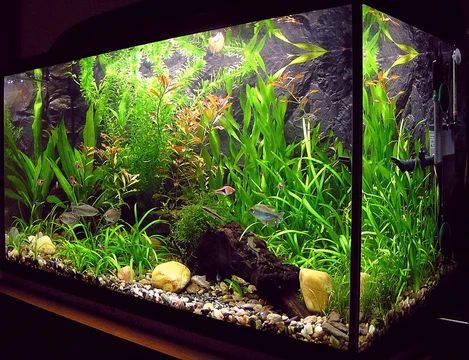
Marsilea quadrifolia is notable for its adaptability in cultivation. It prefers light (sandy) or medium (loamy) soils and can grow in semi-shade or full sun, requiring moist or wet soil and tolerating growth in water. It can be grown as a potted plant with soil kept wet, semi-submerged with emergent fronds, or fully submerged with floating fronds. In the aquarium, it is grown fully submerged, usually in the foreground, spreading by runners. It is generally unfussy about light and water conditions and does not need a rich substrate. Germination from sporocarps is easy but requires the sporocarps to be abraded, cracked, or have an edge sliced off before submerging in water, and germination is infrared-light dependent; full sunlight suffices. Its long history of use as food and in traditional medicine adds to its significance, though it is considered a weed in parts of the United States.
Did You Know?
- Marsilea quadrifolia is an aquatic fern, not a flowering plant.
- Its common name 'four leaf clover' is misleading as it is not a species of clover.
- The sporocarps must be abraded or cracked before germination, which requires infrared light.
More in Aquarium and Aquatic Plants, Part 2 1-24
Spotted an error? Know more?
Reader corrections go straight into our review queue. Suggest an edit · How this site is sourced