Glossostigma elatinoides
Small aquatic or terrestrial herb with mauve flowers.

Glossostigma elatinoides, commonly called small mud-mat, is a flowering plant from the family Phrymaceae. This small herb can grow either in water or on land, and produces mauve flowers. It is native to the eastern states of Australia.
The plant forms a mat and is perennial. Its leaves are green, sometimes with a few hairs, and range from 6 to 20 mm long and 1 to 3 mm wide. They are shaped like an ellipse or an egg, with a base that narrows either abruptly or gradually into a petiole that is 2 to 10 mm long and occasionally whitish. A distinct midvein runs along the lower surface of the leaf. The flower has a two-lipped corolla that is blue-mauve and 2 to 3.5 mm long. The pedicels stand upright and are 1 to 12 mm long, while the green calyx measures 1.5 to 2.3 mm. Flowering happens from December to May, and the fruit is an oval capsule.
First described in 1846 by George Bentham as *Tricholoma elatinoides*, the species was renamed *Glossostigma elatinoides* by Joseph Dalton Hooker in 1853. The new name was published in *The botany of the Antarctic voyage of H.M. discovery ships Erebus and Terror. II. Flora Novae-Zelandiae*.
Small mud-mat grows in wet places such as river flats, near swamps, and around dams. It is found in New South Wales, Victoria, South Australia, Tasmania, and the Australian Capital Territory.
Quick Facts
- Genus
- Glossostigma
- Species
- elatinoides
Facts from the source article.
Lore & Background
Glossostigma elatinoides was first described in 1846 by George Bentham, who named it Tricholoma elatinoides. In 1853, Joseph Dalton Hooker changed the name to Glossostigma elatinoides, and the description was published in The botany of the Antarctic voyage of H.M. discovery ships Erebus and Terror. II. Flora Novae-Zelandiae. The species is a perennial, mat-forming herb that can grow either terrestrially or aquatically. Its leaves are green, occasionally sparsely hairy, elliptic to egg-shaped, with a distinct mid vein on the lower surface and a sometimes whitish petiole. The flowers are two-lipped and blue-mauve, with upright pedicels and a green calyx. The fruit is an oval-shaped capsule.
Reader's Guide
Glossostigma elatinoides is notable as a mat-forming aquatic or terrestrial herb from eastern Australia. Its small size and creeping growth habit make it a distinctive species in wet habitats such as river flats, near swamps, and dams. The plant produces blue-mauve flowers from December to May, and its leaves range from 6 to 20 mm in length. The species was originally described by George Bentham in 1846 under the name Tricholoma elatinoides, later reclassified by Joseph Dalton Hooker in 1853. Its distribution includes New South Wales, Victoria, South Australia, Tasmania, and the Australian Capital Territory. As a member of the family Phrymaceae, it contributes to the diversity of aquatic flora in these regions. The plant's ability to form dense mats and its small, attractive flowers make it a subject of interest for those studying wetland ecosystems.
Did You Know?
- Glossostigma elatinoides is also known as small mud-mat.
- It was first described by George Bentham in 1846 as Tricholoma elatinoides.
- The species flowers from December to May.
Ground-Planting Role in Nature-Style Compositions
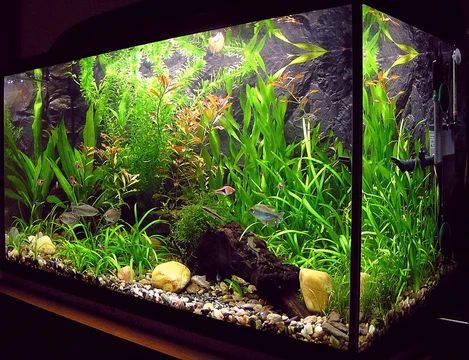
Glossostigma elatinoides occupies a specific niche within the world of aquascaping: that of a small-leaved plant deployed to evoke the appearance of grass or moss on the aquarium floor. In the Nature style, which emerged in the 1990s, such plants are chosen not for bold color or dramatic foliage but for their ability to create a sense of natural ground cover. This stands in sharp contrast to the Dutch style, developed in the Netherlands from the 1930s onward, where more than eighty percent of the tank floor is carpeted with lush, diverse plantings featuring feathery Hygrophila, red Alternanthera, and Rotala arranged in neat linear rows. In a Nature-style composition, by contrast, the hardscape is deliberately left partially visible, and the palette of species is kept deliberately restrained. Glossostigma elatinoides, alongside Eleocharis, small aquatic ferns, and Java moss, forms part of this limited botanical vocabulary that transforms a glass tank into a miniature terrestrial landscape rather than a colorful underwater garden.
Aesthetic Philosophy Governing Its Placement
The placement of a small-leaved plant like Glossostigma elatinoides within an aquascape is never arbitrary; it is governed by a philosophical framework rooted in Japanese aesthetic tradition. The Nature style, as articulated by Takashi Amano in his three-volume series Nature Aquarium World, draws explicitly on the concept of Wabi-sabi, which finds beauty in transience, imperfection, and minimalism. Rather than filling every surface with color and texture, a Nature-style composition arranges masses of relatively few species in an asymmetrical layout, often establishing a single focal point positioned according to the golden ratio. The limited color palette and the deliberate exposure of hardscape elements—stones or driftwood—reflect a preference for restraint over abundance. Within this framework, a carpet of tiny leaves serves the same purpose as moss on a garden stone: it suggests age, quietude, and the slow accumulation of time, inviting the viewer to perceive a complete landscape compressed into a few inches of glass.
The Closed-System Ecosystem It Depends On
Although the primary purpose of placing Glossostigma elatinoides in an aquascape is aesthetic, its survival depends on a carefully managed closed system. The aquarium is a sealed environment in which multiple variables must be held in delicate balance to support healthy plant growth. Filtration must be sufficient to maintain water quality without disturbing the delicate carpet of small leaves. Carbon dioxide levels must be kept high enough to sustain underwater photosynthesis, while lighting intensity and spectrum must match the plant's metabolic needs. Substrate composition and targeted fertilization provide the mineral foundation, and algae control remains an ongoing challenge to prevent the slow smothering of fine foliage. These technical demands apply equally to the Dutch style, where over eighty percent of the floor is planted, and to the Nature style, where a sparse ground cover of small-leaved species must coexist with exposed rock or wood. In both cases, the grower must treat the tank as a living ecosystem, adjusting parameters continuously to keep the composition alive.
The Amano Revolution and a New Botanical Vocabulary
Before the 1990s, the dominant approach to planted aquariums was the Dutch style, refined in the Netherlands since the 1930s following the commercial availability of freshwater fishkeeping equipment. That tradition emphasized abundance: dozens of species, vivid reds and greens, terraced plantings, and near-total floor coverage. The arrival of Takashi Amano's Nature Aquarium World series disrupted this paradigm. Amano, who also worked as a natural-landscape photographer and employed multi-exposure techniques to capture aquariums with unprecedented clarity, proposed a radically different visual language. In his compositions, small-leaved plants such as Glossostigma elatinoides, Eleocharis, and Java moss replaced the showy, tall species of the Dutch tradition. The goal shifted from displaying botanical variety to evoking a single, coherent terrestrial scene. Amano's work was credited with setting a new standard in aquarium management, and his influence spread through a global community of hobbyists who trade plants, enter contests, and share photographs online, with organizations like the Aquatic Gardeners Association in the United States counting roughly 1,200 members.
Frequently Asked Questions
What is Glossostigma elatinoides?
Glossostigma elatinoides, often called small mud-mat, is a tiny perennial flowering herb in the family Phrymaceae. It is a dual-habitat plant, meaning it can thrive both submerged in water and growing on land.
What does Glossostigma elatinoides look like?
It forms a low mat of small green leaves that are elliptical or egg-shaped, measuring roughly 6 to 20 mm long and 1 to 3 mm wide. Each leaf has a visible midvein on its underside and a short petiole, and the plant produces delicate mauve flowers with a corolla only 2 to 3.5 mm long.
Where is Glossostigma elatinoides native to?
This species is indigenous to the eastern states of Australia, with records from New South Wales, Victoria, South Australia, Tasmania, and the Australian Capital Territory.
How does Glossostigma elatinoides grow in an aquarium setting?
As a mat-forming perennial, it spreads horizontally rather than growing tall, making it a popular carpeting choice in planted tanks. Its small size and ability to root in substrate allow it to create a dense, low-profile ground cover.
When does Glossostigma elatinoides produce flowers?
Its flowering window stretches from December through May, during which it raises tiny mauve blooms above the foliage. The corolla of each flower is quite small, typically just 2 to 3.5 mm in length.
More in Aquarium and Aquatic Plants, Part 2 1-24
Spotted an error? Know more?
Reader corrections go straight into our review queue. Suggest an edit · How this site is sourced