Ludwigia palustris
An aquatic perennial herb of marshes and wet soils.

Ludwigia palustris, commonly called marsh seedbox, Hampshire-purslane, or water purslane, is a flowering plant in the evening primrose family. This aquatic or semiaquatic perennial herb thrives in moist, wet, or flooded environments and can sometimes behave as a weed. Its species name, *palustris*, is Latin for "of the marsh," reflecting its typical habitat. The plant forms low, sprawling mats in damp, disturbed areas. Its stems are semi-succulent, reddish, and either smooth or slightly hairy. As they creep along the ground, roots emerge from the nodes, and mature stems can grow 10–40 cm long. The leaves are opposite, smooth, oval-shaped, and up to 4 cm long, with a winged petiole and often a reddish-green tint. The greenish-white flowers are born on the leaf axils and reach 2-3 cm long. They lack petals, consisting instead of four triangular sepals and four white-tipped stamens positioned above a cube-shaped, four-angled ovary. The fruit is a small, cube-shaped capsule, also 2–3 cm long, pale green with darker green stripes along its angles. The sepals persist on the mature fruit. Originally named *Isnardia palustris* by Carl Linnaeus in 1753, it was moved to the genus *Ludwigia* by Stephen Elliott in 1817. It belongs to the family Onagraceae. Although no accepted varieties exist, five variety names appear among its 21 synonyms. This circumpolar species has a large native range across North America, South America, Africa, Asia, and Europe. It has become naturalized or invasive in Hawaii, Australia, and New Zealand. Restricted mostly to low elevations, it grows in shallow water bodies like reservoirs, ditches, and the banks of ponds, rivers, and streams. It requires wet, muddy, or sandy soils low in calcium but rich in humus and nutrients. Globally, the IUCN Red List and NatureServe classify *L. palustris* as secure (G5). In North America, it is also secure (N5) in both Canada and the United States. However, it is critically imperiled (S1) in Arizona and Prince Edward Island, imperiled (S2) in New Mexico, and vulnerable (S3) in Kansas, Iowa, and Quebec. Outside its native range, the plant can be highly invasive, very adaptable, and reproduces asexually. It poses a potential threat to wetland vegetation in Victoria, Australia, and has spread to riverbanks in northeastern Australia and other areas.
Quick Facts
- Genus
- Ludwigia (plant)
- Species
- palustris
Facts from the source article.
Lore & Background
Ludwigia palustris forms prostrate, sprawling mats in wet, disturbed areas. Its stems are semi-succulent, reddish in color, and smooth or slightly hairy. As the stems spread along the ground, roots form from the nodes. At maturity, the stems may reach 10-40 cm long. The leaves are opposite, smooth, oval-shaped, and reach up to 4 cm long. They have a winged petiole and are often reddish-green in color. The greenish-white flowers are born on the leaf axils and reach 2-3 cm long. They lack petals, and are composed of 4 triangular-shaped sepals and 4 white-tipped stamens, set above a cube-shaped, 4-angled ovary. The fruits are small, cube-shaped capsules, 2-3 cm long. They are pale green in color, with darker green stripes along the angles. The sepals are persistent, remaining present on the developed fruits.
Reader's Guide
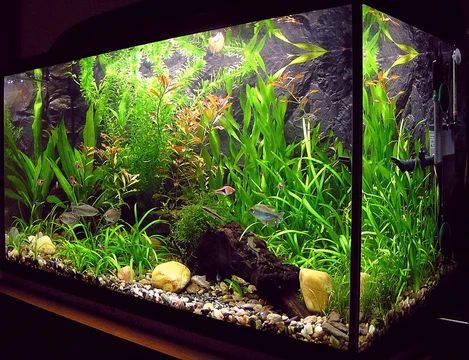
Ludwigia palustris is cultivated for use in aquariums and aquascaping. It is often sold under the names Ludwigia 'super red', Ludwigia 'mini super red', or Ludwigia 'red'. The species is circumpolar with a large native range, occurring in North America, South America, Africa, Asia, and Europe. It occurs as a naturalized or invasive species in Hawaii, Australia, and New Zealand. The species is generally restricted to low elevations, where it grows on shallow bodies of water such as reservoirs, ditches, and the banks of ponds, rivers, and streams. It requires wet, muddy or sandy soils poor in calcium but rich in humus and nutrients.
Globally, L. palustris is designated by the IUCN Red List and NatureServe as a secure (G5) species. In North America, it is also designated as secure (N5) in both Canada and the United States. In some states and provinces, it is designated to be at higher risk. In both Arizona and Prince Edward Island, it is ranked as a critically imperiled (S1) species. In New Mexico it is imperiled (S2). In Kansas, Iowa, and Quebec it is vulnerable (S3). The plant can be highly invasive outside its native range, very adaptable, and reproduces asexually. Ludwigia palustris poses a potential threat to wetland vegetation in Victoria, Australia. It has spread to riverbanks in Northeastern Australia and other areas.
Did You Know?
- The species epithet palustris is Latin for 'of the marsh'.
- The flowers lack petals and are composed of 4 triangular sepals and 4 white-tipped stamens.
- It is sold in the aquarium trade under names such as Ludwigia 'super red'.
More in Aquarium and Aquatic Plants, Part 2 1-24
Spotted an error? Know more?
Reader corrections go straight into our review queue. Suggest an edit · How this site is sourced