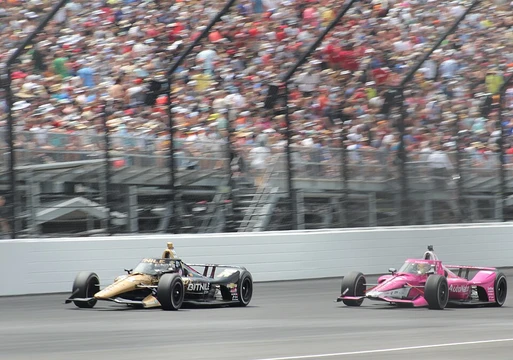
1996 U.S. 500
CART's Memorial Day counter to the 1996 Indianapolis 500.
The 1996 U.S. 500 was a CART series race held at Michigan International Speedway on May 26, 1996, the same day as the Indianapolis 500. It was created as a protest by CART teams against the IRL's 25/8 rule, which reserved most starting spots in the Indy 500 for IRL-based entries. Jimmy Vasser won the race from the pole position.
Quick Facts
- Date
- May 26, 1996
- Location
- Michigan International Speedway, Brooklyn, Michigan
- Series
- 1996 CART PPG Indy Car World Series
- Winner
- Jimmy Vasser
- Team
- Chip Ganassi Racing
Facts from the source article.
Did You Know?
- CART announced a $3.5 million purse for the U.S. 500, with $1 million to the winner, $250,000 for second, and $100,000 for third.
- On February 23, 1996, Tony George met with Roger Penske to discuss a solution; a proposal to expand the Indy 500 field to 42 cars and allow 1996 model year chassis was discussed, but no agreement was reached.
Background
The IRL/CART split originated in the early 1990s when Indianapolis Motor Speedway president Tony George, concerned about rising costs, a lack of ovals, and fewer American participants, began exploring changes. He joined the CART board from 1992 to 1994 as a non-voting member but resigned, disagreeing with the series' direction. In summer 1994, George announced the formation of the Indy Racing League, with the Indianapolis 500 as its centerpiece. CART had sanctioned Indy car racing since 1979, except for the Indy 500, which USAC sanctioned.
A prior USAC/CART split in 1979 had caused controversy, but by 1983 USAC dropped all races outside Indianapolis, and an arrangement recognized the Indy 500 on the CART schedule. Stability returned through 1995, with similar rules between the bodies. On July 3, 1995, the IRL announced the 25/8 rule, guaranteeing the top 25 IRL points drivers starting positions in the 1996 Indy 500, leaving only eight at-large spots. On December 18, 1995, CART teams, believing they were being locked out, announced a boycott and plans for the U.S. 500 at Michigan International Speedway on the same day.
Practice and qualifying
Practice and qualifying were scheduled for May 9–12 and May 24–25, with race day on May 26. The track opened May 9 with rookie orientation; nine drivers participated, and rain fell during part of the day. Roberto Moreno took a refresher test, and Alex Zanardi set the fastest lap. On May 10, two practice sessions were scheduled, but rain cancelled the afternoon session.
Twenty-seven drivers took laps with no incidents; many reported that reduced downforce and turbocharger boost made driving more difficult. Honda-powered cars swept the top four spots, with Adrián Fernández fastest. On May 11, cold temperatures, high winds, and light snow flurries were reported. Fernández again led the speed chart at 235.608 mph, aided by a tow, and Paul Tracy was second.
Scott Pruett had mechanical problems and switched to a back-up car for qualifying. Pole qualifying was held on May 11, the same day and time as Indy 500 pole qualifying, preventing teams from competing for pole at both events.
Race
Race day was overcast and cool with a slight chance of showers. The green flag was scheduled just after 2 p.m. eastern, about two hours after the Indy 500 start. ESPN provided live coverage. Governor John Engler gave the command to start engines.
New experimental rules were announced: pits closed at caution onset, then opened first for lead-lap cars and next for lapped cars; pit road speed limit reduced from 110 mph to 80 mph; stop-and-go penalties replaced with drive-through; two-wide restarts with lead-lap cars outside and lapped cars inside; no passing on restarts until after the start/finish line. A moment of silence honored Scott Brayton, killed at Indianapolis on May 17. The 27-car field lined up in nine rows of three.
On the third pace lap, the front row of Jimmy Vasser (inside), Adrián Fernández (middle), and Bryan Herta (outside) accelerated through turn four. Just before the green flag, Fernández's left front wheel clipped Vasser's right rear wheel. Vasser pivoted right, collecting Herta, and both crashed into the outside wall. Fernández spun inside, and a pileup involved at least twelve cars. Alex Zanardi, Al Unser Jr., Paul Tracy, and Michael Andretti avoided contact.
Legacy
After 1996, CART chose not to run the U.S. 500 opposite the Indianapolis 500 again. The event's success was questionable, and continuing it was debated. Teams and sponsors wanted a Memorial Day weekend race, but few were interested in competing directly with Indy. Teams opposed running two 500-mile races at Michigan in one season.
The U.S. 500 was also believed to have hurt attendance at the Detroit race two weeks later and the traditional Michigan 500 in July. Some observers felt the event did not live up to its hype; motorsports writer Shav Glick noted it was promoted as if it were the Super Bowl, but by 1997 it was conducted with no more vigor than any other race. CART CEO Andrew Craig shifted focus to promoting the season championship as the ultimate prize. From 1997 to 1999, CART held the Motorola 300 at Gateway International Raceway on the day before the Indy 500, but interest waned and it moved to August. The July race became the Firestone Indy 400 under the IRL in 2002, and Indy cars last raced at Michigan in 2007.
More in American Open-wheel Car Racing Controversies
Spotted an error? Know more?
Reader corrections go straight into our review queue. Suggest an edit · How this site is sourced