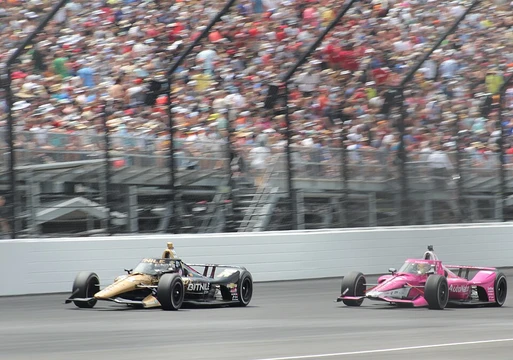
1994 Indianapolis 500
Penske's secret pushrod engine sparked a rules controversy.
The 78th Indianapolis 500, held on May 29, 1994, was race number 4 of the 1994 PPG IndyCar World Series. It is notable for the dominant performance of Marlboro Team Penske's secretly-built Mercedes-Benz pushrod engine, which produced nearly 1000 hp and led to a controversial rules dispute. Al Unser Jr. won the race from the pole position, his second Indy 500 victory.
Quick Facts
- Race name
- 78th Indianapolis 500
- Sanction
- USAC
- Season
- 1994 CART season
- Team
- Penske Racing
- Date
- May 29, 1994
- Winner
- USA Al Unser Jr.
- Time
- 3:06:29.006
- Pole speed
- 228.011 mi/h
Facts from the source article.
Did You Know?
- Rain washed out opening day for the first time since 1975.
- Dick Simon Racing cars created a 'Flying V' formation when they were the first cars on track.
- Defending Indy Lights champion Bryan Herta was withdrawn from Tasman Motorsports and signed with A. J. Foyt.
Background
Nigel Mansell, the 1993 CART champion, returned to Newman Haas alongside Mario Andretti, who announced his retirement at the end of the 1994 season. Emerson Fittipaldi remained at Penske Racing, which expanded to three cars for 1994, adding Al Unser Jr. and Paul Tracy. Michael Andretti returned to Indy car racing with Ganassi after a Formula One stint, winning the season opener at Surfers Paradise. Rahal-Hogan Racing debuted the first Honda Indy car engine.
Chevrolet dropped support of the Ilmor engine program, and the 1994 Ilmor engines were badged as the Ilmor Indy V8. Penske and Ilmor secretly developed a 209 in3 pushrod engine, exploiting a loophole in USAC's rulebook that had existed since 1991. Mercedes badged the engine as the Mercedes-Benz 500I. Jim Nabors returned to sing "Back Home Again in Indiana" after a liver transplant.
The motorsports community was shaken by the death of Ayrton Senna at San Marino; Emerson Fittipaldi, Raul Boesel, and Maurício Gugelmin served as pallbearers at his funeral.
Time Trials – Weekend 2
John Paul Jr. qualified safely, and Scott Goodyear posted a run of 220.737 mph. Johnny Rutherford took a ceremonial final lap in the same car A. J. Foyt had driven the previous year. Mark Smith filled the field to 33 cars at 5:37 p.m. with a speed of 220.683 mph. Davy Jones made the field at 223.817 mph. Mike Groff and Bobby Rahal, the two slowest cars, were bumped but re-qualified in borrowed Penske-Ilmor cars, with Rahal becoming the seventh-fastest car overall. Scott Goodyear ended the day on the bubble. Gary Bettenhausen crashed during a practice run, damaging the rear end of his car. On Bump Day, Marco Greco bumped Goodyear from the field, putting Bryan Herta on the bubble. Greco ran out of fuel on his cool-down lap and stalled. Geoff Brabham waved off his attempt after dropping speeds. Mark Smith, bumped out the previous day, wrecked on his first lap with 15 minutes remaining.
Race summary
Al Unser Sr. took a ceremonial final lap in his 1987 winning car before the race. General Chuck Yeager led the flyover in a P-51 Mustang. Clear skies and mid-70s temperatures greeted race day. Pole-sitter Al Unser Jr. led Emerson Fittipaldi and Raul Boesel into turn one after the Penske teammates weaved and blocked on the frontstretch.
On lap 6, Dennis Vitolo spun but continued. Roberto Guerrero crashed in turn two on lap 20. During the first pit stops, Unser stalled exiting the pits, giving Fittipaldi the lead. A yellow came out when Mike Groff and Dominic Dobson touched wheels and crashed; Adrian Fernandez hit debris, and Lyn St. James clipped Scott Goodyear.
Michael Andretti suffered a puncture and stalled leaving the pits. Eddie Cheever and Nigel Mansell were black-flagged for passing before a restart. By lap 85, Fittipaldi led Unser by 24.6 seconds, with rookie Jacques Villeneuve a lap down in third.
Post race
USAC and CART separately evaluated the Mercedes-Benz 500I engine situation. USAC initially allowed the pushrod engines for 1995 but worried about costs; CART refused to allow increased boost at its events. Two weeks after the race, USAC reduced the boost for purpose-built pushrod engines to 52 inHG for 1995, while stock-block engines stayed at 55 inHG and overhead cam engines at 45 inHG. Other manufacturers considered building similar engines, raising cost concerns. Tony George announced plans for the Indy Racing League in 1996. On August 11, 1994, USAC further reduced boost to 48 inHG and outlawed the pushrod engine for 1996. Roger Penske called the move politically motivated. The Mercedes-Benz 500I never raced again, holding a perfect pole and win record at Indianapolis. Penske continued to dominate the 1994 CART season, winning 12 of 16 races and sweeping the top three in points.
More in American Open-wheel Car Racing Controversies
Spotted an error? Know more?
Reader corrections go straight into our review queue. Suggest an edit · How this site is sourced