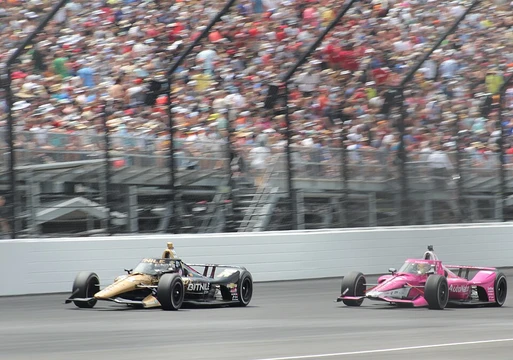
1995 Indianapolis 500
Controversial penalty decides 1995 Indianapolis 500.
The 79th Indianapolis 500, held on May 28, 1995, was a CART PPG Indy Car World Series race sanctioned by USAC. It is notable for a controversial finish involving a penalty against leader Scott Goodyear, which handed the victory to Jacques Villeneuve. Villeneuve became the first Canadian winner of the event and later won the 1995 CART championship before moving to Formula One.
Quick Facts
- Race name
- 79th Indianapolis 500
- Sanction
- USAC
- Season
- 1995 CART season
- Team
- Team Green
- Date
- May 28, 1995
- Winner
- CAN Jacques Villeneuve
- Time
- 3:15:17.561
- Pole
- USA Scott Brayton
Facts from the source article.
Did You Know?
- Opening day practice saw Menard cars of Arie Luyendyk (233.281 mph) and Scott Brayton (232.408 mph) lead the speed chart.
- Davey Hamilton crashed in turn four on May 19, suffering a broken ankle.
- Scott Brayton secured the pole position with a run of 231.604 mph on pole day.
Background
Team Penske dominated the 1994 season with a Mercedes-Benz 500I pushrod engine, winning 12 of 16 races. USAC and CART evaluated the engine's advantage, and two weeks after the 1994 race, USAC reduced boost for such engines from 55 to 52 inHG for 1995, while stock-block engines kept 55 inHG and overhead cam V-8s stayed at 45 inHG. In summer 1994, Tony George announced plans for the Indy Racing League, and on August 11, USAC further cut pushrod boost to 48 inHG, outlawing it for 1996.
Roger Penske viewed this as politically motivated. Penske drivers Al Unser Jr. and Emerson Fittipaldi each won a race early in 1995, but private tests revealed chassis handling problems. A mid-April test produced speeds of 228 mph, enough to qualify but not for the front row. Other changes for 1995 included an updated Honda V-8 and Firestone's return with two tire compounds; most teams used the soft option for qualifying and the hard compound on race day. Goodyear initially had one compound but introduced a soft option four days before the race.
Time trials – weekend 2
On the second weekend of time trials, Al Unser Jr. made his first qualifying attempt at 5 p.m. in a Rahal backup car, but after two laps in the 224 mph range, the run was waved off. Emerson Fittipaldi's first attempt in a Rahal backup car reached 226.097 mph on the third lap, but the crew waved it off, angering Fittipaldi; the speed would have been fast enough to qualify. Unser's second attempt was slower and also waved off. Franck Fréon qualified at 224.432 mph, placing him slowest.
The day ended with 30 cars qualified; both Penske cars and Scott Sharp were not. On bump day, Carlos Guerrero qualified at 225.831 mph, filling the field to 31. After hours of practice, Fittipaldi ran 228.017 mph, while Unser managed only 222.206 mph. Scott Sharp qualified at 225.711 mph, leaving one spot.
Fittipaldi's four-lap run of 224.907 mph put him 33rd. Davy Jones then bumped Fréon with a 225.135 mph run, putting Fittipaldi on the bubble. Fittipaldi survived two attempts, and Unser's final attempt—his first lap at 221.992 mph—was too slow to bump his teammate.
Carburetion Day
During the week, Chip Ganassi Racing announced Bryan Herta would switch to a backup car on race day, moving him to the back of the field. Team Penske withdrew Emerson Fittipaldi as driver of the #9T, forfeiting his status as first alternate; the car returned to Rahal-Hogan Racing with no driver listed. The final practice session on May 25 was delayed by rain until 12:27 p.m. All 33 qualified cars and the two alternates turned laps. Scott Goodyear was fastest at 228.392 mph.
Carlos Guerrero had a smoking turbocharger; Alessandro Zampedri and Raul Boesel stalled out of fuel. Bobby Rahal took laps in his primary car and the #56 backup (the former #9T), and Frank Freon took 23 laps. Polesitter Scott Brayton and Arie Luyendyk were off the pace; John Menard accused USAC of providing defective pop-off valves, which USAC denied. Years later, the boost discrepancy was attributed to an alleged rules infraction during time trials.
The elimination rounds for the pit stop contest were held, with Jacques Villeneuve and Adrián Fernández advancing to the quarterfinals.
Race summary
Rain fell overnight and into the morning, but the track was dried and the start delayed only five minutes. At the start, Scott Goodyear took the lead from the outside of the front row. On the first lap, Stan Fox hit the rumble strips, spun, and crashed into the outside wall in turn one; his car was demolished and his legs exposed. Eddie Cheever, Lyn St. James, and Carlos Guerrero were caught up.
Gil de Ferran broke his front suspension on debris and retired. Fox suffered a closed head injury but no major limb injuries; he recovered but never raced again. After a long caution, the race restarted on lap 10, with Arie Luyendyk taking the lead. On lap 37, Luyendyk, trying to pass Scott Sharp, gave Sharp the finger and knocked off his helmet headrest cushion, which brought out a yellow flag.
The pits closed, and Jacques Villeneuve became the leader on lap 38. Villeneuve, unaware he was leading, passed the pace car twice before pitting; he had a slow stop, nearly pulling away with the fuel hose attached, then stalling.
More in American Open-wheel Car Racing Controversies
Spotted an error? Know more?
Reader corrections go straight into our review queue. Suggest an edit · How this site is sourced