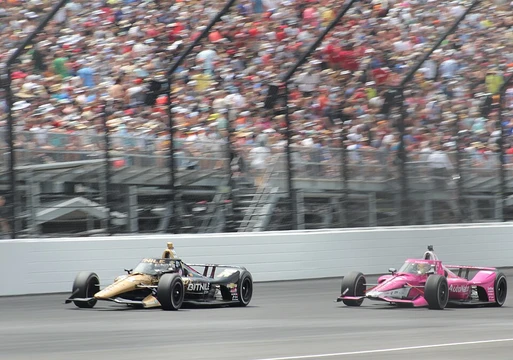
1979 Indianapolis 500
A race overshadowed by the first open-wheel split.
The 63rd Indianapolis 500, held on May 27, 1979, was marked by the debut of the Chaparral 2K ground effect chassis and Rick Mears' first victory. The race took place amid the first open-wheel split, as USAC and the newly formed CART organization competed for control of Indy car racing.
Quick Facts
- Race name
- 63rd Indianapolis 500
- Sanction
- USAC
- Season
- 1979 USAC; 1979 CART
- Team
- Penske Racing
- Date
- May 27, 1979
- Winner
- USA Rick Mears
- Time
- 3:08:47.97
- Pole speed
- 193.736 mi/h
Facts from the source article.
Did You Know?
- Opening Day saw only three cars take to the track; Larry Cannon was the first car on the track.
- Mario Andretti was participating in Formula One full-time in 1979 and a scheduling conflict with Monaco was expected to keep him away from Indy.
Controversies
After the 1978 season, competitors complained about the horsepower advantage of Cosworth DFX V-8 engines over Offenhauser four-cylinder engines. USAC held meetings in August and September 1978 to draft new turbocharger boost rules and engine regulations. In September, they announced that all turbocharged engines would be permitted 80 inHg of boost, pop-off valves would be required at all times, fuel allotment for 500-mile races would increase to 333 gallons, and rear wings would be reduced to 36 inches.
In January 1979, USAC met with owners and chief mechanics including Smokey Yunick, Mike Devin, Bill Finley, Pat Patrick, and Cosworth founder Keith Duckworth. The rules were changed again: V-8 engines were reduced to 50 inHg of boost, Offenhausers to 55 inHg, and stock block engines to 58 inHg. Competitors claimed USAC ignored their technical input. By May, USAC raised Offenhauser boost to 60 inHg while keeping V-8s at 50 inHg, and the increased fuel allotment was scrapped, returning to 280 gallons.
Time Trials – Weekend 1
Rain kept the track closed on pole day until after 4 p.m. During the first practice session, Danny Ongais crashed in turn 4 after a lap of 191.205 mph, suffering a concussion; he was hospitalized and later returned to California. The crash closed the track for 40 minutes, and no qualifying attempts were made that day. Pole qualifying shifted to Sunday. Johnny Rutherford was first to qualify at 188.137 mph. Wally Dallenbach briefly took the pole at 188.285 mph. Al Unser Sr. then posted 192.503 mph, and Bobby Unser ran 189.913 mph. Tom Sneva, seeking a third consecutive pole, took the top spot at 192.998 mph. A. J. Foyt qualified at 189.613 mph. Rick Mears closed the pole round with a four-lap average of 193.736 mph, winning his first of a record six Indy 500 poles. Sneva was bumped to second. Second-day qualifying then commenced, filling the field to 25 cars.
Time Trials – Weekend 2
The third day of time trials opened with eight grid spots available. Hurley Haywood waved off after a fast first lap. Jim McElreath filled the field to 33 cars at 1:15 p.m. Larry Cannon was bumped by Dick Simon, then Tom Bigelow was bumped by Jerry Sneva, who controlled a stuck throttle with the kill switch. Dick Ferguson bumped John Martin but was disqualified and fined $5,000 for an illegal wastegate inlet; his mechanic Wayne Woodward had welded a complete obstruction in the pipe.
Martin was reinstated. Tom Bigelow bumped Steve Krisiloff, then Krisiloff bumped Martin. Larry Rice bumped John Mahler. After the track closed, USAC disqualified Krisiloff and Bigelow for the same wastegate infraction, reinstating Mahler and Martin.
USAC then issued a memo clarifying wastegate specifications. Some teams complained that it was unfair to change rules midway through time trials, and drivers claimed it was difficult for a legal car to bump a cheater.
Race summary
Rain fell the night before the race, but the skies cleared and the race started on time. Al Unser Sr. led from the outside of the front row and dominated the first 24 laps. Seven cars were out with mechanical problems by lap 22. Cliff Hucul stalled on lap 28, bringing out the first caution. Al Unser continued to lead, while Wally Dallenbach lost a wheel on lap 43 and retired. The top five were Al Unser, Rick Mears, Bobby Unser, and Johnny Rutherford. Rutherford pitted with a broken gear and returned after lengthy repairs. Al Unser pitted under caution on lap 97, then returned to the pits after a possible leak was reported; he went back out. On lap 103, Al Unser's Chaparral 2K suffered a failed transmission oil fitting and retired. Bobby Unser took the lead, with Mears second and A. J. Foyt third, one lap down. The first crash involved Larry Rice on lap 156.
More in American Open-wheel Car Racing Controversies
Spotted an error? Know more?
Reader corrections go straight into our review queue. Suggest an edit · How this site is sourced