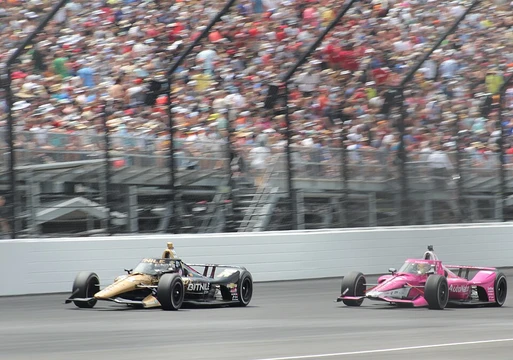
1981 Indianapolis 500
The 1981 Indy 500 saw victory change hands twice.
The 65th Indianapolis 500, held on May 24, 1981, is widely considered one of the most controversial races in Indy history. Bobby Unser initially took the checkered flag, but was penalized for passing cars illegally under caution, dropping him to second place. After a lengthy protest and appeals process, the penalty was rescinded and Unser was reinstated as the winner on October 8.
Quick Facts
- Race name
- 65th Indianapolis 500
- Sanction
- USAC
- Season
- 1981–82 USAC season; 1981 CART season
- Team
- Penske Racing
- Date
- May 24, 1981
- Winner
- USA Bobby Unser
- Time
- 3:35:41.78
- Pole speed
- 200.546 mi/h
Facts from the source article.
Did You Know?
- The 1981 race marked the earliest date (May 24) on which the Indianapolis 500 had ever been held.
- For the first time, USAC held a special Rookie Orientation Program in early April for first-time drivers.
- The 1981 race was part of the 1981–82 USAC season but was a non-championship race for the CART PPG Indy Car World Series.
Practice and qualifying
Practice began on Opening Day, Saturday May 2, with rookies Josele Garza (who lied on his entry form about his age, claiming to be 21 when he was 19) and Geoff Brabham passing their rookie tests. Al Unser became the first driver to practice over 190 mi/h on May 3, and his brother Bobby Unser pushed speeds over 197 mi/h the next day. The first incidents occurred on Monday when Gordon Smiley spun and Pete Halsmer crashed in turn 4. Tuesday was completely rained out, and Wednesday was windy.
A record 50 cars took to the track on Thursday, with Mario Andretti fastest at 194.300 mi/h. On Friday, Penske teammates Bobby Unser and Rick Mears were hand-timed just below 200 mi/h, with Andretti over 198 mi/h. Pole day on Saturday May 9 was delayed by rain until 3:34 p.m., with only nine cars completing qualifying runs; A. J. Foyt took the provisional pole at 196.078 mi/h after lightly brushing the North Chute wall. Rain stopped qualifying at 5:49 p.m., pushing pole qualifying into Sunday, which was rained out entirely.
Among the 27 cars not yet qualified was Mario Andretti, who was due in Belgium for the Grand Prix the following weekend. Rain continued on Monday, and on Tuesday May 12, Danny Ongais broke the 200 mi/h barrier in practice. Andretti took his final practice run and departed for Belgium.
Race recap
As the field accelerated through turn 4, the green flag was not waved until Bobby Unser crossed the start-finish line, surprising many back-row drivers. Unser took the lead into turn 1, with Johnny Rutherford moving into second. Mike Mosley, who started 2nd, blew a radiator on lap 16 and finished last. Tom Sneva charged from 20th to third by lap 20.
Unser pitted on lap 22, and Rutherford took the lead but went out three laps later with a broken fuel pump. Sneva led for a lap, then pitted under yellow. Unser made a second pit stop on lap 32 during a yellow for Don Whittington's accident, extended when Gary Bettenhausen's car stopped. On lap 39, USAC changed its mind about restarting, and several cars passed the pace car before slowing; USAC imposed no penalties.
Sneva held the lead until the second round of pit stops began on lap 56. Sneva's car stalled as he tried to pull away, and new leader Rick Mears pulled into his pit directly behind Sneva. Gordon Smiley led lap 57, his only lap led in his Indy career.
Controversy
Shortly after the race, rumblings of a possible protest surfaced over Bobby Unser passing cars under the yellow on lap 149. Chief race steward Thomas W. Binford learned of the incident by mid-evening. USAC policy dictated that official results would be posted at 8 a.m. the next morning, with protests filed afterward. In a taped interview three hours after the race, Binford said he would review video of lap 149 and that Unser was likely to be penalized.
ABC televised the race on same-day tape delay at 9 p.m. EDT. The television broadcast focused heavily on the incident, reporting it as it aired. It was later revealed that commentators Jim McKay and Jackie Stewart had provided the lap 149 commentary in post-production, knowing a protest was in the works. After the race coverage, a live segment at about 11:45 p.m. EDT featured Mario Andretti in the broadcast booth announcing that a protest was in process, stating that Unser had passed seven, eight, or nine cars ahead of him while exiting the pits.
This was followed by the previously recorded interview with Binford. The overall broadcast was considered misleading and biased against Unser.
Aftermath and lore
The 1981 Indianapolis 500 was largely considered the most controversial running to date, referred to as 'The Great Dispute' and in some circles as 'Undecided.' Bobby Unser, believing the ordeal was politically motivated by his USAC enemies, became disillusioned and took a sabbatical, sitting out the 1982 Indy 500 and retiring from IndyCar racing in 1983. The $40,000 fine for the win, other fines, attorney's fees, and the inability to parlay his victory into endorsements ruined his finances.
After being reinstated, Unser received the miniature Borg-Warner Trophy, while Andretti had already been given the winner's championship ring. Andretti took part in the winner's photo session the morning after the race; no official victory photos were taken of Unser. Months later, Unser's likeness was added to the Borg-Warner Trophy. A claim that Andretti threw away the winner's ring appears to have been fabricated; in a 2001 interview, Andretti confirmed he kept the ring.
More in American Open-wheel Car Racing Controversies
Spotted an error? Know more?
Reader corrections go straight into our review queue. Suggest an edit · How this site is sourced