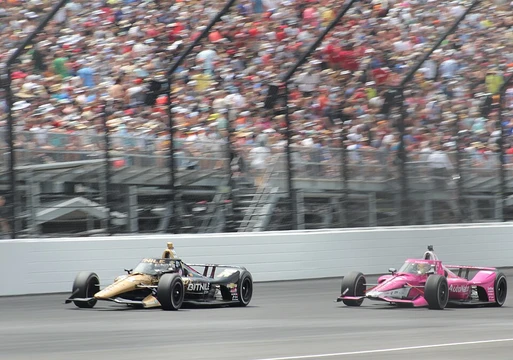
Penske PC-23
A dominant car remembered for its rule-bending pushrod engine.
The Penske PC-23 was a CART racing car designed by Nigel Bennett for the 1994 and 1995 seasons. It is most notable for the controversial pushrod Mercedes-Benz 500I engine, developed specifically for the 1994 Indianapolis 500 by exploiting a loophole between USAC and CART technical rules.
Quick Facts
- Category
- CART IndyCar
- Constructor
- Penske Cars Ltd
- Designer
- Nigel Bennett
- Predecessor
- Penske PC-22
- Successor
- Penske PC-24
- Team
- Penske Racing
- Chassis
- Carbon-fiber monocoque
- Front suspension
- Pushrod
Facts from the source article.
Did You Know?
- The PC-23 was based on the PC-22, which missed the 1993 CART title by only 8 points.
- A book titled Beast, by Jade Gurss, was published in 2014 about the creation of the PC-23.
Overview
The PC-23 evolved from the PC-22, which had won the 1993 Indianapolis 500 and eight races that season. The main difference for 1994 was smaller rear wings on short ovals, mandated by rule changes, which Team Penske addressed through extensive testing. Transmission modifications were also made, but the car was largely a progression. Plans for active suspension were dropped after a CART ban.
The car and its Ilmor engine were ready for testing by mid-December 1993. For the Indianapolis 500, the PC-23 featured a higher engine cover to accommodate the Mercedes-Benz 500I pushrod engine. Gearbox input gears were altered to handle the engine's lower rpm and higher power and torque, though the gearbox weight remained unchanged. The 500I engine was slightly lighter than the Ilmor Indy V-8, but its longer inlets raised the centre of gravity, altering the car's balance.
Development and testing of the 500I, initially called Ilmor 265E, were conducted in secrecy due to concerns about possible boost-level changes or a ban.
Racing history
The PC-23 debuted at the 1994 Australian FAI Indycar Grand Prix, where Emerson Fittipaldi finished second while Al Unser Jr. and Paul Tracy retired with electrical problems. The first oval win came at Phoenix, with Fittipaldi ahead of Unser. The team then won six consecutive races: Unser at Long Beach, Indianapolis, and Milwaukee (where Penske scored a 1-2-3 sweep), Tracy at Detroit, and Unser at Portland (another 1-2-3 sweep) and Cleveland. The streak ended at Toronto when Unser's engine failed; Fittipaldi finished third and Tracy fifth.
After all three Penskes retired at Michigan, the team achieved two more 1-2-3 sweeps at Mid-Ohio and New Hampshire, both won by Unser. Unser also won at Vancouver. Jacques Villeneuve won at Road America, his first CART victory, while Unser clinched the championship ahead of Fittipaldi. Tracy won the final two races at Nazareth and Laguna Seca.
Unser, Fittipaldi, and Tracy finished first, second, and third in the standings. In 1995, Bettenhausen Motorsports used the PC-23 for most of the season, with Stefan Johansson scoring points in eight races and a best finish of third, placing 13th in the standings. The PC-23's final race was the 1996 U.S. 500, where Gary Bettenhausen crashed out on lap 89 while running 21st.
More in American Open-wheel Car Racing Controversies
Spotted an error? Know more?
Reader corrections go straight into our review queue. Suggest an edit · How this site is sourced