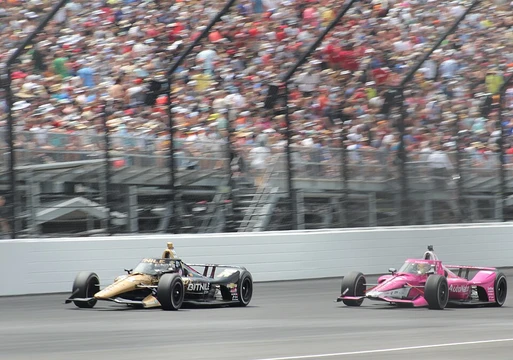
2002 Indianapolis 500
A disputed final-lap pass under caution decided the 2002 winner.
The 86th Indianapolis 500, held on May 26, 2002, was part of the Indy Racing League season and is widely considered one of the most controversial races in the event's history. The finish was disputed when second-place Paul Tracy attempted a pass on leader Hélio Castroneves on the final lap as a caution flag appeared, leading to a protest and an appeal that ultimately upheld Castroneves' victory.
Quick Facts
- Race name
- 86th Indianapolis 500
- Sanction
- Indy Racing League
- Season
- 2002 IRL season
- Team
- Penske Racing
- Date
- May 26, 2002
- Winner
- BRA Hélio Castroneves
- Time
- 3:00:10.8714
- Pole
- BRA Bruno Junqueira
Facts from the source article.
Background
The 2002 Indianapolis 500 saw another wave of CART teams crossing over to compete in the IRL-sanctioned race. Penske Racing, which had moved to the IRL full-time for 2002, joined Chip Ganassi Racing and Team Green in returning from the previous year. Rahal Letterman Racing also decided to participate, crossing series lines for the event. Because of the Tobacco Master Settlement Agreement, Team Green could not use its primary sponsor KOOL, so the cars instead carried the colors of associate sponsor 7-Eleven.
On March 28, Robby Gordon announced he would attempt the "double duty" of racing in both the Indy 500 and the Coca-Cola 600 on the same day. Tony Stewart, who had tried the feat in 1999 and 2001, said he would not do so in 2002, and John Andretti, who had done it in 1994, also declined. That spring, the Indianapolis Motor Speedway diamond-ground its asphalt pavement to smooth out bumps, and in April, the SAFER barrier was installed on the retaining walls in the turns, marking the first use of this energy-absorbing technology at an American superspeedway.
For the 2002 race, all pit crew members working over the wall were required to wear approved helmets. This rule came after a series of accidents and injuries, particularly head injuries, involving pit crews in ACCUS-sanctioned series. Many crews had already been using optional helmets since around 1999, following a pit accident that critically injured Steve Fried, crew chief for Robby McGehee, leaving him in a coma for weeks. Before 2002, only the crew member operating the fuel rig had to wear a helmet, meant to protect against fire from a fuel spill or loss of balance, as his position between the front and rear axles was considered risky. Tire changers, despite being more exposed to cars entering and exiting pit lane, did not wear helmets.
Practice and time trials
The 2002 Indianapolis 500 saw Robby McGehee become the first driver to hit the new SAFER barrier during opening day, while Scott Sharp and Hélio Castroneves topped the speed chart. Rain plagued the first week, delaying track action from Monday through Thursday and dropping over two inches of water. Crashes hit P. J. Jones, Mark Dismore, Max Papis, and Alex Barron. On pole day morning, Paul Tracy wrecked heavily in turn two, destroying his only car, forcing repairs.
Speeds varied wildly, with no driver leading the chart more than twice all month. Bruno Junqueira finally broke 230 mph on Friday, May 10, at about 3:30 p.m. On pole day, May 11, Junqueira ran first in qualifying and posted 231.342 mph, the fastest pole speed since 1996, securing his first Indy 500 pole. He became the first driver since Emerson Fittipaldi in 1990 to win pole as the first qualifier. Robbie Buhl and Raul Boesel joined him on the front row.
Defending champion Castroneves could only manage 13th, while Michael Andretti was second-slowest at 226.780 mph. The second time trials day, May 12, was rained out, pushing remaining qualifying to bump day, May 19. More rain delayed or halted three additional practice days. Paul Tracy returned to the track late that week.
On bump day, nine spots remained open; rain delayed the start over an hour. The field filled to 33 cars just before 2 p.m., with Billy Roe on the bubble. George Mack bumped Roe out at 2:35 p.m., becoming the second African American driver to qualify for the race, after Willy T. Ribbs.
Race running
After a month plagued by constant rain, race day saw clear blue skies and temperatures in the mid 70s (°F). At the start, polesitter Bruno Junqueira took the lead and led the first 32 laps. Greg Ray brought out the first caution with a crash in turn 1. Junqueira stalled exiting the pits, giving the lead to rookie Tomas Scheckter.
A sequence of pit stops around the 65th lap shuffled the leaderboard, and Tony Kanaan took over on lap 70. On lap 78, Sam Hornish Jr. brushed the wall exiting turn four, damaging his suspension. On lap 79, the caution came out for debris; Paul Tracy later claimed responsibility, stating that he threw a headrest cushion out on the track. While the leaders pitted, Robby Gordon suffered a large fire and explosion in his pit stall.
Gordon was uninjured, and his crew moved to the vacated pit stall of Greg Ray. On lap 90, with Kanaan still leading, Jimmy Vasser and Bruno Junqueira both slowed with mechanical problems. An oil leak on the track went unnoticed, and leader Kanaan spun in the oil, crashing into turn 3. Scheckter resumed the lead after Kanaan dropped out.
A very long stretch of green flag racing commenced. Two sequences of green-flag pit stops shuffled the lead among several drivers, but Scheckter found himself back into the lead by lap 166. With 30 laps to go, Scheckter held an 8.3-second lead over Paul Tracy.
Controversy
In the immediate aftermath of the race, confusion reigned among the competitors, broadcasters, and fans. Brian Barnhart, in Race Control, made the initial call stating 'yellow, yellow, yellow, three is your leader' over the director's radio channel, and such was repeated by his assistant Mel Harder over the teams' race control radio channel. On the television broadcast, commentator Paul Page erroneously stated that Castroneves was the leader because the scoring 'reverted back to the previous lap.'
ABC waited over 14 minutes before they showed a replay of the pass or the crash. ABC did air split-screen footage clearly showing the crash occurred before the pass, but the footage did not show conclusive evidence of when the yellow light came on. TV analyst Scott Goodyear was convinced that Helio won the race, referencing his loss of the 500 in 1995 where he figured out that post-race appeals were rarely accepted. On the live radio broadcast Mike King announced that 'race control said the pass would not count.'
Donald Davidson echoed the same erroneous information that the scoring reverted to the previous lap, and added that the cars did not race back to the yellow, as was the policy in NASCAR at the time. A similar controversy took place at the 2019 INDYCAR Portland road course event at the start when a massive crash caused 11 laps of caution as officials could not determine positions based on video evidence.
More in American Open-wheel Car Racing Controversies
Spotted an error? Know more?
Reader corrections go straight into our review queue. Suggest an edit · How this site is sourced